Agentic AI economics compares total human costs against agent costs, introduces pay-per-outcome pricing, and gives you the ROI models to scale automation sustainably on AWS — answering when replacing human labor with agentic AI actually pays off, and where agentic AI economics tips in favor of automating.
Agentic AI Economics: What You’ll Learn
Agentic AI economics is the structured comparison of what human labor really costs against what an agentic AI system really costs, across the full task lifecycle. The AWS Prescriptive Guidance frames this as a shift away from simplistic “human cost minus AI cost” arithmetic toward a model weighing total economic impact, risk, decision quality, and long-term strategic value.
This guide covers both cost models, pay-per-outcome pricing, automation candidate criteria, and ROI metrics — then walks through a document-review worked example mapping Bedrock token pricing, Lambda per-invocation billing, and Step Functions state-transition costs onto real unit economics.
Treat economics as a continuous practice: measure before, after, and as prices shift. Retire what stops paying off; double down on what compounds.
Agentic AI Economics: The Core Question
The AWS guide opens with a line worth memorizing: no system is 100% right. The core question is not “is the agent cheaper?” but “given that both humans and agents err, which mix delivers the best outcome-adjusted return?”
A naive comparison fails fast. A human reviewer at $60/hour fully loaded handles eight documents per hour; a Bedrock agent costs $0.04/document in inference. On raw unit cost the agent wins by three orders of magnitude — until you account for the agent’s 3% hallucination rate at $2,000 per remediation.
Once error cost enters the equation, the cheaper system is not always the agent.
The question changes with volume. At ten documents a day the human’s fixed overhead dominates; at ten thousand, the agent’s near-zero marginal cost dominates. The model answers “when” and “where” as much as “whether,” and captures strategic value: the second automation costs far less once platform, guardrails, and observability exist.
Understanding Total Human Labor Costs
Most teams undercount human costs, biasing the comparison against automation before it begins. Fully loaded cost is not salary; it is salary plus benefits, payroll taxes, facilities, management overhead, hiring, onboarding, training, and turnover — typically 1.4 to 1.8 times base salary.
Two hidden costs dominate. Latency: humans work eight to ten hours a day and handle one task at a time, so backlogs wait and surges create overtime. Error rate: fatigue and consistency errors whose rework and compliance costs are real but rarely attributed.
Training recurs on every policy or product change, and when a tenured reviewer leaves their judgment leaves with them. And scaling human cost is linear and slow — doubling throughput doubles overhead and takes months. That linearity is the lever agentic AI economics exploits.
Agentic AI System Costs on AWS
Inference is the dominant variable cost. Bedrock prices per million tokens; Nova Micro or Claude Haiku cost fractions of a cent per thousand tokens, Sonnet or Nova Pro several times more — favoring tiered selection (route easy 80% to the cheap model, hard 20% to the expensive one).
Infrastructure: Lambda bills per invocation plus GB-second; Step Functions per state transition (a four-tool workflow costs four transitions); Bedrock AgentCore, OpenSearch, and S3 each add their own line. Prompt engineering is skilled labor but amortizes — one versioned prompt serves a million requests. Monitoring — CloudWatch, X-Ray, eval suites, sampled human review — typically adds 10–20% to operating cost.
| Cost Factor | Human Worker | Agentic AI System |
|---|---|---|
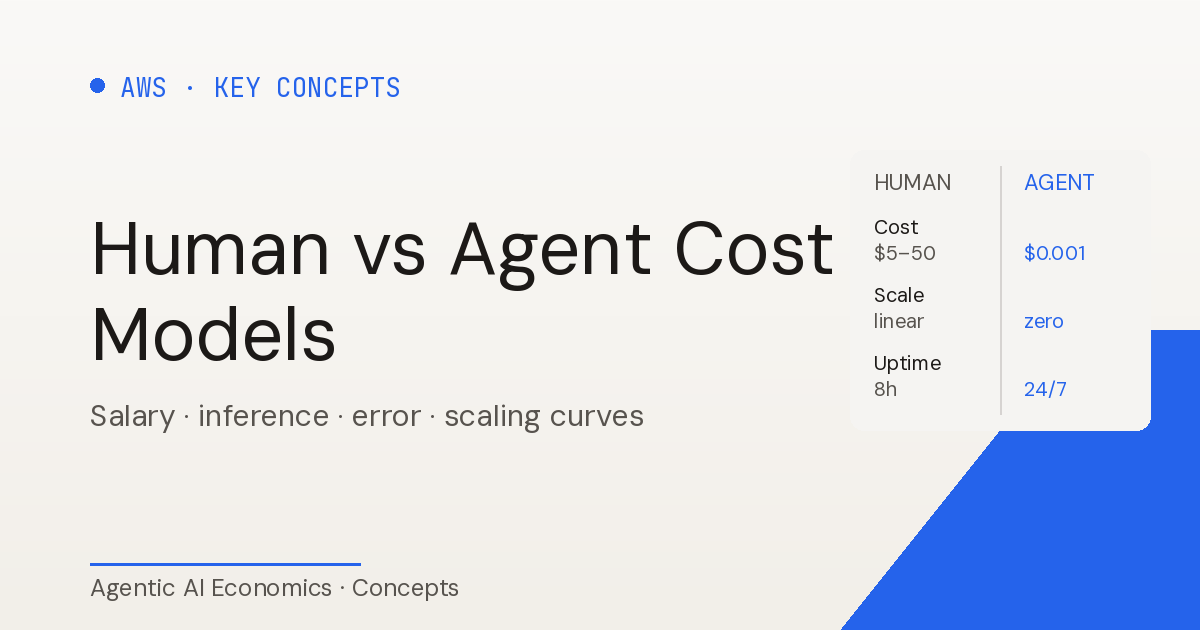
| Per-task cost | $5–$50 (fully loaded) | $0.001–$0.10 (inference) |
| Throughput | 8–10 hrs/day, 1 at a time | 24/7, 1000s in parallel |
| Scaling cost | Linear (hire more) | Near-zero marginal |
| Training cost | Weeks, recurring | Prompt updates, hours |
| Error cost | Variable, recoverable | Variable, needs guardrails |
| Oversight needed | Low (self-monitoring) | Required (trust builds over time) |
The comparison that matters is per completed task, not per hour. Re-baseline quarterly using Cost Explorer and CloudWatch telemetry — token prices fall, and a table accurate in January can mislead by July.
Put a number on it: a customer-support triage agent that sends 600 input tokens and returns 80 output tokens per ticket, orchestrated through two Step Functions transitions and one Lambda invocation, lands near $0.003 per ticket on a mid-tier Bedrock model — before oversight sampling and error cost.
Multiply that by ticket volume and the agentic AI economics of the workload are visible in minutes, which is the entire point of building the per-task table before debating the automation decision in a meeting.
Pay-Per-Outcome: The New Pricing Paradigm
Customers are shifting toward pay-per-outcome models, where you pay only when the agent delivers a measurable business result — a resolved ticket, an approved claim, a classified document — not for the compute that attempted it.
The appeal is risk alignment: under upfront pricing the customer bears underperformance risk; under pay-per-outcome the vendor shares it. ROI becomes self-evident — if each outcome is priced below the human cost of producing it, every transaction is accretive.
The model demands strong attribution — why it pairs naturally with AgentOps (Part 9). The catch is outcome definition: “resolved ticket” is clear until you define “resolved” across ten segments. Pay-per-outcome fits high-volume structured tasks long before ambiguous knowledge work.
Which Jobs Are Good Candidates for Automation?
The strongest candidates are high-volume, structured, repetitive tasks with clear success criteria and bounded ambiguity — document classification, invoice extraction, first-line triage, log anomaly detection, form validation. They repeat enough to amortize integration cost, prompt reliably, and measure accuracy cleanly.
Weak candidates are creative strategy, high-stakes empathy decisions, one-off annual tasks, ambiguous edge cases. High-stakes tasks like medical diagnosis or legal advice belong in a third category: human oversight, where the agent drafts and a human approves — ROI comes from productivity gain (e.g. 70% review-time reduction), not headcount reduction.
Plot tasks on a 2×2 of volume vs ambiguity: high-vol/low-amb = automate-now; high-vol/high-amb = automate-with-overhead; low-vol/low-amb = automate-if-cheap; low-vol/high-amb = leave-alone. Revisit quarterly — tasks become automatable as models improve.
How to Calculate Agentic AI ROI
Cost per task: fully loaded human vs fully loaded agent. Throughput multiplier: how much more the agent produces — reframes “can we afford the agent?” as “can we afford not to?” Error rate + rework cost: the most-skipped, most-decisive metric — error rate × per-error remediation cost for both sides, treated as a first-class line item. Time-to-value: how fast integration cost is repaid.
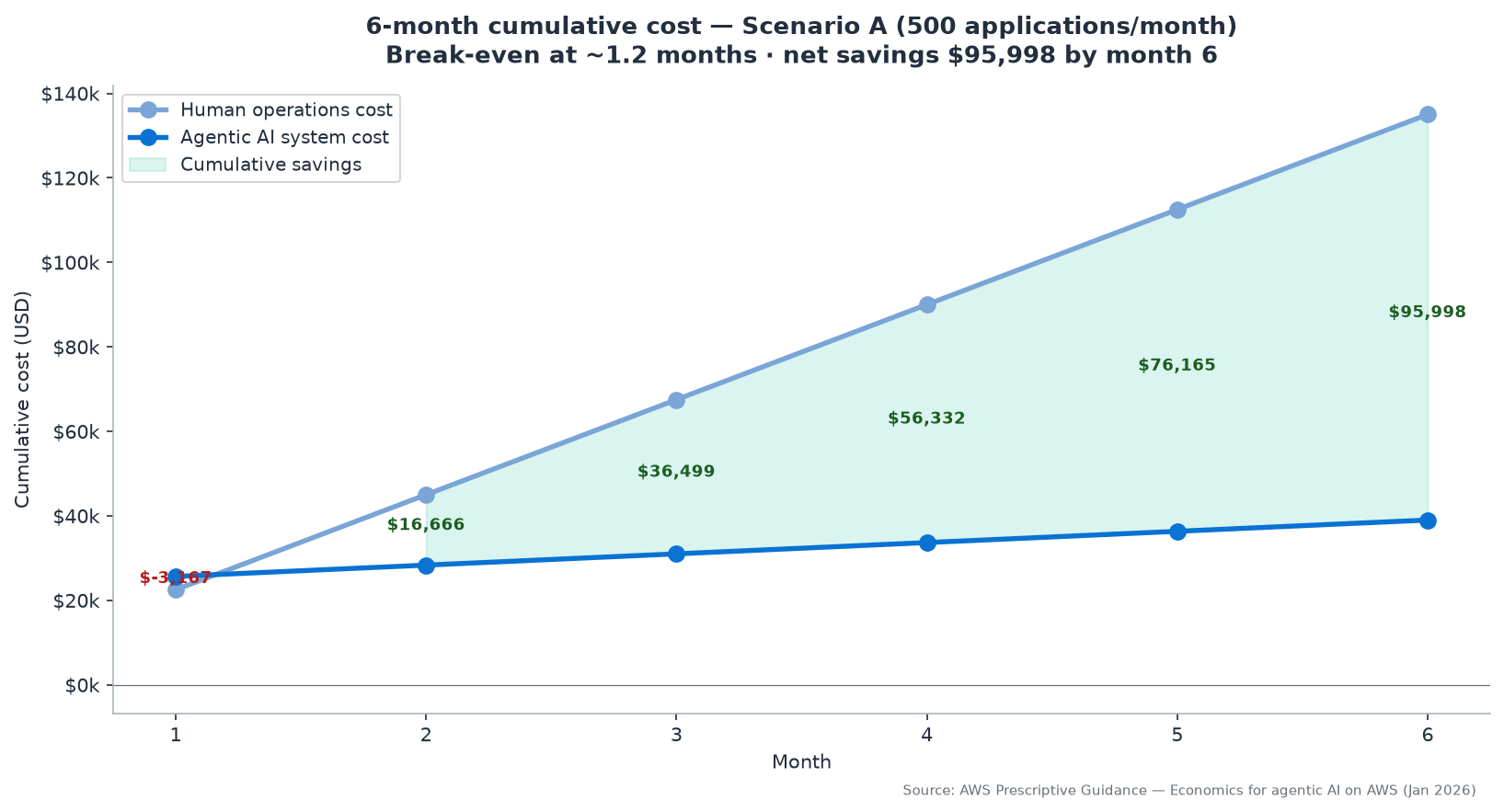
Net annual value = (human cost per task − agent cost per task) × annual volume − one-time integration cost − annual error-cost delta. Benchmark against your own historical data, not vendor case studies.
Run the formula both ways before committing budget. If agentic AI economics only clear the bar at optimistic error rates, the program is under-priced for risk; if they clear it even at pessimistic error rates and volume, integration is the safe next step. The teams that get agentic AI economics right treat this formula as a living spreadsheet updated monthly, not a one-time slide built to win a budget approval.
Scaling What Works: From Pilot to Production
The pattern: start with high-volume structured tasks, measure everything, scale winners, retire failures. Pilots look promising; production surfaces what pilots hid.
Run a 30-day pilot on one task for one team — treat it as an investment in data, not savings. When it clears its ROI bar, ramp volume in stages (10%, 50%, 100%) watching unit cost (should fall) and error cost (rises if task mix drifts harder). Retire failures honestly: a retired pilot is a successful experiment.
Set the ROI threshold before the pilot and act on “stop.”
The portfolio view: a mature program runs dozens of agents on one dashboard and reallocates investment from declining to rising agents quarterly.
Risk Economics: The Cost of Agent Errors
Finance respects this part most; engineering underweights it most. An agent that hallucinates a plausible-but-wrong action can be cheaper per task than a human until you account for catching and reworking the error. Weigh agent errors against equivalent human errors honestly.
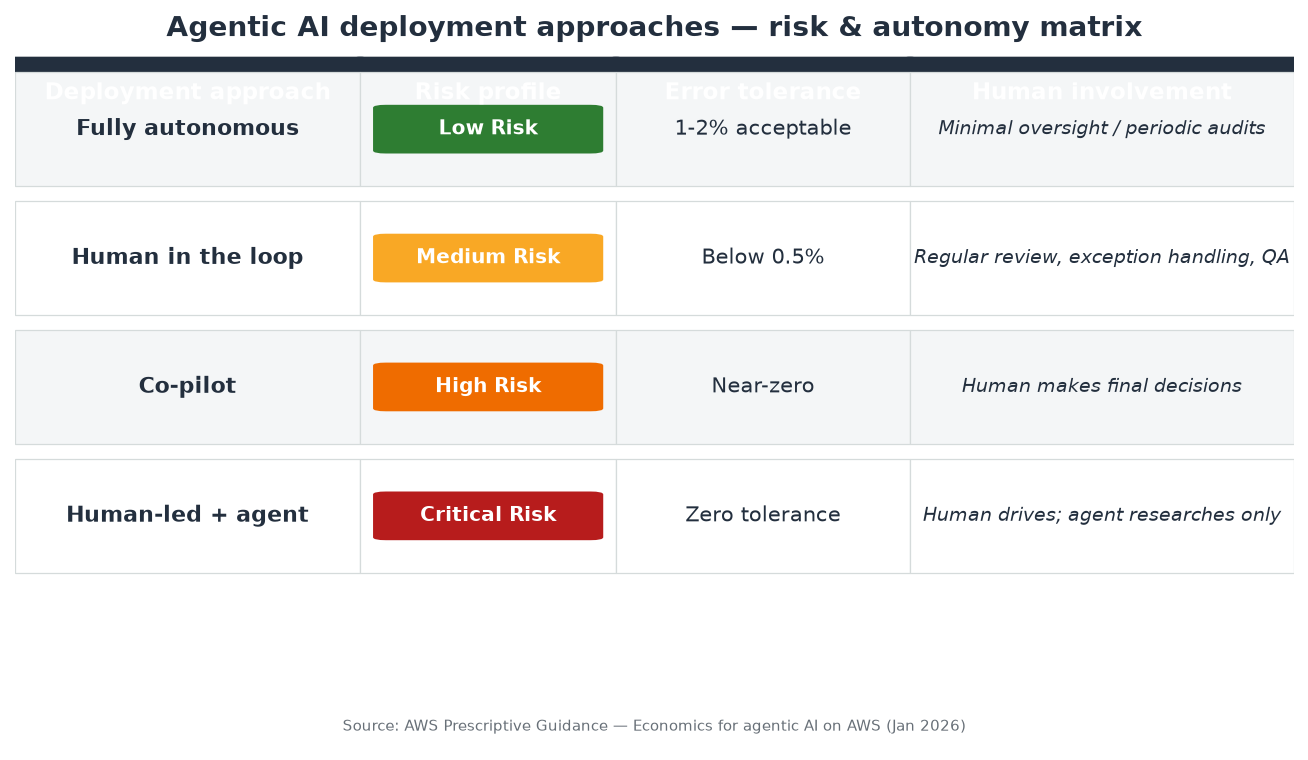
Treat hallucination as expected error cost: error rate × per-error cost. Humans also hallucinate — they misremember policy, apply yesterday’s rule, get tired at hour seven. Measure both sides; do not assume the human baseline is zero.
Bedrock Guardrails tilt risk economics in the agent’s favor — blocking harmful content, masking PII, denying out-of-scope topics, filtering hallucinations through contextual grounding checks before they reach a user. Treat guardrail config as an investment: reduction in expected error cost ÷ build cost. Human-in-the-loop is the other lever — find the sampling rate that catches errors that matter without erasing the throughput advantage.
Risk compounds with scale: a rate tolerable at one thousand tasks a day can be catastrophic at one million. Stress-test at projected scale.
This is where agentic AI economics and reliability engineering merge into one job. A guardrail that costs $0.002 per call but cuts the error rate in half is worth adding at almost any volume once you have priced the error it prevents; a guardrail that adds latency without moving the error rate is a cost with no return. Price every guardrail the same way you price the agent itself.
Agentic AI Economics in Practice: Automating Document Review with ROI Analysis
A financial services firm reviews 8,000 loan applications/month with twelve reviewers at $48/hour fully loaded. Average review time 20 minutes, error rate 4%, each error $1,200 to remediate. They build a Bedrock agent that extracts fields, checks policy, and recommends — inference $0.06/app, Lambda + Step Functions $0.01, human oversight samples 15% at $4 each.
# Agentic AI economics — document review ROI model
monthly_volume = 8000

# Human baseline (fully loaded)
human_hourly = 48
apps_per_hour = 3                      # 20 min each
human_cost_per_task = human_hourly / apps_per_hour   # $16.00
human_error_rate = 0.04
human_error_cost_per_task = human_error_rate * 1200  # $48.00
human_total_per_task = human_cost_per_task + human_error_cost_per_task  # $64.00
human_monthly = human_total_per_task * monthly_volume                # $512,000

# Agent baseline
inference = 0.06
infra = 0.01
oversight = 0.15 * 4                   # sample 15% at $4 each
agent_cost_per_task = inference + infra + oversight  # $0.67
agent_error_rate = 0.025               # measured in pilot
agent_error_cost_per_task = agent_error_rate * 1200  # $30.00
agent_total_per_task = agent_cost_per_task + agent_error_cost_per_task  # $30.67
agent_monthly = agent_total_per_task * monthly_volume                   # $245,360

# ROI
monthly_saving = human_monthly - agent_monthly         # $266,640
integration_cost = 180_000                            # one-time build
break_even_months = integration_cost / monthly_saving  # ~0.7 months

print(f"Human per task:  ${human_total_per_task:.2f}")
print(f"Agent per task:  ${agent_total_per_task:.2f}")
print(f"Monthly saving:  ${monthly_saving:,.0f}")
print(f"Break-even:      {break_even_months:.1f} months")
Agent: $30.67/task vs human $64.00 — $33.33 saved per application, ~$266,000/month. Integration cost ($180K) is repaid in under a month.
But this only holds because error cost was modeled honestly. If agent error rate were 6% instead of 2.5%, error cost would rise to $72/task and the agent would lose.
Guardrails and eval suites hold error rate in the profitable range — which is why economics and engineering must build the model together.
Token Economics: From Price-Per-Million-Tokens to Cost-Per-Task
Bedrock bills separately for input and output tokens, and the two rarely cost the same — output tokens on most foundation models run three to five times the input rate, because generation is the expensive half of inference. A production agentic AI economics model has to price a task by its full token profile, not by a single blended rate pulled from a pricing page.
A document-review call that sends 1,800 input tokens of policy context and returns 220 output tokens of structured JSON is a fundamentally different cost shape than a chat turn that sends 200 tokens and returns 900.
Three levers move the token bill more than model choice alone. Prompt caching on Bedrock lets a repeated system prompt or a large policy document be cached across calls, cutting the input-token charge on every call after the first by roughly 90 percent for the cached portion — decisive for RAG-heavy agentic workloads where the same 2,000-token context accompanies every request.
Output-length discipline — constraining the agent to structured, schema-bound output instead of free-form prose — shrinks the more expensive half of the bill directly; a JSON-only response mode routinely cuts output tokens by half against an unconstrained one. Context trimming — summarizing or windowing conversation history instead of resending the full transcript every turn — keeps input tokens from growing quadratically across a long agent session.
None of this shows up in the sticker price of a model. Two teams running the same Claude or Nova model on the same workload can see per-task inference cost differ by 3–4x purely on prompt engineering discipline — which is why agentic AI economics treats token shape, not model choice, as the primary cost lever engineers actually control.
Orchestration and Hosting: Step Functions and SageMaker in the Same Model
Inference is rarely the whole bill. A four-step agentic workflow — retrieve, reason, call a tool, verify — orchestrated on Step Functions Standard costs one state transition per step at a fraction of a cent each; the same workflow on Step Functions Express, priced by request duration and memory rather than per-transition, is usually cheaper at high volume and short execution times, and more expensive at low volume with long-running steps.
Modeling both and picking per workload — not defaulting to one — is worth real money at scale, and belongs in the same agentic AI economics spreadsheet as the inference line, not a separate infrastructure budget nobody reconciles against it.
When an agent calls a custom fine-tuned model instead of a foundation model on Bedrock, the cost model shifts from per-token to per-instance-hour: a SageMaker real-time endpoint bills for the instance whether or not it is handling traffic, so a lightly used endpoint can cost more per task than a heavily used Bedrock on-demand call.
SageMaker Serverless Inference or Bedrock Provisioned Throughput close that gap for spiky or highly predictable traffic respectively — Provisioned Throughput trades a flat hourly commitment for a much lower per-token rate once volume clears the break-even point, typically in the tens of millions of tokens per month.
Include instance-hour or reserved-throughput cost in the per-task model exactly like Bedrock on-demand pricing; treating hosting as a fixed sunk cost outside the ROI calculation is how pilots that look profitable in a spreadsheet lose money in production.
Agentic AI Economics: Common Mistakes to Avoid
- Comparing agent cost to salary, not fully loaded cost — biases the comparison either way.
- Skipping error cost — the most-decisive line item; omitting it inflates every pilot.
- Automating the hardest task first — start with high-volume structured tasks.
- Scaling on enthusiasm without telemetry — hidden costs surface at full volume.
- Flat pricing where pay-per-outcome fits — match pricing to outcome measurement maturity.
- Retiring pilots into permanent production — set the ROI threshold before the pilot and act on “stop.”
- Ignoring idle hosting cost — a SageMaker real-time endpoint or a Bedrock Provisioned Throughput commitment bills by the hour whether or not it is handling traffic; size it to measured pilot traffic, not a guess, or the fixed cost erases the savings.
- Treating token price as the whole inference bill — output tokens, uncached context, and unconstrained response length routinely double or triple the per-task cost implied by a model’s headline price-per-million-tokens.
Each of these mistakes shares a root cause: modeling the sticker price instead of the delivered cost — agentic AI economics done well prices a task the way finance prices a product — fully loaded, including the hosting commitment, the token shape, the oversight sampling rate, and the error-remediation cost, not the number on a pricing page.
Teams that skip this step consistently overstate ROI in the pilot deck and understate it in the first monthly AWS bill, which is the single most common reason a promising pilot gets killed after month two instead of scaled.
Agentic AI Economics: Best Practices
- Model fully loaded human cost before any automation decision.
- Track an ROI dashboard — cost per task, throughput multiplier, error + rework cost, time-to-value.
- Start with high-volume structured tasks; defer ambiguous, high-stakes, or low-volume work.
- Price error cost as a first-class line item.
- Use tiered model selection on Bedrock — cheap models for easy cases, larger for hard.
- Instrument the attribution pipeline early to enable pay-per-outcome later.
- Scale in stages (10%, 50%, 100%) watching unit cost and error cost.
- Run the portfolio like an asset book — rebalance quarterly.
Cost governance turns these practices from good intentions into an enforced discipline. Tag every Bedrock, Lambda, Step Functions, and SageMaker resource by agent and by task type, then pull a Cost Explorer report grouped by tag monthly — without tagging, agentic AI economics collapses into one opaque AWS bill line that nobody can attribute to a specific automation’s ROI.
Set an AWS Budgets alert per agent so a runaway retry loop or a prompt regression that balloons token usage surfaces in hours, not at the end of the billing cycle.
Quantify the caching and batching levers instead of assuming they help. Bedrock prompt caching, batch inference for non-real-time workloads, and SageMaker Savings Plans for steady-state hosting each independently cut 20–60 percent off their respective cost lines when applicable — layered together across a mature agentic AI economics program, they are usually the difference between a pilot that clears its ROI bar and one that does not.
Re-run the model whenever AWS changes a price, a new model tier ships, or task volume moves by more than 20 percent; a cost table is a snapshot, not a constant.
Agentic AI Economics: Frequently Asked Questions
What is agentic AI economics and why does it matter?
The structured comparison of human labor cost against agentic AI system cost, accounting for total economic impact, risk, and strategic value. It matters because naive comparisons mislead — an agent can look cheaper per task and cost more once error is counted.
What is pay-per-outcome pricing?
You pay only when the agent delivers a measurable business result. It aligns vendor and customer risk, makes ROI self-evident, and is self-funding as volume grows. It demands strong attribution.
When does automation not make economic sense?
When volume is too low to amortize integration cost, ambiguity too high to measure success, or error cost overwhelms the per-task saving.
How do I calculate the ROI of an agentic AI workload on AWS?
Start with fully loaded human cost: salary, overhead, latency, error rate, recurring training. Compare against agent cost: Bedrock inference per million tokens, Lambda per invocation, Step Functions per state transition, AgentCore per session, plus monitoring overhead — agentic AI economics rewards teams that measure outcome-adjusted return — a deflected support contact is worth more than a successful API call.
Net annual value equals per-task saving times volume, minus integration cost, minus annual error-cost delta. Run the dashboard monthly; retire agents whose ROI declines for two quarters.
What AWS services drive the biggest unit-cost savings for agentic AI?
Three levers dominate. Tiered model selection routes the easy 80 percent of traffic to Claude Haiku or Amazon Nova Micro at fractions of a cent per thousand tokens, reserving Claude Sonnet or Nova Pro for the hard 20 percent. Bedrock prompt caching cuts input token cost for RAG-heavy pipelines. Bedrock model invocation jobs handle batch workloads at reduced pricing.
Layered together, these agentic AI economics levers typically produce a 60 to 80 percent cost reduction versus a single-model baseline — agentic AI economics on AWS rewards teams that measure cost-per-task monthly, retire agents whose agentic AI economics deteriorate, and double down on agents whose pay-per-outcome is rising.
The agentic AI economics stack — Bedrock per-token, Lambda per-invocation, Step Functions per-transition, AgentCore per-session — turns abstract AI cost into auditable line items.
Agentic AI Economics: Key Takeaways
- Core question is outcome-adjusted return, not raw unit cost — weigh human and agent error honestly.
- Count fully loaded human cost: salary, overhead, latency, error, recurring training.
- Agent cost = inference + infra + prompts + monitoring, mapped to AWS primitives.
- Pay-per-outcome aligns cost with result — shifts risk to vendor, makes ROI self-evident.
- Automate high-volume structured tasks first; defer ambiguous or high-stakes work.
- Measure ROI with a dashboard, never a single number.
- Scale winners, retire failures — rebalance quarterly.
- Risk economics is the deciding line item — invest in guardrails that hold error rate in the profitable range.
Agentic AI economics comes down to one discipline: price the fully loaded human alternative, price the fully loaded agent — inference, hosting, and error cost together — and let the honest gap decide what gets automated and when it scales. Get the token shape and the error-cost line right, and the agentic AI economics of a well-run program compound quarter over quarter.
Continue Learning
- Lab: Calculating ROI in Practice
- AWS AgentOps — the operational discipline that makes automation measurable and governable
- AWS Agentic AI Foundations — what an agent is, for context on the systems these economics govern
- AWS Serverless AI — the Lambda, Step Functions, and Bedrock pricing primitives behind unit cost