Agentic AI transforms how cloud architects build intelligent systems on AWS. Instead of writing rigid procedural code for every workflow, you delegate goals to software agents that perceive context, reason about trade-offs, and act on your behalf. This guide covers the foundations and shows how Amazon Bedrock, AWS Lambda, and AWS Step Functions bring autonomous agents to production.
Agentic AI: What You’ll Learn
By the end of this guide you’ll understand what agentic AI is, how it differs from traditional automation, and why it has become the dominant pattern for intelligent cloud workloads on AWS in 2026. We’ll trace the evolution from rule-based systems to LLM-powered agents, examine the core properties that define an agentic system, and walk through the AWS services that bring these concepts into production.
What Is Agentic AI?
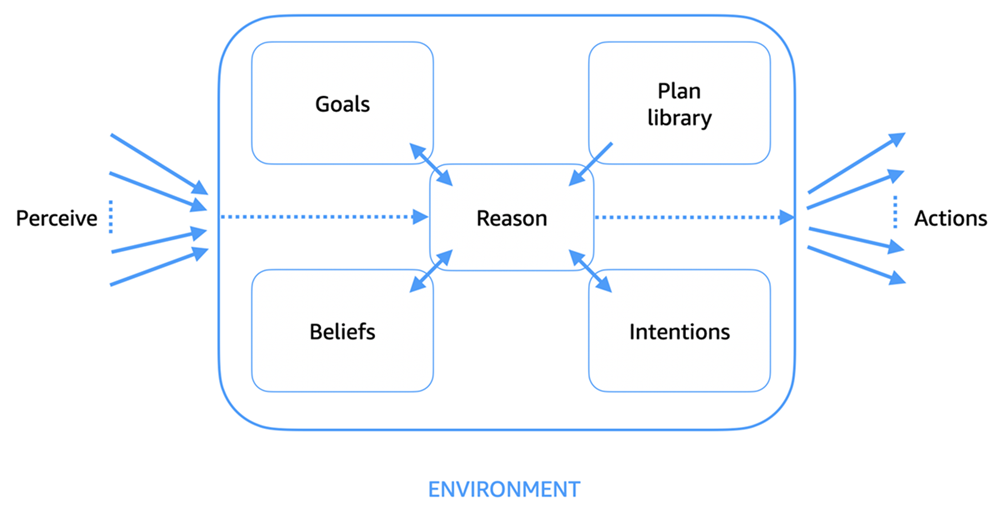
An agent is an entity that perceives its environment, reasons about its current state, and takes action with intent. Unlike a function that returns the same output for the same input, an agent pursues a goal, decides which steps to take, and adapts when the environment changes.
Agentic AI is the modern embodiment of this idea, combining large language models (LLMs) for reasoning, distributed systems for execution, and orchestration protocols for coordination. The result is software that operates with autonomy and real agency at scale.
On AWS, agentic AI is not a single product. It is an architectural pattern realized through Amazon Bedrock for foundation model access, AWS Lambda for event-driven compute, and AWS Step Functions for workflow orchestration. Together these building blocks let you compose agents that read documents, call APIs, query databases, and reason over results.
A useful mental model for comparing the two: a traditional Lambda function handles one request in well under a second by running the same code path every time it is invoked. An agentic AI system built on the same primitives might take three to ten seconds and call two or three tools before it responds, trading some latency for the ability to handle requests nobody explicitly programmed for.
That trade-off is deliberate. You are paying reasoning time for flexibility, and for most knowledge-work tasks a few extra seconds is a reasonable price for not having to write a new code path for every new request shape.
How Agents Differ from Traditional Software
Traditional software is deterministic: given input X, it produces output Y. Microservices and functions extend this model with network calls and scale, but they remain procedural. Every branch must be coded in advance. Agentic AI flips this contract: you specify the desired outcome, and the agent chooses the path.
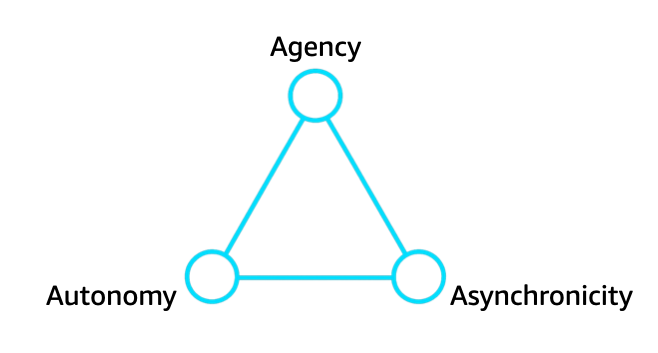
Three distinctions matter most. First, agency: agents act on your behalf rather than waiting for explicit instructions at every step. Second, goal-orientation: agents optimize for an outcome, not a transaction. Third, context-awareness: agents maintain state across interactions, learning from prior turns and external signals.
Where a microservice exposes endpoints, an agent exposes intent. This shift compresses complex, multi-step workflows into a single delegated goal, and it tolerates ambiguity that would break traditional code.
The intent-outcome contract is what most clearly separates agentic AI from the request-response services most cloud architects grew up with. A REST endpoint answers “given this exact input, what is the output?”; an agentic AI system answers “given this goal, what sequence of actions achieves it?” The first contract is verifiable with a fixed test vector. The second is only verifiable against outcome criteria, which is why evaluation harnesses for agentic AI look more like acceptance suites than unit tests.
Concretely, a traditional order-status endpoint receives an order ID and returns a row from the database every time, in well under a second. An agentic AI version of the same workflow might receive a vague question like “where is my stuff?”, decide it needs a customer lookup first, then an order lookup, then a shipping tracker call, and finally compose a sentence that references all three. Both workflows are valid; they solve different shapes of problem, and most production systems run them side by side rather than replacing one with the other.
| Dimension | Request-response service | Agentic AI system |
|---|---|---|
| Contract | Exact input, exact output | Goal in, acceptable outcome out |
| Test shape | Fixed test vectors | Acceptance criteria over many runs |
| Latency profile | Single hop, milliseconds | Multi-step, seconds, variable |
| Failure surface | Network, schema, auth | All of those plus reasoning, tool choice, grounding |
| Observability need | Metrics and logs | Full traces including rationale |
The Core Properties of an Agentic AI System
Every production-grade agentic AI system shares a small set of core properties.
- Autonomy: the agent acts without constant human prompting, deciding which tool to call and when.
- Adaptivity: the agent adjusts its plan when the environment or input changes mid-task.
- Tool use: the agent invokes external systems: databases, APIs, file systems, other agents.
- Memory: the agent retains context across turns, sessions, and longer-running workflows.
- Non-determinism: the agent may take different valid paths to the same goal, which is acceptable as long as outcomes are correct.
Non-determinism is the property that surprises teams moving from traditional microservices. You can no longer assert “this code path always runs”; instead, you assert “this outcome always occurs.” This is why observability, guardrails, and evaluation harnesses become central. Amazon Bedrock, AWS X-Ray, and Amazon CloudWatch exist precisely to bring discipline to non-deterministic systems.
Tool use deserves special attention. An agent without tools is just a chatbot. It can reason but cannot act. On AWS, tools are typically implemented as AWS Lambda functions exposed through Amazon Bedrock Agent action groups, or as MCP servers hosted on Amazon Bedrock AgentCore. The agent decides at runtime which tool to call based on the user’s goal.
Memory closes the loop. Without memory, every agent invocation starts from scratch. With memory, an agent can recall a customer’s preferences, reference a previous decision, or build on an earlier analysis. Amazon Bedrock AgentCore provides managed session memory, while Amazon DynamoDB and OpenSearch Service handle longer-term storage.
Memory in an agentic AI system splits into three layers, and which layer you lean on changes what the agent can do. Short-term, working memory is the current turn: the user message, the in-flight tool results, the system prompt. It lives in the model’s context window and disappears when the session ends. Session memory persists across turns inside one conversation so the agent can refer to “the order we just discussed” without re-fetching it; Amazon Bedrock AgentCore Memory is the managed primitive for this layer. Long-term memory spans sessions and users, typically a vector store (OpenSearch Service, pgvector) or a key-value store (DynamoDB) that holds customer preferences, past decisions, and learned facts.
Each layer fails differently. Working memory fails by truncation when the context window fills, which is why summarization between turns matters for long sessions. Session memory fails by tenant scope leakage if the session key is mishandled, which is why session IDs are tied to authenticated identities, not request bodies. Long-term memory fails by drift: a stored preference from six months ago may no longer match the customer’s current situation. Mature agentic AI deployments add a TTL or a recency-weighted retrieval step at this layer rather than treating the store as append-only truth.
Adaptivity is easiest to see when something goes wrong mid-task. If an agent calls a Lambda tool and the tool times out or returns an error, a traditional integration would simply fail the request.
An agentic AI system can catch that error, reason about it (was the timeout transient, is there an alternative tool, should it retry once before escalating) and choose a different path without a human rewriting any code. This is what “the agent adjusts its plan when the environment changes” means in practice: error handling becomes part of the agent’s reasoning loop instead of a fixed try/catch block.
Why Agentic AI Matters for Cloud Architects
For cloud architects, agentic AI changes the design questions you ask. Instead of “what endpoints do I expose?” you ask “what goals can I delegate?” Instead of “how do I scale this function?” you ask “how do I coordinate many agents working in parallel?” The architectural primitives shift from request-response to intent-outcome.
Adopting agentic architectures accelerates time to value by automating knowledge work, improves customer engagement through context-aware assistants, and reduces operational costs by automating decisions that once needed human oversight. It also modernizes legacy workflows by reframing brittle scripts into modular reasoning agents.
AWS is uniquely positioned for this shift because nearly every primitive an agent needs (compute, storage, messaging, identity, observability) is already a managed service. An agent that needs to read a file, query a database, and post a Slack message can do all three using AWS Lambda, Amazon DynamoDB, and Amazon SNS without provisioning a single server.
Three architectural shifts show up repeatedly when an organization moves from piloting agentic AI to running it in production. The first is the move from endpoints to events: synchronous request-response works for the first agent, but as soon as a second agent needs to react to the first one’s output, an event bus like Amazon EventBridge becomes cheaper to operate than a chain of HTTP callbacks. The second is the move from a single prompt to a versioned prompt registry, because every prompt edit silently changes the behavior of every downstream tool call, and treating prompts as unmanaged strings makes regression impossible to bisect. The third is the move from logs to traces: CloudWatch Logs answers “what did this Lambda print?”, but an agentic AI workflow needs X-Ray traces that link the model’s rationale, the tool call, and the tool’s response into one observable unit so a wrong answer can be diagnosed rather than guessed at.
Each shift is small in isolation, but together they explain why a team’s first agentic AI deployment often takes six weeks and the second takes six days. The first deployment builds the scaffolding (event bus, prompt registry, tracing) along with the agent; the second one reuses it. Teams that try to skip the scaffolding on the theory that one agent does not need it usually end up rebuilding it under load, which is more expensive and more disruptive than building it the first time.
Common Agentic AI Use Cases on AWS
Agentic AI shines in scenarios where the work is goal-shaped rather than step-shaped. On AWS, four use case patterns dominate production deployments today.
- Knowledge work automation: summarizing documents, drafting reports, and extracting structured data using Amazon Bedrock and Knowledge Bases. A common pattern is a contract-review agent that reads a 40-page vendor agreement, flags clauses that deviate from a standard template stored in the knowledge base, and produces a one-page summary for legal review instead of a full manual read-through.
- Customer-facing assistants: resolving support tickets, answering product questions, and routing complex cases to humans with context attached. The key difference from a scripted chatbot is that the assistant can chain several tool calls (check account status, check policy, check inventory) before answering, rather than following a fixed decision tree.
- Operational copilots: helping engineers diagnose incidents, query logs, and propose remediations via Amazon Q Developer. An operational copilot given read access to CloudWatch Logs Insights can correlate a spike in 500 errors with a recent deployment far faster than a human paging through dashboards, though the remediation action itself is usually still gated behind human approval.
- Multi-step research agents: retrieving information from many sources, cross-referencing, and producing synthesized briefs. These agents typically make five to fifteen tool calls per request, which is why cost and latency budgets matter more here than in single-lookup use cases.
- Data engineering copilots: agents that sit alongside an analyst and handle the mechanical parts of pipeline work, writing SQL drafts, suggesting schema mappings, generating Glue job skeletons, and explaining why a PySpark stage took longer than expected. The agent does not run production pipelines itself; it accelerates the human who does, and the value shows up as engineer-hours saved per week rather than as tickets resolved.
| Use case pattern | Typical tool calls per request | Lambda + Bedrock cost driver |
|---|---|---|
| Knowledge work automation | 1 to 3 (mostly Knowledge Base retrieval) | Token count on long input documents |
| Customer-facing assistant | 2 to 5 (account, policy, inventory) | Concurrency at peak hours |
| Operational copilot | 3 to 8 (log queries, deploy history) | X-Ray trace volume and storage |
| Multi-step research agent | 5 to 15 (cross-source synthesis) | Token count, retries on slow sources |
| Data engineering copilot | 2 to 6 (schema introspection, dry runs) | Glue and Athena execution cost, not the agent itself |
Reading the table top to bottom is also a rough maturity ladder. Most teams land their first agentic AI win in row one (a single Knowledge Base retrieval), graduate to row two when they add account-scoped tools, and only attempt row four once they have an evaluation harness reliable enough to catch a research agent that confidently over-cites a stale source.
Each pattern maps to a different AWS service combination, but they all share the agentic contract: the user states a goal, the agent plans a sequence, calls tools, validates results, and returns a grounded answer. Start with one pattern that matches your highest-value workflow before attempting a multi-agent system.
The Evolution from Automation to Agentic AI
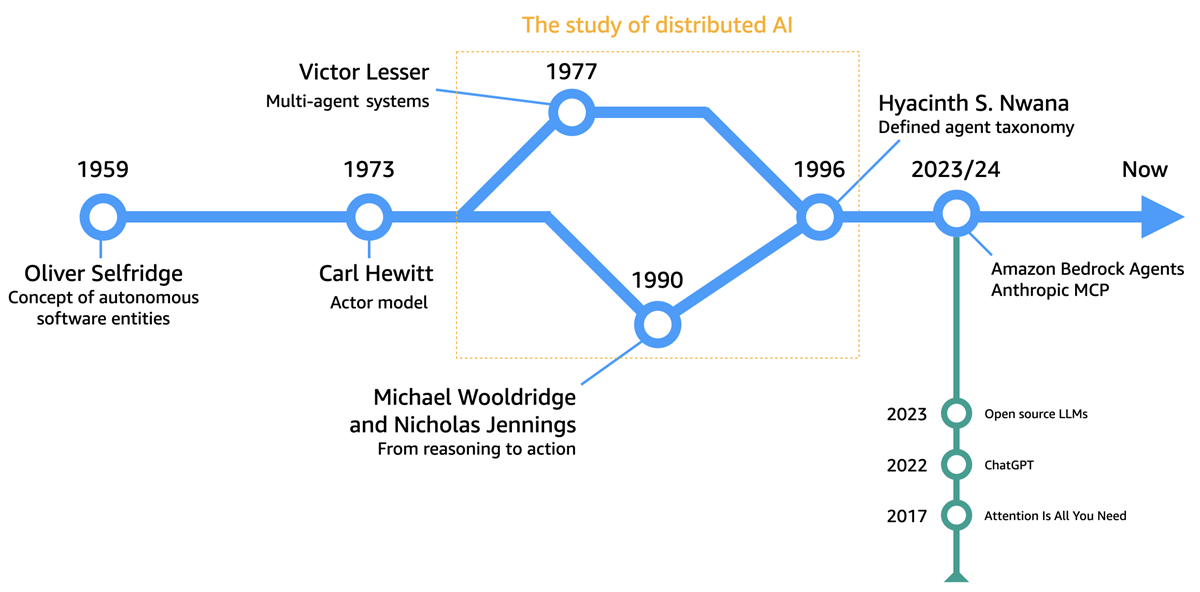
Agentic AI did not appear overnight. It is the convergence of decades of work: early cybernetics, rule-based expert systems, reactive automation, distributed agents, multi-agent systems, and finally large language models. Each wave added a missing capability.
Rule-based systems brought encoded expertise but could not learn. Reactive automation (cron, ETL pipelines, CI/CD) brought reliability but required every path to be specified in advance. Multi-agent systems brought coordination but were limited by brittle protocols. Large language models brought flexible reasoning, finally making it possible for an agent to interpret an ambiguous goal, plan a sequence, and adapt when a step failed.
The current wave combines LLM reasoning with serverless compute and standardized orchestration protocols like the Model Context Protocol (MCP). This combination is what makes agents practical at production scale: reasoning is flexible, execution is elastic, and tool integration is finally standardized.
The multi-agent systems wave is worth dwelling on because it explains why modern agentic AI architectures favor several small, specialized agents over one large generalist agent. Coordination between narrow agents with well-defined responsibilities is easier to debug and evaluate than a single agent juggling every responsibility at once.
Amazon Bedrock AgentCore’s multi-agent orchestration features exist specifically to make that coordination, handing a sub-task to a specialist agent and merging its result back into the parent conversation, a managed capability instead of custom glue code.
The 2022 ReAct paper (Reason + Act, Yao et al.) is the moment agentic AI stopped being a research curiosity and started being a production pattern. The core insight was small but load-bearing: an LLM that alternates a reasoning trace with an action trace can recover from a failed tool call without a human rewriting the prompt, because the model itself reads the failure, decides what to try instead, and emits the next action. Earlier agent frameworks had hand-coded this recovery logic per tool; ReAct let one prompting strategy handle every tool uniformly.
That uniformity is why modern managed platforms like Amazon Bedrock Agents ship ReAct as the default orchestration. A team building agentic AI on AWS in 2026 gets the reasoning loop, the tool-call dispatch, and the failure-recovery path for free, and only writes the tools and the prompt. The work that used to take a multi-week research-to-engineering handoff now fits in an afternoon, which is also why the discipline around evaluation, guardrails, and observability has become the differentiator between teams that ship reliable agentic AI and teams that ship expensive demos.
Agentic AI on AWS: The Enabling Stack
The AWS stack maps cleanly onto the layers an agentic AI system needs.
- Foundation models: Amazon Bedrock provides Claude, Llama, Nova, and other models through a single API.
- Agent runtime: Amazon Bedrock Agents and Amazon Bedrock AgentCore orchestrate tool calls, memory, and multi-agent coordination.
- Compute: AWS Lambda runs custom logic on demand; AWS Step Functions coordinates multi-step agent workflows.
- Memory and retrieval: Amazon Bedrock Knowledge Bases, Amazon OpenSearch Service, and Amazon DynamoDB store context.
- Observability: Amazon CloudWatch and AWS X-Ray trace every agent action for debugging and audit.
A minimal agent invocation looks like the example below. You call invoke_agent on the Bedrock Agent Runtime, supply a session ID for memory continuity, and let the agent choose which tools to call to satisfy the goal.
import boto3

client = boto3.client('bedrock-agent-runtime', region_name='us-east-1')

response = client.invoke_agent(
    agentId='YOUR_AGENT_ID',
    agentAliasId='TSTALIASID',
    sessionId='session-001',
    inputText='Summarize the latest sales report and flag anomalies.'
)

for event in response['completion']:
    if 'chunk' in event:
        print(event['chunk']['bytes'].decode())
This single call hides enormous complexity: the agent retrieves context, decides which tools to invoke, formats the output, and writes back to memory for the next turn. Because the runtime is fully managed, you focus on agent behavior rather than infrastructure.
Real agentic AI systems on AWS almost always wire in at least one custom tool through a Lambda action group. Consider a tool that looks up a customer’s subscription tier before the agent decides whether it is even allowed to offer a refund:
import json

def lambda_handler(event, context):
    account_id = event['parameters'][0]['value']
    tier = lookup_subscription_tier(account_id)  # DynamoDB read

    return {
        'response': {
            'actionGroup': event['actionGroup'],
            'function': event['function'],
            'functionResponse': {
                'responseBody': {
                    'TEXT': {'body': json.dumps({
                        'account_id': account_id,
                        'tier': tier
                    })}
                }
            }
        }
    }
You register this function as an action group in Amazon Bedrock Agents and describe its parameters in the action group schema. The agent decides at runtime whether calling it is necessary to satisfy the user’s goal. This is the mechanism that turns a language model from a text generator into an agent that can look up real account data before responding.
Multi-step workflows that span several tool calls, retries, and conditional branches typically graduate from a single Lambda invocation to an AWS Step Functions state machine. A state machine can call the Bedrock Agent, wait for a callback, branch on the response, and retry a failed Lambda step with exponential backoff, all without custom orchestration code.
Bedrock Agents for reasoning, Step Functions for control flow, and Lambda for individual actions is the most common production pattern for agentic AI on AWS today.
Two Amazon managed runtimes sit on top of that foundation stack, and choosing between them is a real architectural decision rather than a preference. Amazon Bedrock Agents, the older of the two, manages the ReAct loop, the action group dispatch, and the session state for you, and is the right default for a single-agent workload with a handful of tools. Amazon Bedrock AgentCore, the newer platform, layers in a serverless microVM runtime for tool execution, native MCP tool integration, an Agent-to-Agent gateway, and managed long-term memory, which together make it the better fit for multi-tenant or multi-agent agentic AI where isolation between tenants and between agents matters as much as the reasoning loop itself.
A common trajectory is to start on Bedrock Agents (lower conceptual overhead, faster first deploy) and graduate to AgentCore once one of three triggers fires: a second agent that needs to coordinate with the first, a multi-tenant requirement that demands stronger isolation than IAM scoping provides, or an MCP tool ecosystem that would be expensive to re-implement as inline action groups. None of those triggers requires migration on day one, but architecting for them (keeping tools stateless, keeping prompts in version control, tagging every resource) keeps the option open without forcing the move.
Agentic AI in Practice: A Worked Example
Imagine a customer support team that receives 500 tickets per day. A traditional automation might triage by keyword, route to a queue, and escalate anything unmatched. An agentic AI system rethinks this entirely. You give the agent a goal: resolve the ticket or escalate with a recommended action. The agent then reads the ticket, retrieves the customer’s prior history, drafts a response, checks an internal policy document, and either replies or escalates with context.
On AWS, this workflow uses Amazon Bedrock Agents for reasoning, Bedrock Knowledge Bases for policy and product documentation, AWS Lambda for custom logic (account status, refunds), and Amazon SES for replies. AWS Step Functions coordinates longer multi-step flows, and every action is logged to CloudWatch for audit. The agent does not replace the human. It handles the 80% of tickets that follow predictable patterns and frees humans for the 20% that need judgment.
The architectural win is that the same agent code handles new ticket types without redeployment. When a new product launches, you simply update the knowledge base; the agent retrieves the new content on its next call. This separates agentic AI from brittle rule-based automation. The agent adapts without code changes.
To make this concrete, walk through what actually happens inside AWS when a single ticket arrives. Amazon EventBridge or an API Gateway webhook triggers a Step Functions execution with the ticket payload. The first state invokes the Bedrock Agent with the ticket text and a session ID tied to the customer, so any prior interaction is already available in memory.
The agent’s first action is almost always a knowledge base retrieval. It queries Bedrock Knowledge Bases for the relevant product or policy document, typically returning the top three to five chunks ranked by semantic similarity.
With grounding in hand, the agent decides whether it needs additional facts. For a refund request, it calls a Lambda tool that reads the customer’s order history from DynamoDB and a second tool that checks the current refund policy window, for example, thirty days from purchase. Only after both tool calls return does the agent draft a response.
This ordering matters: an agent that drafts a reply before checking the policy window will confidently propose refunds it cannot actually authorize, which is exactly the kind of failure a well-designed agentic AI workflow is built to avoid.
If the two tool calls disagree, say the order history shows a purchase forty-five days ago but the customer claims twenty, the agent is instructed, through the action group descriptions and system prompt, to escalate rather than guess. This is the guardrail that keeps a non-deterministic system safe in production: some decisions are reserved for a human, encoded directly into the agent’s available actions rather than left to chance.
Once a decision is reached, a Lambda function sends the reply through Amazon SES and writes the full transcript (ticket, retrieved documents, tool calls, and final response) to an audit log in Amazon S3 and CloudWatch Logs.
Teams running this pattern typically review a random 5% sample of resolved tickets weekly to catch drift before it becomes a support escalation. At the volume this example started with, 500 tickets a day, that is 25 tickets to review, a task that takes a support lead under an hour and catches most failure patterns before they compound into a wider incident.
Putting rough numbers on the worked example makes the cost picture concrete. At a typical Anthropic Claude on Bedrock price near two cents per 1,000 input tokens and roughly six cents per 1,000 output tokens, a single ticket that consumes 3,500 input tokens (system prompt, retrieved chunks, ticket text, prior history) and produces 450 output tokens costs about one cent in model fees. Add two Lambda action group calls at a fraction of a cent each and the all-in per-ticket compute lands near one to one and a half cents.
At 500 tickets a day that is roughly five to eight dollars per day in compute, before Knowledge Base ingestion and CloudWatch storage. Most teams discover the second-order cost driver is not the per-ticket number; it is the retry rate. An agentic AI system that retries failed tool calls without a budget cap can quietly double or triple spend, which is why the “set a maximum tool-call budget per session” rule shows up in the best-practices section below rather than as an afterthought.
Agentic AI: Common Mistakes to Avoid
Even experienced engineers run into pitfalls with agentic AI. Here are the most common ones teams hit when moving their first agent to production on AWS.
- Treating agents as functions: expecting deterministic outputs breaks the moment inputs vary; design for outcomes, not paths. A support agent that returns a different, but equally valid, resolution for the same ticket on two different days is not broken; it is behaving correctly for a non-deterministic system. Teams that write tests asserting an exact output string discover this the hard way and end up rewriting the suite around outcome assertions instead.
- Skipping guardrails: agents without output validation can take harmful actions, such as issuing a refund above the policy limit. Always wrap consequential tool calls with an explicit policy check inside the Lambda function itself, not just in the prompt. A policy described only in natural language is a suggestion, not a control.
- Ignoring observability: without tracing you cannot debug a non-deterministic failure; instrument from day one. When a resolution is wrong, you need to see exactly which knowledge base chunks were retrieved and which tool call returned which value, not just the agent’s final response.
- Overloading one agent: stuffing every tool into a single agent degrades reasoning. An agent given twenty tools to choose from picks the wrong one measurably more often than an agent given four; split into specialized subagents (one per domain: billing, technical support, account changes) and route between them instead.
- Skipping cost guardrails: an agent that retries a failed tool call in an unbounded loop, or re-queries the knowledge base on every turn instead of reusing context, can turn a one-cent interaction into a two-dollar one. Set a maximum tool-call budget per session and alert when a single session’s Bedrock token spend crosses an outlier threshold.
- Letting the knowledge base go stale: an agent is only as accurate as what it retrieves. Teams that update product docs but forget to re-sync the Bedrock Knowledge Base data source end up with an agent confidently citing a pricing page that changed months ago. Treat the knowledge base sync as part of the deployment pipeline, not a manual afterthought.
- Underestimating cold-start latency: a Lambda action group that takes 800 milliseconds to initialize on its first invocation can push a four-step reasoning loop past the user’s perceived-response-time budget. Provisioned concurrency on the handful of action groups inside the critical path costs more per hour but recovers seconds of perceived latency, which is usually the right trade for any agent a customer waits on synchronously.
- Confusing evaluation with vibe checks: asking three engineers to read 20 sample responses and vote thumbs-up is not an evaluation harness. A real harness runs a fixed set of cases through the agent on every prompt change, scores outcomes against known-good answers, and fails the build on a regression threshold. Without that harness, every prompt edit is a gamble on production traffic.
Agentic AI: Best Practices
- Start narrow, then expand scope. Ship an agent that does one thing well, for example, answering billing questions, before adding a second domain. A narrow agent has a smaller action space, which makes its reasoning easier to evaluate and its failures easier to isolate. Expand scope only after the narrow version has run stable in production for a few weeks.
- Ground every fact in a Knowledge Base. Never let the agent rely on what the underlying foundation model remembers from training for anything that changes: pricing, policy, feature availability. Amazon Bedrock Knowledge Bases re-index automatically when the source documents in Amazon S3 change, so grounding stays current without redeploying the agent.
- Instrument from the first deploy, not after the first incident. Amazon CloudWatch and AWS X-Ray should trace every tool call, every knowledge base query, and every token count from day one. Retrofitting observability onto a production agent after an incident means you cannot fully diagnose the incident that just happened.
- Version prompts and configuration like source code. Store agent instructions, action group schemas, and knowledge base configuration in the same repository as your Lambda functions, tagged and reviewed the same way. A prompt change that regresses accuracy should be as easy to revert as a bad code deploy.
- Run an evaluation harness on every change. Maintain a fixed set of representative test cases (real, anonymized tickets work well) with known-good outcomes, and run the full agent pipeline against them before shipping any prompt, model, or knowledge base change. A regression of even five percent against this set is a signal to pause and investigate before it reaches production traffic.
- Set explicit escalation criteria. Decide up front which categories of decision the agent may make autonomously and which must go to a human, and encode that boundary in the action groups themselves rather than relying on the model to infer it. Refunds above a dollar threshold, anything involving account closure, or requests where the agent’s confidence falls below a set bar are common lines teams draw for agentic AI deployments.
Two practices that look like extras but are actually load-bearing deserve a final call-out. The first is a weekly drift review: someone reads a sample of the agent’s recent responses against the current prompt and current knowledge base, looking specifically for answers that would have been right three months ago and are wrong now. Pricing pages change, policy windows tighten, feature flags flip; without the weekly review, the agent slowly drifts out of correctness and nobody notices until a customer files a ticket. The second is a shared prompt-and-tool registry: a single internal catalog of every prompt version and every tool definition across all agentic AI workloads in the organization, so a security reviewer or a new engineer can answer “what agents do we run, and what can each one do?” without grepping through repositories. Teams that skip the registry usually build one after their second or third agent, when the surface area stops fitting in one engineer’s head.
A drift review does not need to be elaborate to be useful. Picking ten random transcripts per agent per week, reading each in two minutes, and tagging any that look even slightly off is enough to catch the slow-moving correctness decay that an evaluation harness running against static test cases will miss by definition. The harness catches what you predicted; the drift review catches what you did not.
Agentic AI: Frequently Asked Questions
What is the difference between agentic AI and a chatbot?
A chatbot responds to messages with text; agentic AI pursues goals by calling tools, retaining memory, and taking multi-step actions on your behalf. A chatbot answers questions; an agent resolves situations. On AWS, a chatbot uses Amazon Bedrock’s converse API, while an agent uses invoke_agent with action groups and session memory.
Do I need a large language model to build an agent?
Modern agentic AI systems almost always use an LLM for reasoning, typically accessed through Amazon Bedrock. Rule-based agents still exist, but they cannot adapt to ambiguous goals the way an LLM-backed agent can.
Is agentic AI safe for production workloads?
Yes, when you add guardrails, observability, and human-in-the-loop checkpoints. AWS services like Amazon Bedrock Guardrails, AWS IAM, and Amazon CloudWatch provide the safety primitives you need. The safest deployments start with read-only tools, add validation layers, and grant agents consequential actions only after evaluation harnesses confirm reliability.
How much does agentic AI cost to run on AWS?
Costs scale with model usage (tokens), tool invocations, and compute. Bedrock charges per token, Lambda per invocation, and Step Functions per state transition. Start small, measure with AWS Cost Explorer, and use provisioned throughput only when traffic justifies it. Most pilots cost single-digit dollars per day.
How do I get started with agentic AI on AWS?
Start with a single Amazon Bedrock Agent wired to one or two Lambda tools that solve a real workflow. Add Bedrock Knowledge Bases for grounding, instrument with CloudWatch, and iterate. AWS provides a free tier that lets you prototype end-to-end for less than the cost of a typical SaaS subscription.
Agentic AI: Key Takeaways
Agentic AI on AWS is a foundational shift in how you build intelligent systems: agents are goal-oriented, context-aware entities that combine LLM reasoning with serverless compute and orchestration protocols to act autonomously on your behalf.
- AWS provides every primitive an agent needs: Bedrock, Lambda, Step Functions, Knowledge Bases.
- Agents complement rather than replace microservices. They orchestrate decisions and hand off deterministic execution to your existing APIs.
- Design for outcomes, instrument everything, and add guardrails from day one.
Agentic AI on AWS gives you the building blocks to delegate real work to software agents, with managed services that handle scale, security, and observability for you.