


AgentOps turns one-off agent experiments into production-grade infrastructure. This guide covers the six focus areas AWS Prescriptive Guidance identifies for scaling agentic AI: CI/CD for agents, runtime guardrails, observability, multi-tenancy, lifecycle management, and business alignment.

AgentOps: What You’ll Learn
AgentOps is the discipline of running agentic AI the way you run microservices — with versioning, pipelines, guardrails, telemetry, and clear ownership. This guide walks through the six AWS focus areas, the team structures, and the AWS services (Bedrock, CloudWatch, X-Ray, IAM, CodePipeline, EventBridge) that implement them. Treat the six areas as dimensions you strengthen in parallel, not a maturity model you climb linearly.
By the end of this AgentOps guide you can scope an agent charter a business owner will sign off on, decide when a single agent is enough versus when a multi-agent, arbiter-based design earns its complexity, and wire Bedrock Guardrails and AWS X-Ray into a runtime as day-one requirements rather than afterthoughts.
You will also see how a retail organization sequences an AgentOps rollout — from a single-tenant pilot, to a pooled multi-brand platform, to a canary-gated CI/CD pipeline with chargeback reporting — and how the same sequencing generalizes to other pooled-agent scenarios.
AgentOps: Why Agentic AI Is an Operational Paradigm
The AWS guide opens with a line worth memorizing: agentic AI is not a feature — it is a new operational paradigm. A Lambda function returns the same output for the same input; an agent reasons, calls tools, consults memory, and can fail silently by hallucinating a plausible but wrong action. That non-determinism is why the practices built for request-response services do not transfer.
AgentOps teams blend AI engineering, platform operations, and domain expertise, owning the agent end-to-end.

Focus Area 1: Define Agent Intent and Scope
Before you build anything, answer: what cognitive bottleneck is this agent removing, and what business priority does it map to? AWS recommends treating agents as digital teammates — a teammate takes a goal, reasons about context, decides how to act.
That autonomy only works if the mandate is sharply scoped: “classify tickets and draft a first response” stays useful; “help with customer support” roams. AgentOps teams refuse to operate agents without a named business owner and a measurable outcome.
Scope is the other half — a read-only summarization agent is low-risk; an agent that executes financial transactions demands guardrails, human approval steps, audit trails. Write a one-page agent charter before shipping: owner, success metric, scope envelope (explicit allow/deny lists), data access, rollback plan.
Focus Area 2: Design for Composability and Collaboration
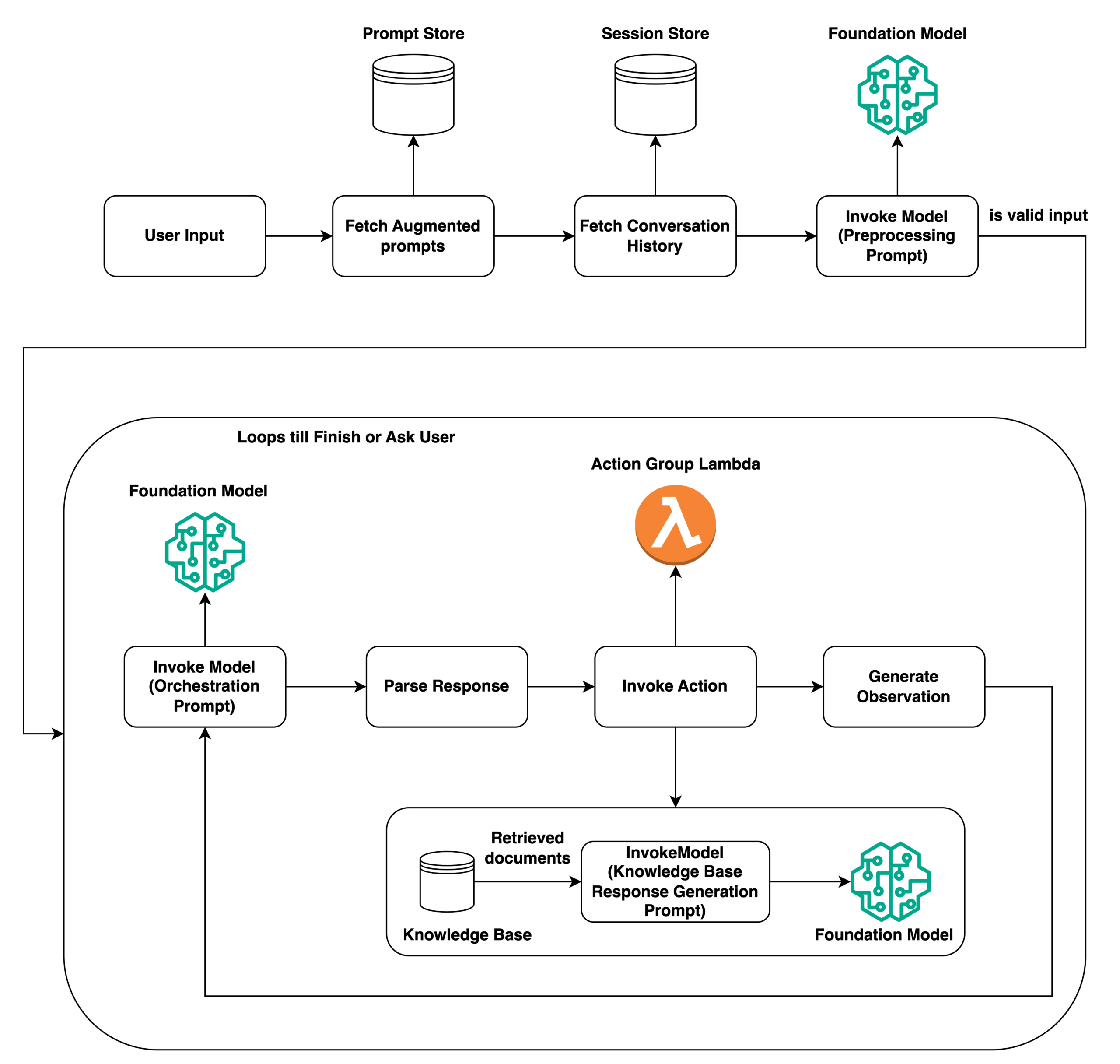
Production agents are rarely singletons; they are multi-agent systems where an arbiter agent receives a request, decomposes it, delegates subtasks to specialists — the AgentOps equivalent of microservice decomposition. The arbiter handles routing, not execution, governing handoffs through logged routing decisions, exposed reasoning traces, and provenance on merged output.
The split maps onto cost and latency: a cheaper model (Claude Haiku, Amazon Nova Micro) routes high-volume decisions; specialists on larger models (Claude Sonnet, Nova Pro) are invoked only when needed.
Semantic protocols are the glue — teams standardize on MCP (tool use) or A2A (agent-to-agent), enforced through schemas, validators, contract tests. Multi-agent systems need loop limits, confidence thresholds, circuit breakers to prevent runaway feedback. On AWS, Bedrock AgentCore provides a managed supervisor runtime; Strands Agents and LangGraph offer code-first alternatives.
Not every workload needs the arbiter pattern. A single well-scoped agent with a handful of tools is easier to eval, debug, and operate than a multi-agent system, and AgentOps teams generally start there. The move to specialists is worth the added orchestration and observability overhead only once one agent is doing work with clearly separable domains — for example, order lookup versus policy interpretation — that benefit from different models, prompts, or update cadences.

Focus Area 3: Multi-Tenancy and Centralized Control
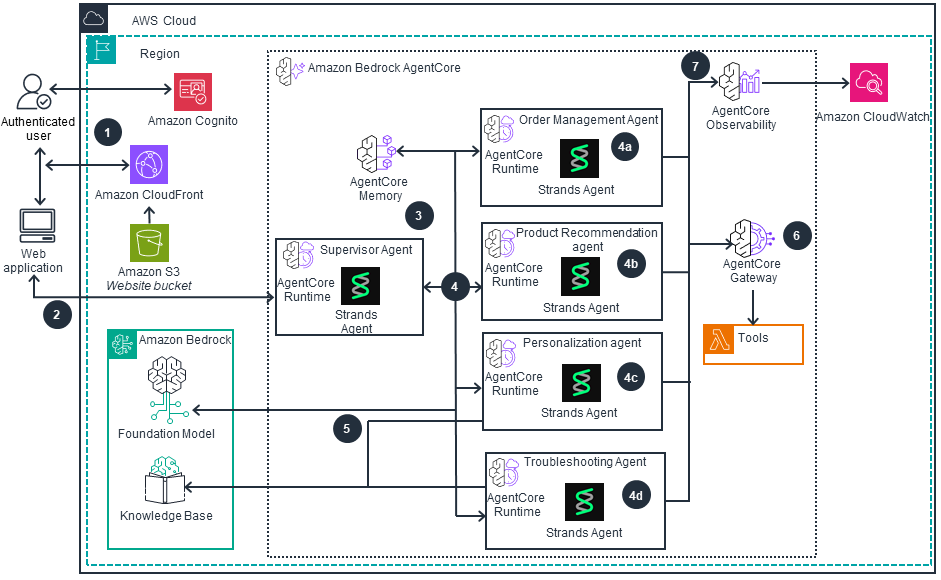
Once an agent succeeds for one team, every business unit wants it, and the cheapest way to serve them is a shared platform with per-tenant isolation — an agent control plane that onboards tenants, provisions configuration, enforces policy, meters usage. On AWS this means a DynamoDB tenant registry, per-tenant IAM roles, Bedrock AgentCore memory instances, EventBridge events on lifecycle changes. Centralizing policy means every agent inherits the same baseline controls.
The governance model is layered: platform baseline (content filters, PII masking, identity propagation, audit logging) no tenant can disable; tenant policy (which tools, knowledge bases, models may be invoked); agent policy (the specific scope envelope). Role-based access per agent makes it work — a pooled agent assumes a different IAM role per request, scopes memory by tenant, tags telemetry accordingly. Teams verify propagation through weekly chaos tests attempting cross-tenant access.
Concretely, a tenant registry entry might record the tenant identifier, the IAM role ARN it assumes, which knowledge bases and tools it may call, and its guardrail configuration. When a request arrives, the control plane looks up the tenant, assumes the scoped role for that request only, and attaches the tenant identifier to every downstream call so telemetry and memory lookups stay partitioned without each tool needing its own isolation logic.
Focus Area 4: Building Trust Through Guardrails and Observability
Trust rests on three pillars. Identity establishes who is acting — every agent invocation carries an authenticated identity propagating through CloudTrail, IAM, and Bedrock AgentCore session metadata. Guardrails enforce policy at runtime: Bedrock Guardrails block harmful content, mask PII, deny disallowed topics, and filter hallucinations through contextual grounding checks before they reach the user. AgentOps teams configure guardrails as code.
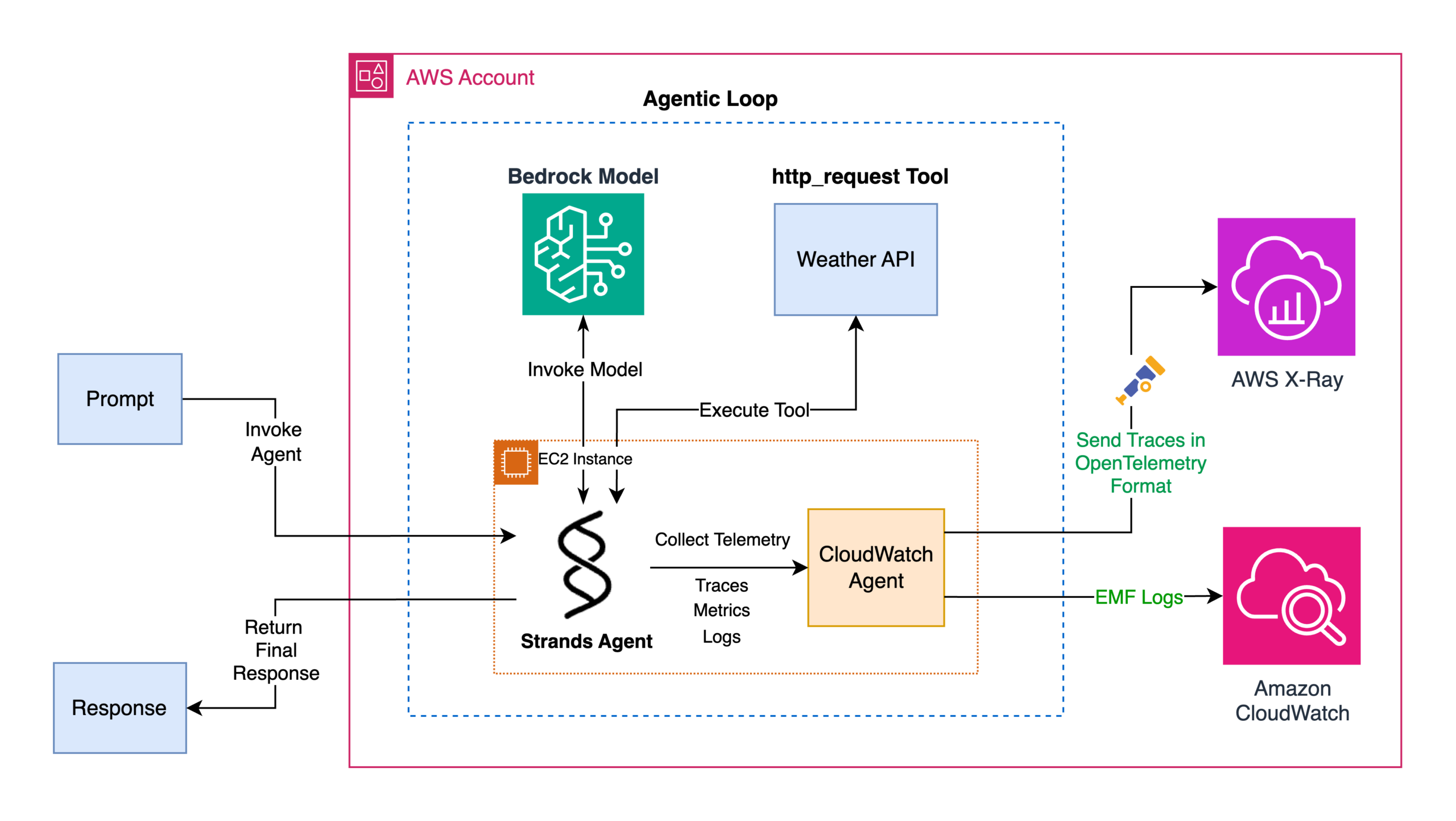
Observability closes the loop. AWS X-Ray traces every agent step — model call, tool invocation, memory lookup — filterable by tenant or session. CloudWatch aggregates latency, error rate, guardrail intervention rate, and cost per task.
Together with Bedrock AgentCore’s recorded tool inputs and outputs, these produce the audit evidence trail; instrument for explainability from the first deployment. A practical trust metric is the guardrail intervention rate — low and stable means within policy; rising means drift.
Contextual grounding checks compare a generated response against the source documents or tool outputs it is supposed to be based on, flagging responses that drift from what the retrieved context actually supports. That check catches a specific failure mode plain content filters miss: a fluent, policy-compliant answer that is simply not supported by the data the agent retrieved.

Focus Area 5: Agent Lifecycle Management (CI/CD for Agents)
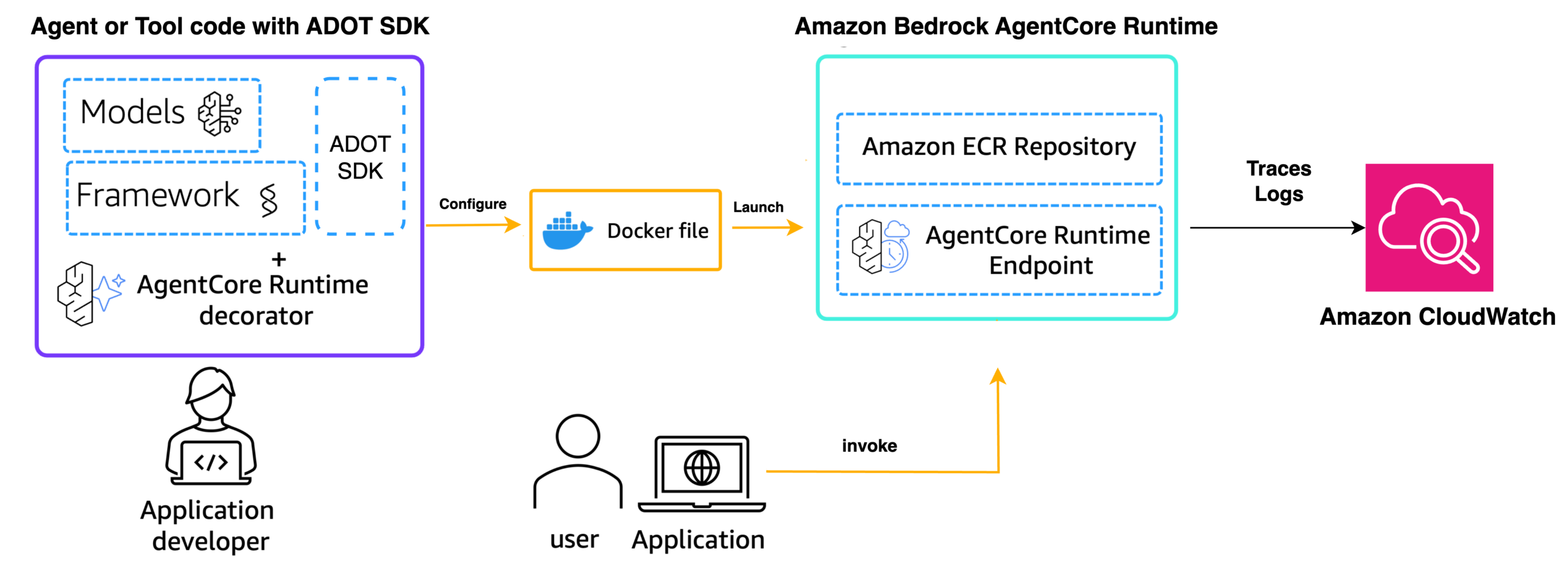
Agents are continuously improved through prompt changes, tool updates, model upgrades, guardrail tuning — AgentOps brings CI/CD discipline to these artifacts.
The mechanics mirror application CI/CD closely enough that most platform teams reuse existing pipeline tooling: a pull request against the prompt repository triggers the eval suite automatically, a reviewer approves the diff, and a merge to the main branch is what starts the canary rather than a direct deploy to production.
AgentOps is to agentic AI what DevOps is to microservices — a discipline that turns one-off agent experiments into production-grade, continuously improved infrastructure. It includes prompt versioning (like code versioning), agent canary deployments (like blue/green), and telemetry dashboards that track agent success rates, latency, and cost per task.
Prompt versioning is foundational: prompts in Git, reviewed in pull requests, tested against a golden eval suite (synthetic edge cases, production traces, adversarial cases) before promotion. Agent canary deployments mirror blue/green — a new prompt, model, or tool config rolls out to 5% of traffic, evaluated against SLOs (success rate, p95 latency, cost per task, guardrail pass rate), promoted or rolled back via CodePipeline.
Continuous retraining closes the loop: telemetry surfaces underperformance, those cases become eval cases, the improved agent ships through the same pipeline.

Focus Area 6: Aligning Agents with Business Models
An agent that cannot be monetized or measured against ROI loses budget at the first downturn. Three patterns dominate. Internal ROI measures cost savings with before-and-after telemetry. Usage-based commercial offerings charge per invocation, task, or token — needing precise metering. Outcome-based pricing charges only for measurable business results — boldest, strongest attribution.
The attribution pipeline supporting all three has a common shape: every agent invocation emits a telemetry record (tenant, business unit, agent version, model ID, token counts, tool calls, outcome); a downstream aggregation job rolls these into per-tenant cost and outcome reports feeding internal chargebacks and external billing. Build it once and you can switch monetization models without re-instrumenting.
Building Your AgentOps Team
Most production deployments converge on a triad. AI Engineering owns prompts, tools, model selection, eval suites. Platform Operations owns Bedrock AgentCore, the control plane, CI/CD pipelines, guardrail config, observability dashboards, on-call. Business Units own outcomes — intent, success metrics, business rules. Each role has a veto; each artifact (prompt, guardrail, tool) has an owner.
For a handful of agents, a single platform engineer and a rotating AI engineer per business unit carry the practice. Beyond ten production agents or three business units sharing a platform, a dedicated platform team becomes rational — the trigger is maintaining more than two parallel pipelines.
The transition is usually visible before anyone declares it: the same platform engineer starts triaging incidents for agents owned by different business units, on-call rotations blur across teams, and the CI/CD pipeline configuration for one agent quietly becomes the template every new agent copies. Formalizing the platform team at that point simply names what is already happening.
Avoid the anti-pattern of a center of excellence that advises but does not own; the pattern that works is a platform team owning shared agent infrastructure as a product, with SLAs and on-call rotation.
AgentOps in Practice: Retail Enterprise Rolling Out AgentOps
A retail enterprise deploying a shopping assistant across five brands builds a pooled agent platform on Bedrock AgentCore: one runtime serves all five; tenant context (brand identifier) is injected at API Gateway from the JWT, propagated through Lambda into session metadata and every tool. The product-catalog tool scopes DynamoDB queries by brand; the returns tool retrieves per-brand policy from S3.
Pooled deployment delivers the capability at roughly a fifth of baseline cost; per-tenant IAM roles preserve isolation.
The rollout follows four phases rather than a single big-bang launch. Phase 1 ships one brand on a dedicated agent to validate the prompt, tools, and guardrails against real traffic before any pooling logic exists. Phase 2 introduces the shared runtime and the tenant-scoping code shown below, migrating brands one at a time behind a feature flag.
Phase 3 adds the CI/CD layer: prompts move into version control, the golden eval suite runs on every change, and canary promotion replaces manual deployment for all five brands. Phase 4 turns on chargeback reporting and widens the chaos-testing schedule once a full quarter of production telemetry is available to tune alert thresholds.
import boto3, os
agentcore = boto3.client('bedrock-agentcore')

def build_shopping_agent(brand_id: str):
    # Per-brand system prompt pinned in Git, versioned, reviewed
    prompt_version = load_prompt(f"shopping-assistant@v3.4", brand=brand_id)
    system_prompt = prompt_version.text + f"\nBrand context: {brand_id}. Scope all tool calls with brand_id."

    return agentcore.create_runtime_session(
        agentId=os.environ["SHOPPING_AGENT_ID"],   # single shared agent
        sessionMetadata={"tenant_id": brand_id},    # propagates to tools + telemetry
        guardrailIdentifier=os.environ["GUARDRAIL_ID"],  # centralized policy
    )
The AgentOps layer sits on top.
Failure handling is part of the design, not an add-on. If create_runtime_session raises because a guardrail identifier is missing or a brand’s IAM role lacks a required permission, the calling Lambda catches the exception, logs it with the brand identifier attached, and falls back to a degraded static-response flow instead of surfacing a raw error to the shopper. That fallback path is itself covered by the golden eval suite.
Rollback follows the same canary mechanism used for promotion. If the CloudWatch dashboard shows the new prompt version breaching its p95 latency or guardrail-intervention SLO during the 48-hour canary window, CodePipeline reroutes the canary traffic back to the previously approved prompt version and pages the on-call platform engineer.
Prompts live in CodeCatalyst with pull-request review and a golden eval set of 200 conversations; CodePipeline runs the eval suite on every change. Promotions go through a canary: 5% of traffic for 48 hours, evaluated against SLOs, then ramped to the remaining brands once the SLOs hold.
Every agent step emits an X-Ray segment annotated with brand_id, filterable in CloudWatch ServiceLens, so a support engineer can trace a single shopper’s session across orchestration, tool calls, and guardrail checks without cross-referencing separate logs.
Each brand pays an internal chargeback based on per-invocation telemetry; the metric deflected contacts — support tickets the agent resolved without human escalation — is what business owners review monthly to justify continued investment. When a Bedrock model upgrade lands, the platform team runs the eval suite against all five brands before touching production, then ships any required prompt tweak through the same canary pipeline used for ordinary changes.
AgentOps: Common Mistakes to Avoid
- Treating prompts as configuration, not code. Editing prompts directly in a console loses the audit trail of what changed and why, so a regression cannot be bisected to a specific edit. Diagnose it by checking whether the last prompt change went through a pull request. Fix it by moving every prompt into Git on day one, reviewed like application code.
- Deploying without an eval suite. Without a golden dataset, a successful deployment and a silent regression look identical until customers notice. Diagnose the gap by checking whether the last few prompt or model changes were validated against a fixed test set. Fix it by building even a small suite (20–30 cases) before the first production deployment, then growing it from every incident.
- No guardrails on production agents. Skipping Bedrock Guardrails to save integration time turns a controllable agent into a liability the first time it is asked something the prompt did not anticipate. Diagnose exposure by checking whether any content filtering, PII masking, or topic denial runs between the model and the user. Fix it by making guardrails a required deployment-pipeline step, not an optional add-on.
- Observability as an afterthought. Bolting on X-Ray and CloudWatch after the first incident means the traces that would explain it were never captured. Diagnose it by asking whether you could reconstruct the last agent failure step by step from existing telemetry. Fix it by instrumenting every invocation — model call, tool call, memory lookup — from the first deployment.
- Single shared IAM role for all tenants. Pooling agents for cost efficiency without per-tenant IAM roles means one misconfigured tool call can expose every tenant’s data through shared credentials. Diagnose it with a chaos test that deliberately attempts cross-tenant access and confirms it is denied. Fix it by scoping a distinct IAM role per tenant or per request, validated on a recurring schedule.
- No business owner. Ownerless agents keep running long after the business case that justified them has changed, and nobody is positioned to fund or retire them properly. Diagnose it by asking who signs off on the agent’s success metric this quarter. Fix it by naming an accountable owner before production, revisited at every lifecycle review.
- Letting the golden eval set go stale. Teams build an eval suite at launch and stop adding to it, so the tests stop reflecting how the agent is actually used months later. Diagnose it by comparing the date of the last added case against the date of the last production incident. Fix it by making “add a case” a required step of every incident postmortem.
- Ignoring token and cost drift. Model upgrades, prompt growth, and longer tool-call chains can quietly raise cost per task well past the number that justified the agent. Diagnose it by comparing current cost-per-task telemetry against the baseline recorded at launch. Fix it by alerting on cost-per-task deviation the same way you alert on latency or error rate.
- Delaying chaos tests until after an incident. Multi-tenant isolation looks solid in design reviews but is often untested under adversarial conditions until something leaks. Diagnose it by checking whether cross-tenant access attempts run on a recurring schedule, not just at launch. Fix it by scheduling weekly automated chaos tests against the control plane from the first pooled deployment onward.
AgentOps: Best Practices
The checklist below is a starting point, not a sequence — how you apply it depends on two architecture decisions made earlier: whether to run a dedicated agent runtime per tenant or a pooled multi-tenant runtime, and whether to orchestrate on a managed service like Bedrock AgentCore or a code-first framework such as Strands Agents or LangGraph running on Lambda or ECS.
Dedicated per-tenant runtimes give the simplest security model — isolation is structural, not enforced by application logic — but they multiply infrastructure cost and make a shared prompt or tool improvement harder to roll out consistently. Pooled runtimes, like the retail example above, cut baseline cost roughly in proportion to the number of tenants sharing the platform, at the price of the IAM-per-request and chaos-testing discipline described in Focus Area 3.
Managed orchestration through Bedrock AgentCore reduces the custom session-management and memory code a team maintains, and integrates directly with Bedrock Guardrails, IAM, and CloudWatch. Code-first frameworks such as Strands Agents or LangGraph offer more control over orchestration logic and run on standard compute, which suits teams with existing Lambda or ECS operational tooling.
Cost and performance tradeoffs mostly come down to model tiering and canary sizing. Routing high-volume, low-complexity requests to a smaller model and reserving a larger model for cases needing deeper reasoning keeps average cost per task down without capping quality where it matters. A canary window that is too short does not accumulate enough traffic to detect a real SLO regression before it reaches full rollout.
Security considerations layer on top of the architecture choice: KMS encryption for data at rest, Bedrock Guardrails for content and PII policy at runtime, and IAM conditions that scope every tool call to the requesting tenant. None of these is expensive to add individually — skipping them is what produces the mistakes covered in the previous section.
- Version every agent artifact (prompts, tools, guardrails, model IDs) in Git with pull-request review and a release tag per deployment.
- Maintain a golden eval dataset per agent; run it via CodePipeline and block promotions that regress accuracy.
- Deploy through a canary (5% traffic, defined window, SLO-gated ramp).
- Enable Bedrock Guardrails on every production agent, configured as code, with content filters, PII masking, topic denial, and contextual grounding checks.
- Instrument every agent step with AWS X-Ray, annotated with tenant identifier.
- Define SLOs (success rate, p95 latency, cost per task, guardrail pass rate) before first deployment; wire to automated rollback.
- Treat multi-tenancy as a control plane: per-tenant IAM roles, per-tenant memory for regulated workloads, weekly chaos tests.
- Name a business owner and success metric for every agent; retire agents whose ROI is declining.
AgentOps: Frequently Asked Questions
What is AgentOps and how is it different from MLOps?
AgentOps is CI/CD, monitoring, and governance pipelines for AI agents. MLOps covers model training, validation, deployment; AgentOps extends that to the artifacts that change continuously — prompts, tools, guardrails, memory — and to the non-deterministic runtime behavior traditional MLOps does not address.
Which AWS services implement AgentOps?
The core stack: Bedrock (and Bedrock AgentCore) for the runtime, Bedrock Guardrails for runtime policy, AWS X-Ray and CloudWatch for observability, IAM for tenant isolation, CodePipeline (or CodeCatalyst) for CI/CD, EventBridge for lifecycle events.
Do I need a dedicated AgentOps team?
For a single prototype, no. For multiple production agents serving multiple tenants, yes — or a dedicated function within platform engineering. The signal is when the same artifacts (prompts, guardrails, pipelines) are maintained ad hoc by more than two squads. Centralize proactively.
What is the cheapest first step toward AgentOps?
Move your prompts into version control and run an eval suite on every change. It costs almost nothing, prevents the most common regression class, and establishes the discipline everything else builds on.
How does Bedrock AgentCore support multi-tenant AgentOps?
AgentCore provides per-tenant session isolation, per-tenant memory instances, and per-tenant telemetry tagging out of the box. A pooled agent assumes a different IAM role per request, scopes Bedrock AgentCore memory by tenant identifier, and emits X-Ray segments annotated with the same identifier. AgentOps teams verify the isolation holds with weekly chaos tests that attempt cross-tenant access; any leak blocks deployment. The pattern works for both HIPAA-regulated workloads and internal multi-brand deployments.
AgentOps: Key Takeaways
- Agentic AI is an operational paradigm, not a feature.
- Define intent and scope first; treat agents as digital teammates with a named owner and measurable outcome.
- Design for composability with arbiter agents, semantic protocols (MCP, A2A), loop-limit safeguards.
- Multi-tenancy is a control plane — shared services, per-tenant IAM, weekly chaos tests.
- Trust is engineered through identity propagation, Bedrock Guardrails as code, X-Ray/CloudWatch per tenant.
- Lifecycle management is CI/CD for agents: prompt versioning, canaries, SLO-gated rollouts.
- Align agents with business models — internal ROI, usage-based, or outcome-based pricing.
- Build a triad team: AI Engineering owns the agent, Platform Ops owns infrastructure, Business Units own outcomes.
AgentOps on AWS separates agents that scale from agents that stall. Start with prompt versioning and an eval suite, layer in guardrails and observability, build toward a control plane and a triad team.
Continue Learning
- Lab: Instrumenting Agent Observability
- AWS Agentic AI Foundations — what an agent is
- AWS Multi-Tenant Agents — multi-tenancy patterns AgentOps operationalizes
- AWS Agentic AI Economics — cost and ROI models driving business alignment