The branches of AI are subfields that each do the same four jobs differently; machine learning is one branch, with neural networks inside it and deep learning a layer deeper still.
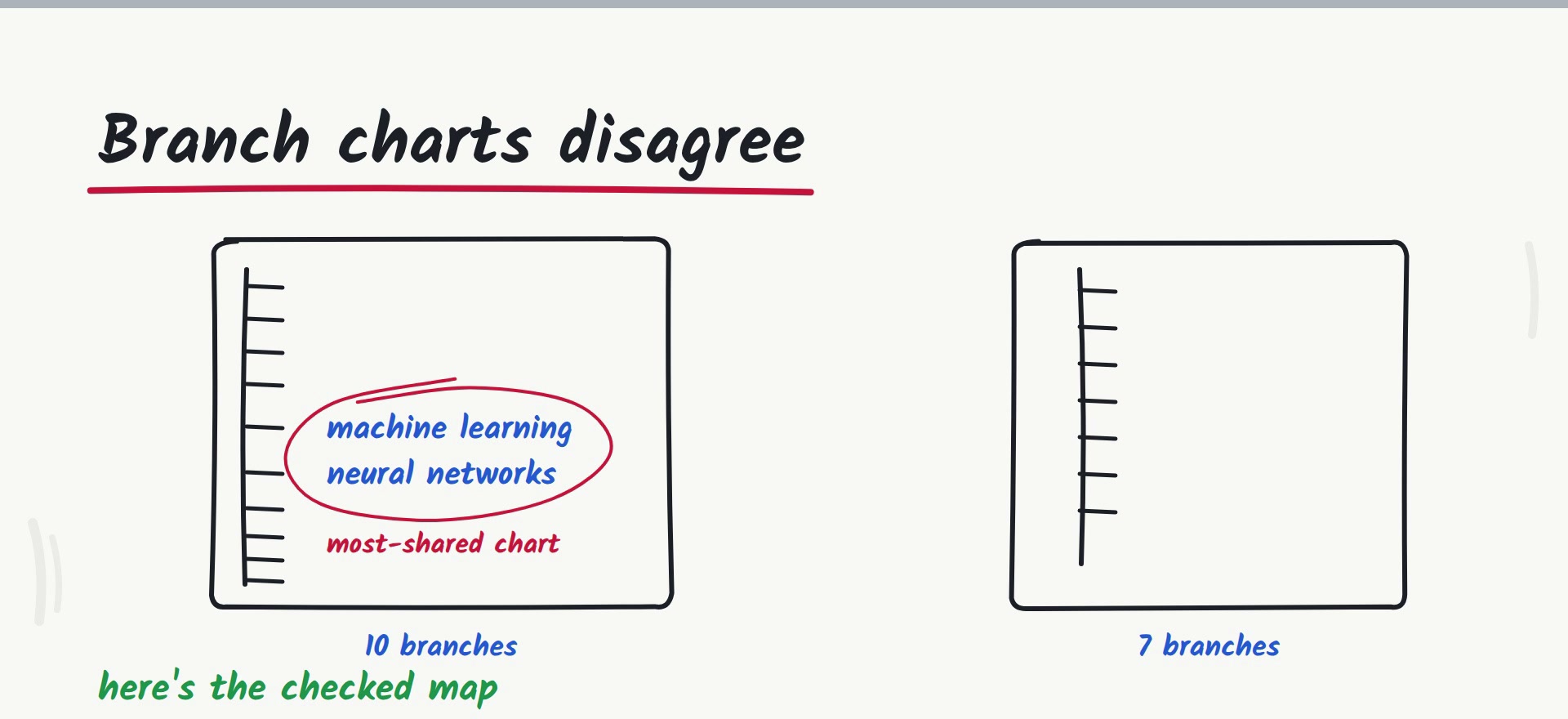
- Two tutorial pages from one source disagree on the count: the AI page lists ten branches, the machine learning page seven, and the most-shared chart seats neural networks beside machine learning, an older convention.
- The current references nest instead: Wikipedia defines machine learning as “a field of study in artificial intelligence”, calls deep learning a branch of machine learning, and has retitled its neural network article to Neural network (machine learning).
- Expert systems run on knowledge written down by knowledge engineers, with nothing learned from data: MYCIN in medicine, R1 configuring DEC VAX computers, and “two-thirds of the Fortune 500” applying them in daily business by the 1980s.
- Fuzzy logic (Lotfi Zadeh, 1965) lets truth take any value between 0 and 1, with the Sendai Subway 1000 series as a first notable application; cognitive computing has no widely agreed definition and belongs on the list as a label.
A chart of the branches of AI opens most tutorials, and the charts disagree: the page this episode fact-checks counts ten branches, its sibling page counts seven, and the most-shared chart of all seats neural networks beside machine learning as siblings. This article is the companion to the Whiteboard Architect episode The Branches of AI (and Where ML Sits): same chapters, same fact-checks, plus the tables and links a video cannot carry. Where the popular charts and the current references disagree, the references win, and the article names which.
The four jobs every branch performs
Chapter one of the episode asks what an AI system actually does. Four jobs cover the tour. Learning finds and reads patterns in data. Decision-making draws conclusions through rules, probabilities and algorithms. Problem-solving searches the moves the rules allow. Perception turns sensory input into something usable. Each branch mixes the four in its own proportions, and the instances below are ones you can check yourself.
| Job | What it involves | An instance to check |
|---|---|---|
| Learning | Finding and reading patterns in data | Siri turning speech into text with a trained model |
| Decision-making | Rules, probabilities, algorithms | Grammarly flagging a misplaced comma |
| Problem-solving | Searching the moves the rules allow | A chess engine picking its strongest move |
| Perception | Turning sensory input into something usable | Object recognition, image identification, video analysis, segmentation |
The ten branches of AI on one board
The tutorial the episode fact-checks lists ten branches. The table walks them in tour order and adds the column the popular chart lacks: a seat. One entry belongs inside another branch; one is a label.
| Branch | What it does | Seat on the checked map |
|---|---|---|
| Machine learning | Statistical algorithms learn from data and generalize to data never seen; nobody hand-writes rules | A branch of AI |
| Neural networks | Connected nodes in brain-inspired layers; training tunes the connection weights toward better accuracy | Inside machine learning |
| Deep learning | Machine learning built on neural networks stacked many layers deep | Inside machine learning, multilayer |
| Natural language processing | Works on human language in both directions: recognition, understanding, generation | A branch of AI |
| Computer vision | Extracts meaning from images and video: recognition, detection, tracking, faces | A branch of AI, since the late 1960s |
| Robotics | Builds and controls machines that sense, process, then act | A branch of AI |
| Expert systems | Facts and rules in a knowledge base, an inference engine reasoning like a human expert | A branch of AI, knowledge written in |
| Fuzzy logic | Truth anywhere on the scale between false and true, not a binary 0 or 1 | A branch of AI, Zadeh 1965 |
| Evolutionary computation | Optimizes the way evolution does: population, evaluate, select, vary, repeat | A branch of AI |
| Swarm intelligence | Many small agents, simple rules, no leader; the group still solves problems | A branch of AI |
| Cognitive computing | Platforms sold as brain-like: sensing, reasoning, responding | A label, no settled branch |
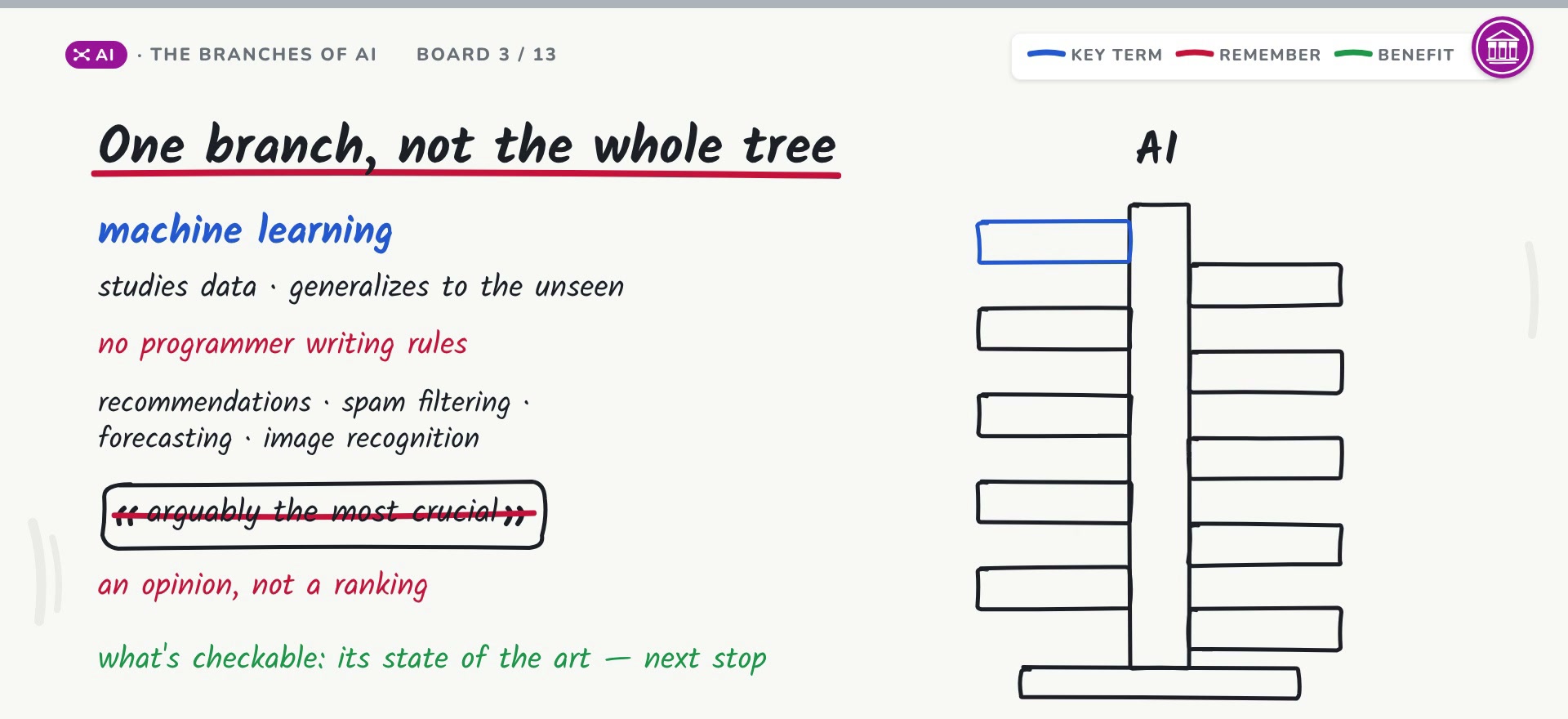
One row needs a clarification before the tour moves on. The tutorial’s phrase for machine learning, “arguably the most crucial” branch, is an opinion; no reference ranks the branches. What the references do say is narrower: Wikipedia’s machine learning article defines a field concerned with statistical algorithms “that can learn from data and generalize to unseen data”, doing work “without being explicitly programmed”, and its applications list runs long, from recommender systems to time-series forecasting.
The re-seating: where neural networks actually sit
The most-shared chart seats neural networks beside machine learning, two siblings under AI. The current reference pages draw it differently, in three places. Wikipedia has retitled its neural network article to Neural network (machine learning), and the lead sentence places the network “in machine learning”, defined as “a computational model”. The deep learning article’s first hatnote calls deep learning a branch of machine learning. Machine learning itself is “a field of study in artificial intelligence”. Read together: deep learning sits inside machine learning, which sits inside AI, the same three circles the first lesson in this series drew.
The vocabulary follows the drawing. A neural network is the model; machine learning is the discipline that trains it, tuning connection weights toward better accuracy; deep learning is the multilayer end of that same family. The fact-check behind the episode records the inner circle’s bill as GPU-scale compute and vast numbers of sample inputs; the deep dive below lists the returns.
What did deep learning spend to reach the state of the art?
The deep learning article is specific about the cost and the payoff. The 2010s jump in adoption and performance, it states, came from efficient implementations of convolutional networks on GPU hardware; the models had existed for decades before the hardware caught up. That is what the extra layers needed: compute and training samples at a scale earlier decades could not supply.
Speech recognition is where it first paid off. The article calls large-scale automatic speech recognition “the first and most convincing successful case of deep learning”, and records that “all major commercial speech recognition systems” use it, naming Microsoft Cortana, Xbox, Skype Translator, Amazon Alexa, Google Now, Apple Siri, Baidu and iFlytek. The assistant on a phone and the console voice commands share a branch.
Computer vision is the other headline application area, with the speech results documented in detail alongside it. The history section traces the reach further back still, to a 1988 application predicting protein structure.
Expert systems write their knowledge down
The sharpest contrast on the board is expert systems, the branch that does everything machine learning does not. An expert system keeps a knowledge base that holds facts and rules, together with an inference engine that reasons over them, standing in for a human expert’s decisions. Nothing in it is learned. Knowledge engineers interview the expert, write the rules down, and the system replays them; the episode’s fact-check flags knowledge acquisition as the field’s bottleneck, knowledge extracted from human heads by hand.
The wave was real while it lasted. MYCIN ran in medicine, alongside Internist-I and later CADUCEUS. R1, internally called XCON, was a production-rule system written in OPS5 at Carnegie Mellon in 1978 to configure Digital Equipment Corporation’s VAX computers for salespeople, per the Xcon article. By the 1980s, per the expert-system article, “two-thirds of the Fortune 500” companies applied the technology “in daily business activities”. That boom, and the winter that followed, have their own episode in this series.
How does an expert system reach a decision?
The expert system article breaks a system into five parts. Two do the core work: a knowledge base with the facts, and an inference engine to reason over them. Three wrap it: a user interface, an explanation facility, and a knowledge acquisition facility for getting rules in. Facts live as if-then rules, not procedural code, and the engine reasons in two modes, chaining forward from facts to conclusions or backward from a hypothesized conclusion.
The article is blunt about the weak part: getting knowledge out of human experts and into rules was the expensive step, which is why the acquisition facility exists as a component at all. Each expert’s knowledge had to be extracted rule by rule, by people.
In medicine the approach produced MYCIN, Internist-I and CADUCEUS; in business it configured DEC VAX computers and spread until the article’s adoption figure, two-thirds of the Fortune 500 by the 1980s. One vocabulary rule survives: nobody trains an expert system, because people wrote in every rule it knows.
The rest of the board: fuzzy logic, evolution, swarms, one label
Fuzzy logic handles the ground between yes and no. Boolean logic gives a computer exactly two options, true or false, 0 or 1; fuzzy logic, in the article’s wording, lets the truth value of a variable “be any real number between 0 and 1”. Lotfi Zadeh introduced it with his 1965 proposal of fuzzy set theory, with the basic mathematics studied since the 1920s, per the article. Its first notable application was the Sendai Subway 1000 series, where fuzzy control made the ride more economical, more comfortable and more precise. Washing machines and medical decision making use the same mathematics.
Two further branches take their ideas from biology. Evolutionary computation runs a simulated version of it: breed a pool of candidate solutions, score them, keep the best, mutate and recombine, and go around again, each pass scoring a little better. It was founded three times over, in evolution strategies, evolutionary programming and genetic algorithms, with genetic programming arriving as a fourth in the 1990s. Swarm intelligence studies the collective instead: ants, bees, birds and fish, many small agents each obeying simple rules with no controller anywhere, and the colony as a whole still solving problems. Its two named algorithms are ant colony optimization and particle swarm optimization.
Cognitive computing closes the tour and earns an asterisk. Its Wikipedia page opens the Definition section by stating there is “no widely agreed upon definition for cognitive computing in either academia or industry”, describes platforms built to mimic the functioning of the human brain, sensing, reasoning and responding, and then the field’s own caveat: such systems “may not be artificially intelligent”. The Applications section covers education first.
What is fuzzy logic computing, exactly?
Classical logic gives every statement one of two truth values, and computers natively work that way. Fuzzy logic lets a statement be partly true: 0.8 reads as mostly true, 0.2 as mostly false, and the labels people actually use, closer to “possibly yes” and “maybe no”, map onto that scale. Zadeh’s 1965 fuzzy set theory formalized it, and the article records that the underlying mathematics had been studied since the 1920s.
The payoff is control in situations a true-or-false rule cannot grade. The Sendai Subway 1000 series is the flagship case, with fuzzy control credited for the ride’s economy, comfort and precision, and the same approach runs in consumer washing machines and medical decision making.
Is cognitive computing a real branch?
By the page’s own account, nobody has settled that. The Definition section states that neither academia nor industry has a widely agreed definition, an admission no other branch on this board has to make. The term covers platforms that imitate the functioning of the human brain, aimed at models of how a mind senses, reasons and responds.
Then comes the caveat that matters when sorting a syllabus: in the field’s own words, such systems “may not be artificially intelligent”. The Applications section covers education among other areas. It stays on the map, asterisk attached, and any product list published under that label reads as marketing until the definition exists.
Where do the four jobs show up in one phone?
Take one phone. Say the wake word and speech recognition turns sound into text: learning, on a trained model, the same way Siri’s recognizer works, machine learning with convolutional and LSTM networks inside. Type a sentence and the keyboard’s grammar check flags a comma: decision-making, rules plus machine learning, the mix Grammarly documents for its own reviews. Open the chess app and the engine plays on: problem-solving, searching the positions the rules allow for its strongest move.
Search the photo library for “dog” and the results appear: perception, image identification across thousands of shots. Four apps, four jobs, and the branch label on each one tells you which method did the work.
What makes robotics an AI branch?
Robotics is the branch that exists outside the screen: machines that sense the world, process what they sense, then act on it. What puts it on the AI tree is that sense-process-act loop, not a human shape or a face; automation is the defining trait. The same branch covers robot-assisted surgery, manufacturing lines, Mars rovers and domestic robots. Charts that describe robots as working “similar to humans” are naming one design choice among several.
The map is the lesson
The list of branches is an author’s choice: the AI page this episode fact-checks lists ten, its sibling page on machine learning seven, dropping evolutionary computation, cognitive computing and swarm intelligence entirely.
Beyond those two pages, the standard references organize the field differently. Wikipedia’s artificial intelligence article sorts it by goal areas: reasoning and problem-solving, knowledge representation, planning and decision-making, learning, natural language processing, perception, and social and general intelligence. Search and optimisation, logic, and probabilistic methods appear there as techniques underneath the goals, not as branches. None of those headings appear on either tutorial list. The author drawing the tree picks the branches, so read any chart, this one among them, as one map of several.
Three fixes to take from the tour
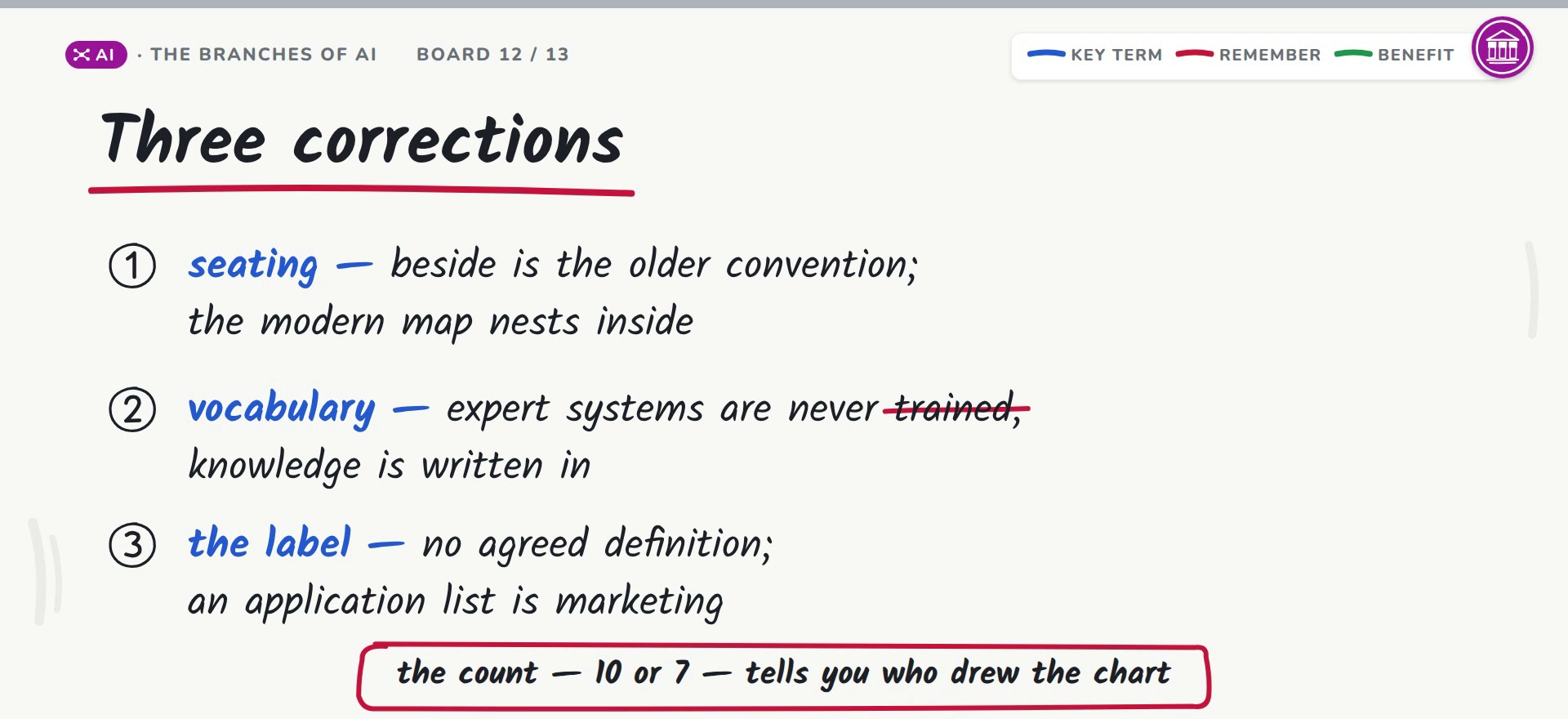
The first correction is the seating: a chart with neural networks beside machine learning draws the older convention, and the modern references nest them. The second is vocabulary: nobody trains an expert system; knowledge engineers write its knowledge in, and trained belongs to machine learning. The third is the label: no agreed definition exists for cognitive computing, so an application list published under that heading is marketing copy rather than a lesson. A count of ten or seven identifies the chart’s author; it says nothing about what AI is.
In short
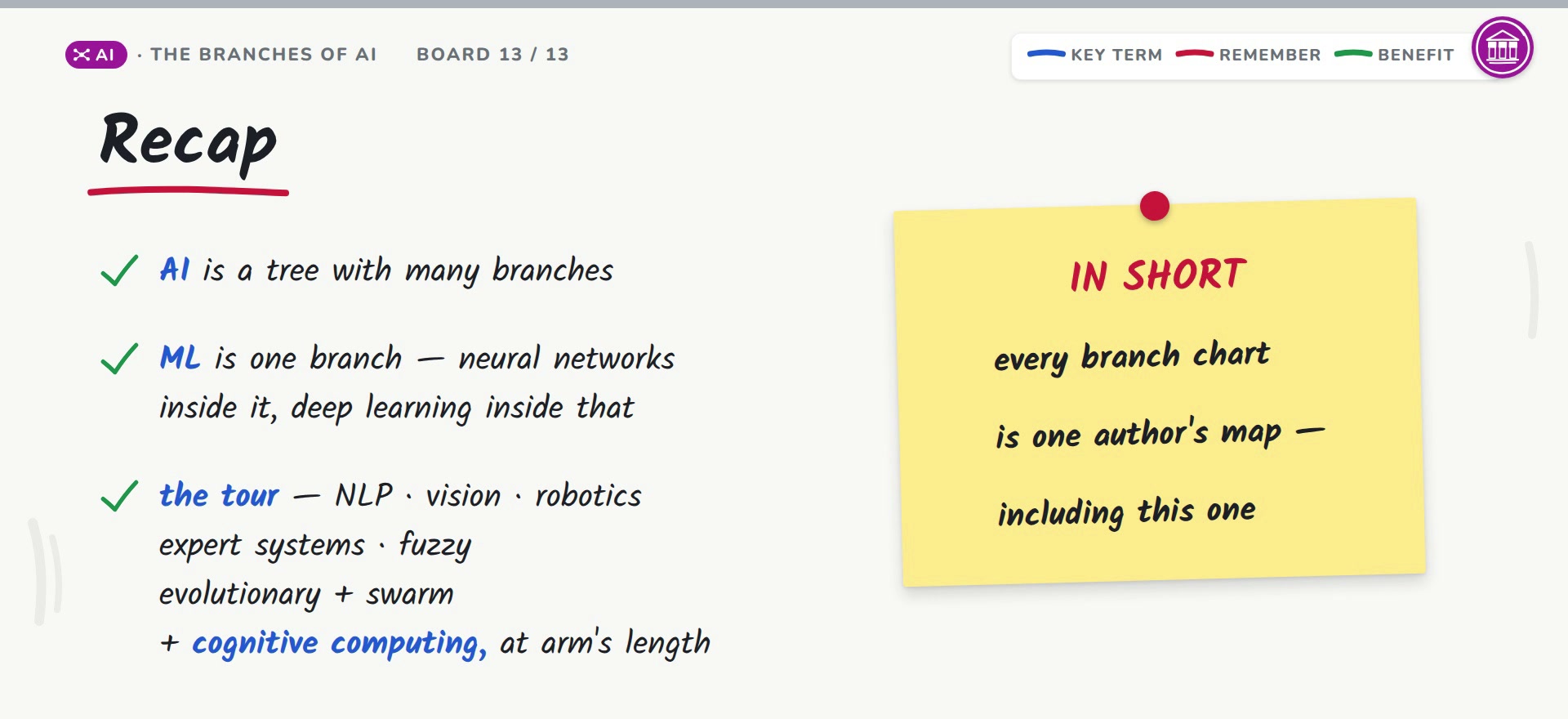
AI grows as a many-branched tree, and machine learning is a single branch of it: neural networks live inside machine learning, deep learning one layer further in. The tour covers language through natural language processing, sight through computer vision, action through robotics, written-down knowledge through expert systems, the in-between grades of truth through fuzzy logic, the rest of biology through evolutionary computation and swarm intelligence, and one label kept at a distance, cognitive computing. The branches of AI on any chart are one author’s map, including the ten on this one.
Continue learning
- Machine Learning: The Honest First Lesson: the three-circle nesting episode, deep learning within machine learning within AI, plus the learning loop and the four learning families.
- AI History: Booms, Winters, and Revivals: the 1980s expert-systems boom and the winter that followed it, with MYCIN and R1 in their decade.
- Narrow AI to Superintelligence: The Lines That Matter: the lines between narrow, general and superhuman AI, and why the whole tree is narrow today.