30 sec7 min coredeep dive optional
The history of cloud computing is fifty years of assembly work: one shared machine from the fifties, slices and a network dream from the sixties, and a metering idea from 1961, combined in 2006 into a single product you rent.
- The 2006 launch assembled rather than invented: S3 reached general availability on March 14, 2006, the first AWS infrastructure service to do so, EC2 opened that August, and the AWS brand itself dates to July 2002.
- IBM’s CP-40 and CP-67 hypervisors date to production use in 1967; the record calls CP-67/CMS the first widely available virtual machine architecture, and the line runs unbroken into z/VM, with VMware downstream of its influence.
- John McCarthy sketched computing as a metered public utility at MIT’s 1961 centennial, and NIST pinned the modern definition down in September 2011: five essential characteristics and three service models.
- The climb went from one machine in the middle, to clusters acting as a single system, to grids spanning organizations, to rented machines with a meter attached; the word cloud only became popular in 2007.
- Five dates get mistold: shared terminals are early-1970s, virtualization production is 1967, the grid name is early-1990s, 1951 is a UNIVAC delivery, and mainframes still run bulk processing today.
The short version of this story has one date in it: 2006, one company, one product launch. The checked history of cloud computing runs fifty years deeper: a shared machine in the fifties, slices and a network dream in the sixties, a delivery network in the nineties, and a meter older than every piece it now prices. This article accompanies lesson three of the Whiteboard Architect cloud computing series: watch the full episode on YouTube for the boards drawn in real time, or read on, where every date below sits beside the page it was verified against.
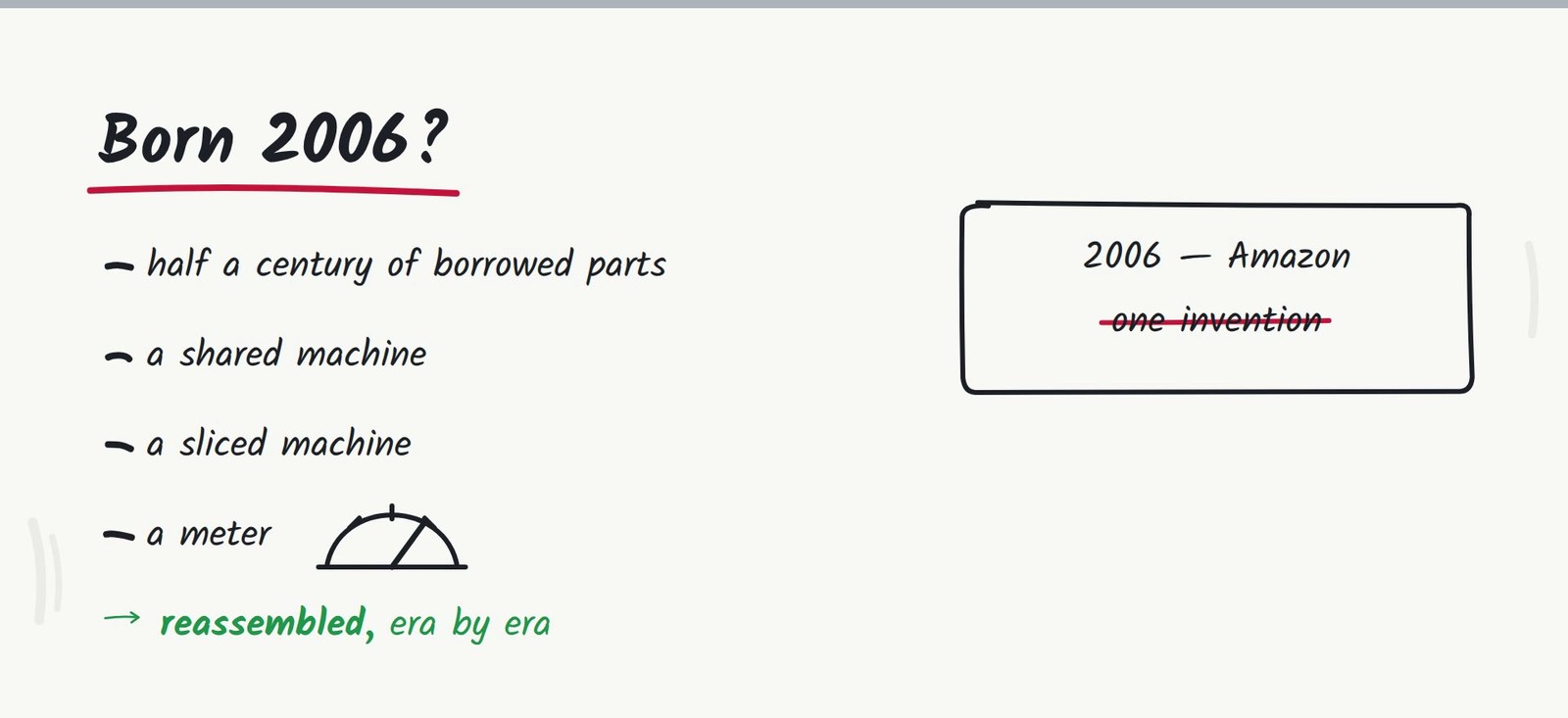
Born 2006? The myth on the opening board
The opening board states the myth as a birth certificate: born 2006, parent Amazon, single invention. The redraw that follows strikes out the invention clause. What Amazon shipped that year was a rentable product assembled from older parts, the three the board’s inventory column names: a shared machine, a sliced machine, and a meter. Each part has a dated paper trail, and the boards that follow draw them in era order.
The fifties: one room-sized machine
The oldest piece is a machine so costly that a whole organization shared it. A 1950s mainframe filled a room and took its work in batches: payroll and billing jobs fed in on punched cards and magnetic tape, with no terminal to sit at. A user handed a deck of cards to the operator and waited. The decade’s famous date is a delivery, not a birthday: on March 31, 1951, the US Census Bureau received the first UNIVAC I, the earliest general-purpose business machine an American company had produced.
Time-sharing, the cloud’s oldest ancestor
Time-sharing is the oldest ancestor the cloud still uses. It seated many users at one machine, rotating processor time among them so quickly that each seemed to have a computer of their own. The CTSS prototype ran its first tests in November 1961, and by March 1964 Dartmouth was operating a time-sharing service. The idea later went quiet; the Internet revived it at server-farm scale.
How did time-sharing actually slice the machine?
Before time-sharing, the machine had a queue: your deck of punched cards went to the operator, and the printout came back hours later. Time-sharing swapped the queue for rapid rotation: the processor’s attention moved from user to user in short turns, each quick enough that everyone sitting at a terminal believed the machine was entirely theirs. CTSS proved the arrangement in November 1961; Dartmouth had a service in daily operation by March 1964. The revival is the part this history leans on: the Internet made time-sharing a mainstream idea again, at a scale the original operators never saw, with server-farm resources shared among thousands of paying customers.
What did the network dream actually propose?
Connecting the slices was the next dream, and it had a name before it had wires. J.C.R. Licklider floated the goal in memos through August 1962, then wrote it out on April 23, 1963, in a memorandum headed Intergalactic Computer Network, a document that reads today like a preview of the Internet, cloud computing very much included. The program it shaped became ARPANET.
1967: virtualization is older than the PC
Virtualization carries a production date, and it lands fourteen years before the first IBM PC. IBM’s CP-40 and CP-67 hypervisors entered production use in 1967, and CP-67/CMS won the record’s designation as the first widely available virtual machine architecture. VM/370 arrived in 1972 as the supported product; the line runs unbroken into today’s z/VM, with VMware downstream of its influence.
The era’s formal definition still holds: each virtual machine is an isolated duplicate of real hardware, efficient enough to be genuinely usable, and the hypervisor is the layer that stacks several such guests, each a full operating system, onto one host. Server consolidation, the practice that fills every cloud region, is that technique at scale.
Why 1967, when the famous product is VM/370 from 1972?
Because production use predates the product name. IBM’s Cambridge team ran CP-40, and then CP-67, in production from 1967, and CP-67/CMS was the first widely available virtual machine architecture: other installations could get it and run it. VM/370, announced in 1972, carried the design forward as a supported IBM product line, and the family never broke, running through the decades into z/VM, which still ships.
The CP/CMS record also states the influence plainly: the work “anticipated and heavily influenced” later virtualization software, VMware among it. The defensible sentence, then, is that hypervisors reached production in 1967, and 1972 is when the design acquired its durable product name.
The eighties detour: computing scatters
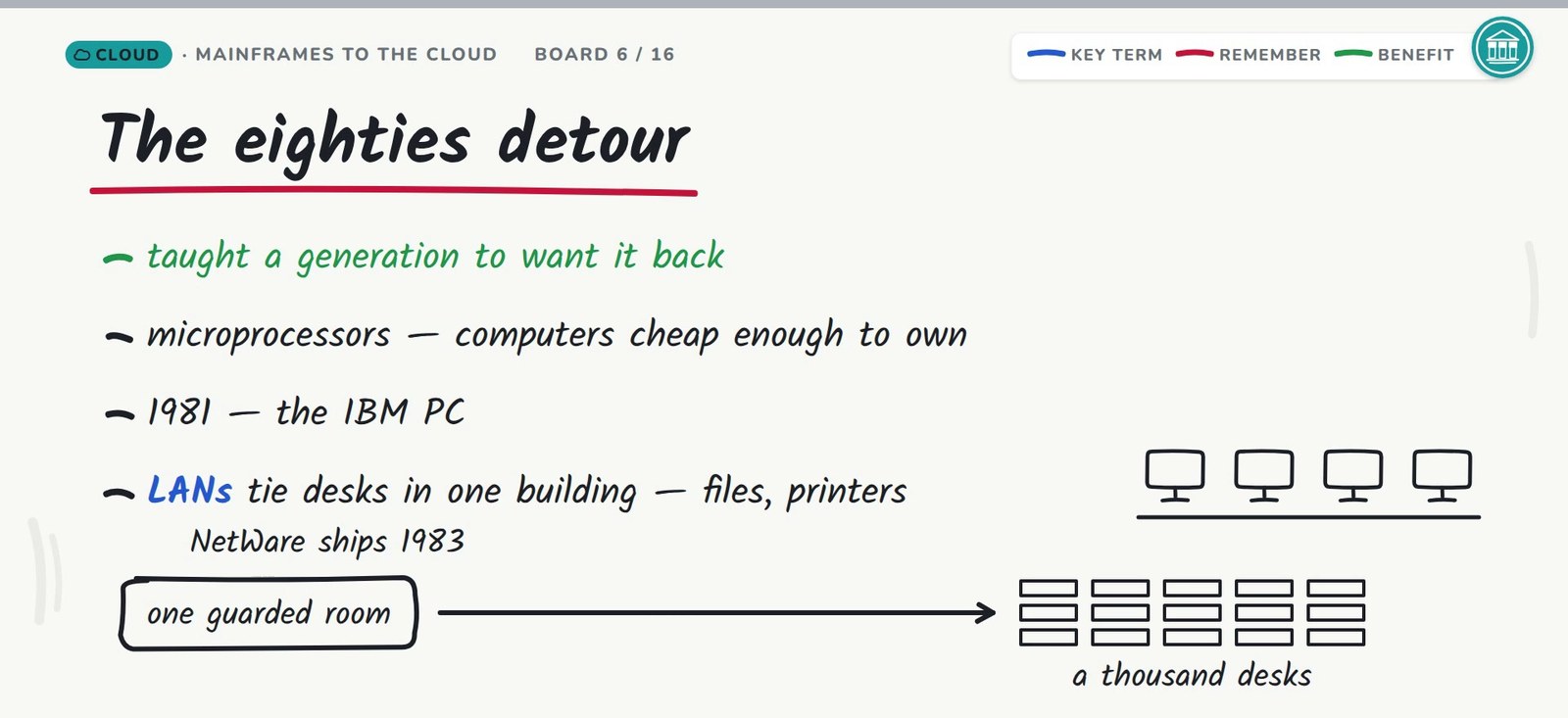
Cheaper processors undid the sharing for a while. Microprocessors pushed computers down to a price a department could own, and the IBM PC landed in 1981. Offices strung local area networks through their buildings so those desks could share files and a printer, with NetWare shipping from 1983. Computing had left the guarded room for a grid of desks, and the decade taught the generation that grew up owning machines what sharing had been worth.
The nineties: the Web makes software deliverable
What the Web contributed to the cloud was reach: an application could now sit anywhere and still arrive on a user’s screen. The dates line up cleanly, and Berners-Lee’s project supplies all four.
| Milestone | Date |
|---|---|
| Proposed at CERN | 1989 |
| Working system running | End of 1990 |
| Opened to the whole Internet | August 23, 1991 |
| Released royalty-free | April 30, 1993 |
The first commercial form showed up in the late 1990s under the name Application Service Providers: companies whose business was running an application on their own servers and reaching customers through the Web. Salesforce, started on March 8, 1999, took that shape into customer-relationship management and became one of software-as-a-service’s early landmark wins. The ASP category faded without the idea dying; software-as-a-service grew directly out of it.
The history of cloud computing, rung by rung
Two named rungs sit between the mainframe and the cloud, both applications of distributed computing: parts of a program on networked machines, passing messages toward a shared objective, pooling resources, and surviving individual node failures. Cluster, grid, and cloud all belong to that family. The ladder looks like this.
| Rung | What it is | Checked anchor |
|---|---|---|
| Mainframe | One central machine, shared by an organization | UNIVAC I delivered March 31, 1951 |
| Cluster | Autonomous computers working as one system under clustering middleware, scaled by adding nodes | Bought for performance, redundancy, fault tolerance |
| Grid | Many organizations’ heterogeneous resources, federated rather than physically coupled | Name dates to the early 1990s, after the electricity grid; blueprint by Foster and Kesselman, late nineties |
| Cloud | Rented, metered machines delivered on demand | Term popular from 2007 |
The grid rung is the cloud’s nearest relative: the sources count cloud computing as close kin to the grid definition, with delivery changed to metered, on-demand services. The bottom rung also stayed occupied: banks and government agencies still use mainframes for bulk data processing and for large-scale transaction work.
Did the mainframe actually die?
No, and the sources say so in so many words. Mainframes never stopped doing this work: financial services firms and government agencies still buy them for the jobs they have always held, bulk data processing and large-scale transaction work, and the machines are built to keep running for decades.
The picture most people carry of fifties computing, rows of users at shared terminals, belongs to a later decade: interactive terminals reached mainframes in the early 1970s, when many installations attached them and turned their machines into timesharing systems serving hundreds of users at once. The fifties user handed a deck to the operator and waited. So the honest history keeps the mainframe in the story the whole way through: it starts as the only machine in the building and ends as a rung the cloud never replaced, still carrying the same class of work decades later.
Is the cloud just the grid with a billing system?
The family resemblance is real and the sources draw it too. Grid computing picked up its name at the start of the nineties, borrowed from the electricity grid, and Foster and Kesselman’s late-nineties blueprint made the idea canonical: resources spread wide, of different kinds, crossing organizational lines, and never physically wired together. The sources count cloud computing as a close relative of that definition, with the delivery changed to metered, on-demand services.
What separates the rungs is ownership and access. A grid federates machines that stay with their owners; a cloud rents you machines the provider owns, by the hour, with a meter running. Read that way, the top rung is the grid’s federation combined with McCarthy’s meter, packaged for sale.
2006: the recombination, not the invention
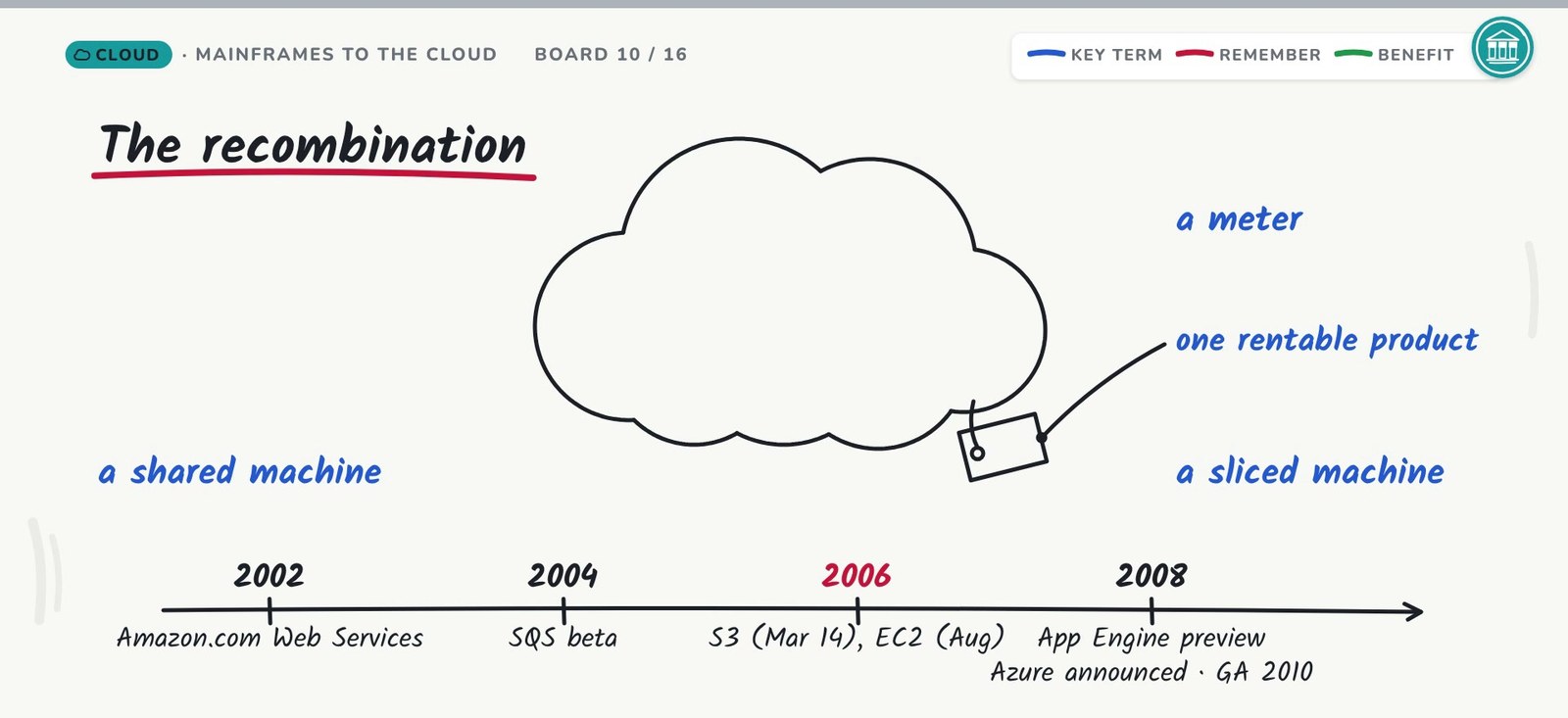
By 2006 the pieces were ready to be priced as one product, and the route there is documented step by step. The AWS brand opened in July 2002 under the name Amazon.com Web Services, and its first infrastructure offering, the Simple Queue Service, spent November 2004 onward in beta. What people usually mean by AWS is younger: S3 became the first of the company’s infrastructure services to reach general availability, on March 14, 2006, and EC2 opened to customers that August. The platform layer filled in behind; the table carries the sequence.
| Product | Date |
|---|---|
| Amazon.com Web Services, the brand | July 2002 |
| Simple Queue Service beta | November 2004 |
| S3, generally available | March 14, 2006 |
| EC2 | August 2006 |
| Google App Engine preview | April 2008 |
| Azure announced | October 2008 |
| Azure commercially available | February 1, 2010 |
Why does the sentence AWS launched in 2006 grate?
Because it flattens three separately dated events into one. The brand opened in July 2002 as Amazon.com Web Services. The Simple Queue Service, the first infrastructure offering, ran in beta beginning November 2004. And the platform a speaker usually means went generally available with S3 on March 14, 2006, EC2 following in August. Each step has its own page in the record, and one date blurs all three.
A second sentence in circulation, that cloud, grid, and managed IT services all stand on utility computing, needs the same trim: the sources back two of those three legs, and the managed-IT leg is an ornament. One more: nothing authoritative pins a date on the word IaaS itself, so anchor the claim to the products and to NIST’s 2011 definition rather than to the term.
The platform layer behind the assembly dates just as firmly: Google put App Engine out in preview in April 2008, Microsoft announced Azure in October 2008, and Azure reached commercial availability on February 1, 2010.
What made the shift feel normal to the public?
Familiar software moving is what caught the public’s eye. Google shipped Docs on October 10, 2006, after buying the product that became it. Dropbox appeared in 2007 and opened for general use in 2008, keeping one of your folders in sync on the company’s own servers. The mood even carried a label, Web 2.0, the banner for participation and user-built content, popularized by Tim O’Reilly’s 2004 conference.
The oldest piece in the stack is the meter
In 1961, at MIT’s centennial, John McCarthy told the audience that computing might one day be sold like a public utility, and the network he had in mind was the telephone system, not the electric grid.
Utility computing gave the idea its name and billing model: metered resources paid for by actual use instead of a flat fee, credited by the sources as the basis of the later move to on-demand services, SaaS, and cloud. Service-oriented architecture supplied the plumbing, services kept independent of any single vendor, product, or technology and coupled loosely enough to interoperate. NIST’s SP 800-145, published September 2011, pinned the modern definition down: five essential characteristics, measured service among them, and three service models.
What did NIST’s September 2011 definition actually fix?
The definition does three kinds of counting. It lists five essential characteristics of cloud computing, measured service among them, which puts the billing model inside the definition itself. It names three service models. And it states the billing basis in plain words: infrastructure delivered and charged on utility terms, the metering model McCarthy proposed in 1961. When a vendor slides between meanings of the word cloud, SP 800-145, published September 2011, is the definition to hold them to.
Where the story lands: Netflix, 2012
At AWS’s first re:Invent, in November 2012, Netflix chief executive Reed Hastings stood up and committed the company to moving the whole of its infrastructure, 100 percent, onto AWS. The streaming era would run on that rented utility, its meter the one proposed in 1961.
Gotchas: five dates to fix before you repeat them
This history gets mistold in the same five places, and the episode closes by correcting each. The table pairs the told version with the checked one.
| As often told | The checked version |
|---|---|
| Fifties users sat at shared terminals | Terminals arrived in the early 1970s; a fifties user handed the operator a card deck |
| Virtualization was born in the 1970s | Hypervisors were in production use by 1967, with CP-40 and CP-67 |
| Grid computing was introduced in 1990 | The grid name dates to the early 1990s; its blueprint came late in the decade |
| Mainframes were developed in 1951 | 1951 is the first UNIVAC delivery, in March |
| Cloud computing was proposed in the 1950s | The fifties supplied one shared machine; the term reached popularity in 2007 |
In short
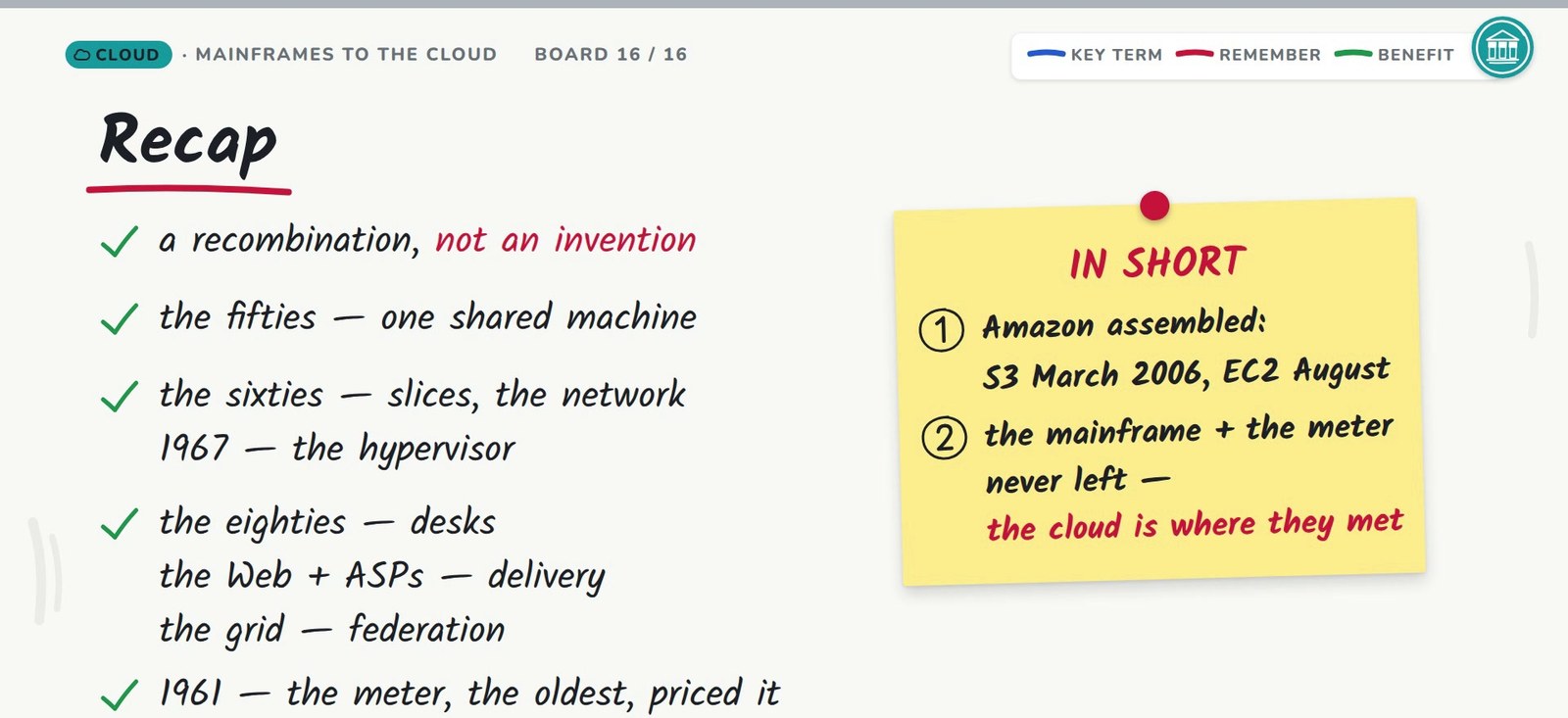
The whole chain reads quickly once the parts carry their dates. The fifties contributed the single shared machine; the sixties, time-sharing slices and the network dream; 1967, the hypervisor; the eighties, desks everywhere; the Web and the ASPs, delivery; the grid, federation across organizations; and 1961’s meter set the price. Amazon’s contribution was the assembly itself, S3 in March 2006 and EC2 that August. Two pieces never exited the story, the mainframe and the meter, and the cloud is the place where they ended up together.
Continue learning
- What Cloud Computing Actually Is: The Honest First Lesson: lesson one of the series, with the NIST definition and its arithmetic.
- You Already Use the Cloud Every Day (Without Noticing): lesson two, on the cloud services already in an ordinary day.
- A Short History of DevOps: The Checked Timeline: the DevOps series’ history episode, in the same checked format.