If you learn best from a book in your hands, this is the short shelf of AI agents books worth the shelf space in 2026. Seven titles, chosen because they are the ones the courses, the papers, and the engineering essays on this site keep referring back to, not because they crowd the top of an Amazon search. Two are free, the rest are paid, and together they walk you from the deep learning foundations up to shipping a real agent in production. Read them in roughly the order they are listed here and you will not waste a month on the wrong one.
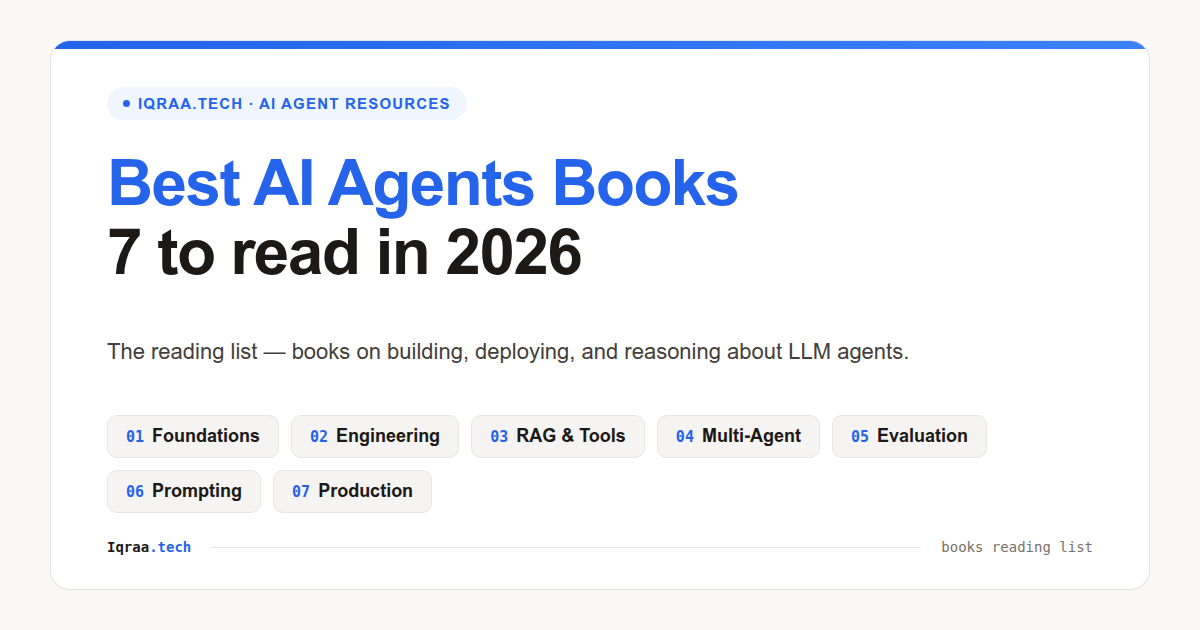
The list is grouped by what each book is for, starting with the foundations and moving up to the applied agent books. It is the companion to the 12-post Learn AI Agents series on this site: where the series teaches the how in short lessons, these seven AI agents books are the longer, denser reference you reach for when a lesson is not enough. Three of them are pure agent work; the other four are the prerequisite reading on deep learning, language model internals, and production ML that an agent book will assume you already know.
The foundations: books that teach what an agent is built on
Before you build an agent that reasons and calls tools, you need to understand the model it sits on top of and the training pipeline that produced it. These three books cover that substrate. They are the AI agents books you read first if the math or the engineering under the hood still feels fuzzy, and they pair naturally with the deep learning and language model courses in the main series.
- Understanding Deep Learning (free, online textbook; print edition paid). The reference textbook that walks the full arc from linear models to diffusion and transformers in clear, illustrated chapters, with the whole text free on the author’s site. It is the right starting point if you want the vocabulary of modern deep learning laid out once, properly, before you touch anything agent-specific. Read Understanding Deep Learning online.
- Building an LLM from Scratch (paid, Manning). A code-first book that builds a small but complete GPT-style model from raw tokens up to a model that generates text, chapter by chapter in Python. It is the single best way to stop treating a language model as a black box, because you watch every weight, every attention head, and every training loop get wired in by hand. Find Building an LLM from Scratch on Manning.
- The LLM Engineer’s Handbook by Paul Iusztin and Maxime Labonne (paid, Packt; hosted on O’Reilly). An end-to-end reference for the production stack around a language model: data pipelines, fine-tuning, evaluation, serving, and MLOps. It earns its place on this list because agents live or die on that surrounding engineering, and this is the book that maps the whole terrain instead of hand-waving the deployment half. Read The LLM Engineer’s Handbook on O’Reilly.
The applied AI agents books: building, engineering, and production agents
Once the foundations are in place, the next four books are where the agent work actually happens. They cover the spectrum from a first agent you build in a weekend to the full engineering discipline of shipping one at scale. These are the AI agents books that turn the theory from the papers and the courses into code you can run, evaluate, and put behind an API. Read them in roughly this order, since each one assumes a little more of the previous.
- Building Applications with AI Agents by Michael Albada (paid, O’Reilly). A grounded, architecture-first walkthrough of what an agent application actually is, covering the components, the orchestration patterns, and the trade-offs between single-agent and multi-agent designs. It is the book to read once you understand one framework and want to see the design space above it, written for engineers who care about how the pieces compose rather than which vendor to pick. Find Building Applications with AI Agents on O’Reilly.
- AI Agents: The Definitive Guide by Nicole Koenigstein (paid, O’Reilly). A practical reference covering agent architecture, the tooling layer, and deployment patterns, aimed at practitioners who want one book that names the moving parts instead of a dozen blog posts. It sits well next to Building Applications with AI Agents, where that one zooms out on design, this one zooms in on the building blocks and how to wire them into a shipping system. Find AI Agents: The Definitive Guide on O’Reilly.
- AI Agents with MCP by Kyle Stratis (paid, O’Reilly). The first book-length treatment of the Model Context Protocol, the emerging standard for how an agent connects to tools, data sources, and other agents through a shared interface. It is worth a slot on the shelf precisely because MCP is the part of the stack moving fastest in 2026, and a book that walks the protocol, the servers, and the client patterns in one place saves you stitching it together from changelogs. Find AI Agents with MCP on O’Reilly.
- AI Engineering by Chip Huyen (paid, O’Reilly). The production-engineering counterpart to the agent books above, covering the full lifecycle from data and training through evaluation, deployment, monitoring, and the failure modes that only show up at scale. Read it last, once you have built a working agent, because it is the book that turns a demo into a system you would actually run in production, with the eval and observability rigor the agent books can only gesture at. Read AI Engineering on O’Reilly.
If you only buy two of these AI agents books, start with Building an LLM from Scratch if you need the model internals, and AI Agents: The Definitive Guide by Nicole Koenigstein if you already have the foundations and want the agent stack named in one place. Understanding Deep Learning is free, so read it alongside either as the prerequisite. From there, AI Engineering by Chip Huyen is the one to add when you are close to shipping, and AI Agents with MCP by Kyle Stratis is the one to pick up the moment you start wiring tools into your agent.
Keep going with the rest of the Iqraa AI Agents series.
- The Hugging Face AI Agents Course is the hands-on companion to the theory in these books, implementing the same agent loop in smolagents, LangGraph, and LlamaIndex with a benchmarked certificate at the end.
- Andrew Ng’s Agentic AI Design Patterns on DeepLearning.AI names the four design patterns, Reflection, Tool Use, Planning, and Multi-Agent, in raw Python, so you can see the abstractions from the agent books implemented in code.
- The AI Agents Papers roundup is the sibling to this list: where these books teach the long form, that roundup points at the six research papers the field is actually built on.