Agentic AI Design Patterns is the nine hour fifty five minute paid course by Andrew Ng on DeepLearning.AI. It teaches the four core design patterns behind every production agent system, Reflection, Tool Use, Planning, and Multi Agent, in raw Python without hiding details in a framework. The course launched October 7, 2025 and is the only paid course in this Iqraa AI Agents series.
Agentic AI Design Patterns: What You’ll Learn
Andrew Ng’s thesis across the course is that the single biggest predictor of whether a team executes well on agents is disciplined process for evaluations and error analysis. The course walks the four patterns and the eval discipline together, because in production they cannot be separated. The course is vendor neutral. The code samples are raw Python against the Claude API, OpenAI API, or any OpenAI compatible provider. No LangChain, no LangGraph, no AutoGen, no smolagents.
This is the only paid course in the Iqraa AI Agents series. DeepLearning.AI PRO membership is required. A free trial is sometimes available. The course is not on Coursera as of mid 2026.
Agentic AI Design Patterns: The Four Design Patterns
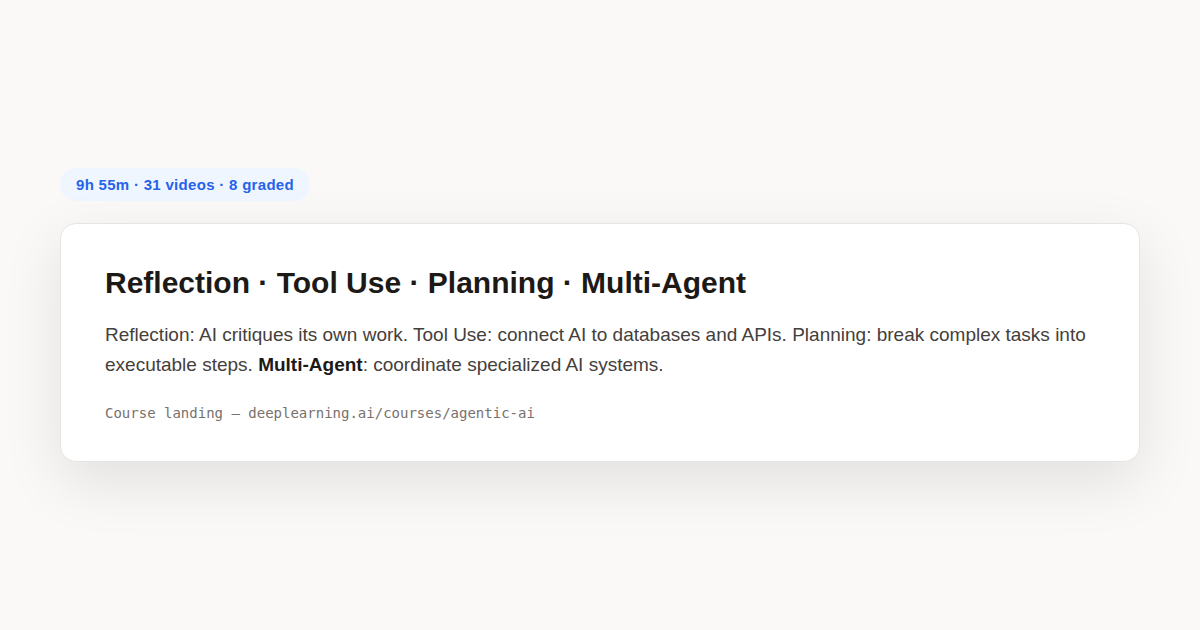
The course organizes everything around four named patterns. Every other pattern in the agent literature is, per Ng, a variation or combination of these four.
Reflection is when an AI critiques its own work and iterates to improve quality. The course teaches it as automated code review. The generation step produces output. The reflection step takes the same model or a different model and critiques the output against criteria. The output is revised based on the critique. The pattern pays off on tasks where errors are detectable but expensive to find manually.
Tool Use is when AI is connected to databases, APIs, and external services so it can perform actions, not just generate text. The course walks tool declaration, tool selection by the model, tool execution by the agent runtime, and result folding into the next model call. This is the function calling pattern covered in earlier courses on this site, taught here without the framework wrapper.
Planning is when the agent breaks a complex task into executable steps it can follow and adapt when things go wrong. The course teaches planning with text, planning with code execution, and the failure modes of each. Ng is candid that planning is the least reliable of the four patterns in production.
Multi Agent is when multiple specialized AI systems handle different parts of a complex workflow. The course covers communication patterns for multi agent systems, including handoff, debate, and hierarchical decomposition. The capstone in Module 5 is a multi agent market research team.
The Course Structure
Nine hours fifty five minutes total. Thirty one video lessons. Seven code example labs, ungraded. Eight graded assignments, which decompose as five module quizzes plus three graded code labs. Self paced.
Module 1, Introduction to Agentic Workflows. Eight videos including what is agentic AI, degrees of autonomy, benefits, applications, task decomposition, evaluating agentic AI, agentic design patterns. Plus the first code example, a research agent.
Module 2, Reflection Design Pattern. Why reflection works. Chart generation walkthrough. Evaluating the impact of reflection. Using external feedback. The graded lab is a reflection implementation.
Module 3, Tool Use. Creating tools. Tool syntax. Email assistant workflow. Code execution. MCP as a tool pattern. The graded lab builds a tool use agent.
Module 4, Practical Tips for Building Agentic AI. Evaluations. Error analysis and prioritization. Component level evaluations. How to address problems you identify. Latency, cost optimization. Module 4 has no graded code lab, only a quiz.
Module 5, Patterns for Highly Autonomous Agents. Planning workflows. Creating and executing LLM plans. Planning with code execution. Multi agentic workflows. Communication patterns for multi agent systems. The graded assignment is an agentic workflows project.
The Deep Research Agent Capstone
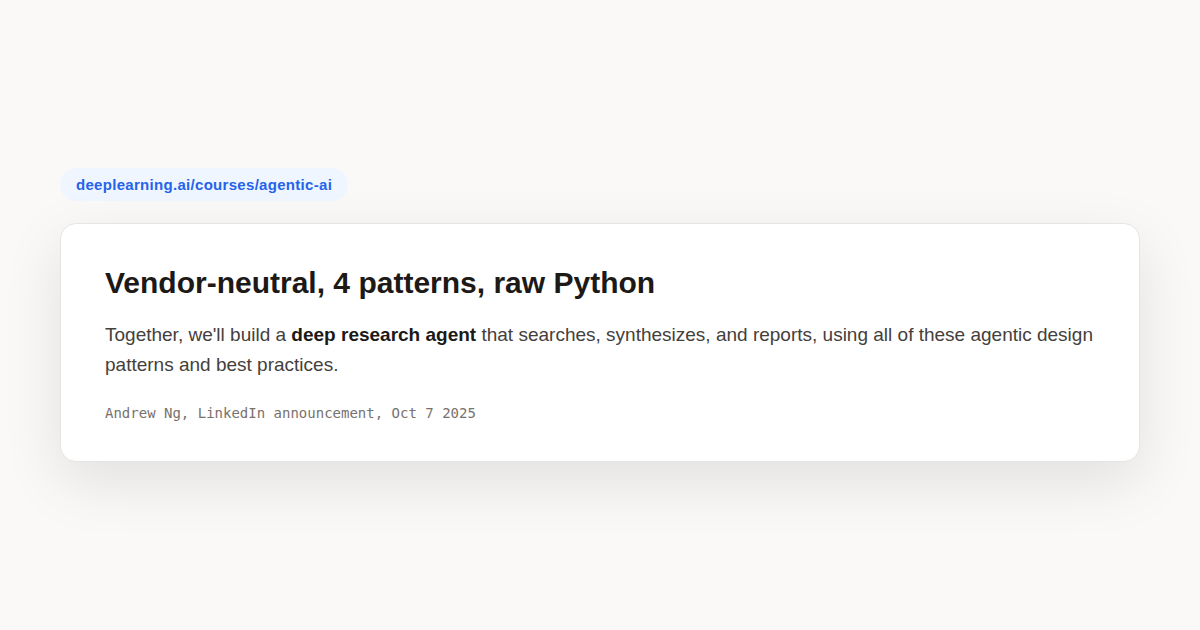
Across the five modules you build incrementally toward a single capstone artifact, a deep research agent that searches, synthesizes, and reports. Andrew Ng’s words from the launch announcement, together we will build a deep research agent that searches, synthesizes, and reports, using all of these agentic design patterns and best practices.
The companion GitHub repo at https-deeplearning-ai/agentic-ai-public ships a Reflective Research Agent built on FastAPI plus Postgres. It has a planner, a research writer, and an editor in a multi agent pipeline hitting Tavily for web search, arXiv for papers, and Wikipedia for background. The repo has six hundred stars as of mid 2026 and is actively maintained.
Prerequisites and Cost
Andrew Ng states the only prerequisite is familiarity with Python, though knowing a bit about LLMs helps too. The level is intermediate. In practice, you should be comfortable reading Python class definitions, working with async patterns, and calling REST APIs.
The course is paid. DeepLearning.AI PRO membership is required for full access including the graded assignments and the certificate. A free trial is sometimes available. As of mid 2026 there is no financial aid option for this specific course, unlike Coursera specializations which have audit and aid tiers.
Beyond the membership, you need an LLM API key. The official repo uses Tavily, arXiv, and Wikipedia which are free. If you swap in a paid LLM, budget a few dollars for the labs.
Why No Framework
The most distinctive choice in the course is teaching without a framework. Ng is explicit about the reasoning. He wants you to learn the core concepts that you can then implement using any popular agentic AI framework, or using no framework.
This is the opposite of the Hugging Face course which teaches three frameworks comparatively, and the opposite of the Microsoft course which is single framework on Microsoft Agent Framework. Ng’s bet is that the framework free view transfers better across the rapidly changing framework landscape.
The trade off is real. The course code is more verbose than the equivalent smolagents or LangGraph code. You write more lines. You also understand what each line does, because there is no abstraction hiding it. If you have done the Hugging Face or Microsoft course on this site, the Ng course will feel slow at first and then clarifying. If you have not done either, do one of them first, then come back to Ng for the design pattern theory.
A Worked Example, Reflection in Depth
Module 2 is the densest module because reflection is the pattern most often misunderstood. The naive version of reflection is asking the model to look at its own output and tell you if it is good. That does not work. The model that generated the output is biased toward saying the output is good.
Ng’s version is structured. The reflection step takes the original prompt, the generated output, and an explicit rubric. The model is asked to score the output against the rubric, list specific defects, and propose specific revisions. The revised output goes through the same reflection again. After a fixed number of iterations or a satisfactory score, the loop exits.
The module’s worked example is chart generation. The agent writes code to generate a chart from data. The reflection step checks the code for correctness, the chart for readability, and the underlying data for misleading visualization. The revised chart is on average measurably better than the first draft.
The point of the example is that reflection works when the rubric is explicit. Without an explicit rubric, reflection is the model flattering itself. With an explicit rubric, reflection is a real quality gate. This is the kind of pattern that looks like prompt engineering on the surface and is actually evaluation engineering underneath.
Agentic AI Design Patterns: Common Mistakes to Avoid
- Expecting the course to teach a framework. It does not. If you need LangGraph or smolagents recipes, do those courses on this site. Ng’s course is framework free on purpose.
- Skipping Module 4 because it has no code lab. Module 4 is the eval and error analysis module. It is the module most teams in production need most. Skipping it because it has no graded code lab is the wrong call.
- Treating the deep research agent capstone as a portfolio piece. The capstone is a teaching artifact. The companion GitHub repo is more polished than what you produce in the labs. Use the capstone for the patterns it teaches, not as a resume item.
- Confusing this course with the older DeepLearning.AI short courses. DeepLearning.AI has multiple shorter courses on agents, including AI Agents in LangGraph with Harrison Chase and AI Agentic Design Patterns with AutoGen. Those are older, shorter, free, and different. Ng’s course is the new flagship.
Agentic AI Design Patterns: Best Practices
- Do the course in order. Modules build on each other. Skipping ahead to Module 5 multi agent without Modules 1 through 4 leaves gaps.
- Pair the course with the official GitHub repo at
https-deeplearning-ai/agentic-ai-public. The repo is the polished version of what the labs teach. - Apply each pattern immediately to your own project after the relevant module. The patterns only stick when you use them.
- Use the course as a vocabulary anchor. When someone on your team says reflection, point them at Module 2 of Ng’s course to settle what the word means.
- Pair with the framework courses in this series for the framework specific recipes Ng does not cover.
Agentic AI Design Patterns: Frequently Asked Questions
Is the Andrew Ng Agentic AI course free?
No. It requires a DeepLearning.AI PRO membership. A free trial is sometimes available. Unlike DeepLearning.AI short courses which are free with login, this is a full graded course.
Does the course issue a certificate?
Yes. With PRO membership you earn a DeepLearning.AI certificate on completion. The certificate is vendor issued, real, and verifiable.
Is the course on Coursera?
Not as of mid 2026. DeepLearning.AI keeps Andrew Ng’s newer courses exclusive to their own platform.
What framework does the course teach?
None. The course is deliberately vendor neutral and uses raw Python against LLM APIs. Andrew Ng’s stated goal is teaching concepts that transfer across frameworks.
How does this course compare to the Hugging Face AI Agents Course on this site?
The Hugging Face course is framework comparative, free, and benchmark graded. Ng’s course is framework free, paid, and design pattern focused. They are complementary. Do Hugging Face for framework practice, do Ng for design pattern theory.
How long does the course take?
Nine hours fifty five minutes of video, plus roughly twenty hours of lab work, plus the capstone. Realistic total is thirty to forty hours of focused work.
Agentic AI Design Patterns is the design pattern theory course. Pair it with the framework courses on this site for hands on practice and with the Berkeley MOOC for the research frontier view.