AI jargon is scattered across papers, release notes, and vendor docs, and each source assumes you already know the other half of the vocabulary. This AI glossary gathers the language of modern LLM work into sixteen short lessons: every term gets a one or two sentence definition, the terms people mix up are paired and separated, and anything that deserves a full walkthrough links to the deeper tutorial on this site. Read the track front to back as a course, or land on the one lesson that names the thing you are stuck on.
How the AI glossary track is organized
The sixteen lessons follow the stack itself. Four on foundations: what a model is, what architecture it uses, what it reads, and what a serious training run looks like. Three on the conversation layer where prompts, embeddings, and retrieval live. Two on agents and serving, then three on steering and measuring models after pretraining. The final four cover safety, reasoning, multimodality, and operations. Each lesson defines ten to twenty terms, flags the confusions worth knowing about, and closes with a short further reading list.
Foundations: models, tokens, and training
The vocabulary you need before anything else makes sense.
- Lesson 01: Models and Training Basics. The bedrock terms: supervised and self-supervised learning, loss functions, gradient descent, backpropagation, overfitting, and regularization, then the large model words such as pretraining, foundation model, and scaling laws, closing with double descent and the two kinds of uncertainty.
- Lesson 02: Neural Architectures, Beyond Transformers. Anatomy words for networks, from activation functions and residual connections through convolution and recurrence, then the attention core of query key value, self-attention, positional encoding, KV cache, and mixture of experts, with a look at the challengers: state space models, RWKV, and diffusion language models.
- Lesson 03: Tokens, Data and Context. How a model reads: tokenization, subword and byte-level schemes, vocabulary size, special tokens, and chat templates, followed by the data pipeline terms of corpus, web-scale data, filtering, deduplication, synthetic data, and data mixtures.
- Lesson 04: Training at Scale and Optimization. The vocabulary of cluster-sized runs: optimizers such as AdamW, learning rate schedules, gradient clipping and accumulation, mixed precision, the three parallelism flavors, ZeRO and FSDP, loss spikes, and checkpointing.
The conversation layer: prompting, embeddings, retrieval
What you say to a model, and how you feed it knowledge it never memorized.
- Lesson 05: Prompting and In-Context Learning. The request-side terms: zero-shot and few-shot, chain-of-thought, self-consistency, ReAct, structured output, prompt chaining, role prompting, context engineering, and prompt compression.
- Lesson 06: Embeddings and Vector Search. The geometry half of retrieval: embeddings, contrastive learning, hard negatives, similarity metrics, vector databases, ANN search and HNSW, then rerankers, cross-encoders, sparse retrieval, and hybrid search.
- Lesson 07: RAG and Grounding. The retrieval-augmented generation stack: grounding and citation, ingestion pipelines, chunking, top-k retrieval, lost in the middle, query rewriting, contextual and parent-document retrieval, multi-hop and agentic RAG, and how RAG systems get evaluated.
Agents and serving
Models that act, and what it takes to answer a request at all.
- Lesson 08: Agents, Tools and MCP. The words around models that act: planning, tool use, reflection, agent memory and context management, trajectories, orchestration and handoffs, the protocol layer of MCP and A2A, computer use, sandboxing, and human-in-the-loop.
- Lesson 09: Inference, Decoding and Serving. What happens at request time: temperature, top-p, greedy decoding and repetition penalties, prefill versus decode, continuous batching, prompt caching, speculative decoding, quantization, streaming, and cost per token.
Steering and measuring
How a base model becomes a product, and how anyone proves it works.
- Lesson 10: Fine-Tuning and Adaptation. The adaptation family: transfer learning, supervised and instruction tuning, domain adaptation, the parameter-efficient set of PEFT, LoRA, and adapters, soft prompts, layer freezing, and the defense against catastrophic forgetting.
- Lesson 11: Alignment, RLHF and Reinforcement Learning. Post-training vocabulary: preference data, reward models, reward hacking, the KL penalty, RLHF, PPO, DPO, constitutional AI, and RLVR, all sitting on the reinforcement learning core of policies, reward functions, and exploration versus exploitation.
- Lesson 12: Evaluation and Benchmarks. The measurement words: evals, benchmarks, and held-out sets, golden datasets, MMLU and GSM8K, Chatbot Arena, LLM-as-a-judge, pass@k, BLEU and ROUGE, data contamination, and Goodhart’s law.
Safety, reasoning, and the edges of the map
The vocabulary of trust, the newest reasoning terms, and everything past text.
- Lesson 13: Safety, Security and Interpretability. The trust terms: safety versus security, red teaming, guardrails, prompt injection and jailbreaking, data poisoning, adversarial examples, PII, differential privacy, watermarking, and model cards, then the interpretability words of sparse autoencoders and circuits.
- Lesson 14: Reasoning and Test-Time Compute. The newest coinage in the field: long chain-of-thought, budget forcing, overthinking, inference-time scaling laws, STaR, cold-start data, reasoning distillation, self-correction, verifier-guided search, and whether a chain of thought is faithful at all.
- Lesson 15: Multimodal, Speech and Multilingual AI. Beyond text: multimodal models, vision-language models, vision transformers, patch embeddings, projectors, and diffusion models, the speech terms of speech-to-text, text-to-speech, and word error rate, plus the multilingual words diglossia, diacritization, and cross-lingual transfer.
- Lesson 16: Infrastructure, MLOps and LLMOps. The production vocabulary: accelerators, FLOPs and MFU, interconnects, experiment tracking, model registries, data and concept drift, canary and shadow deployments, observability, semantic caching, and model routing.
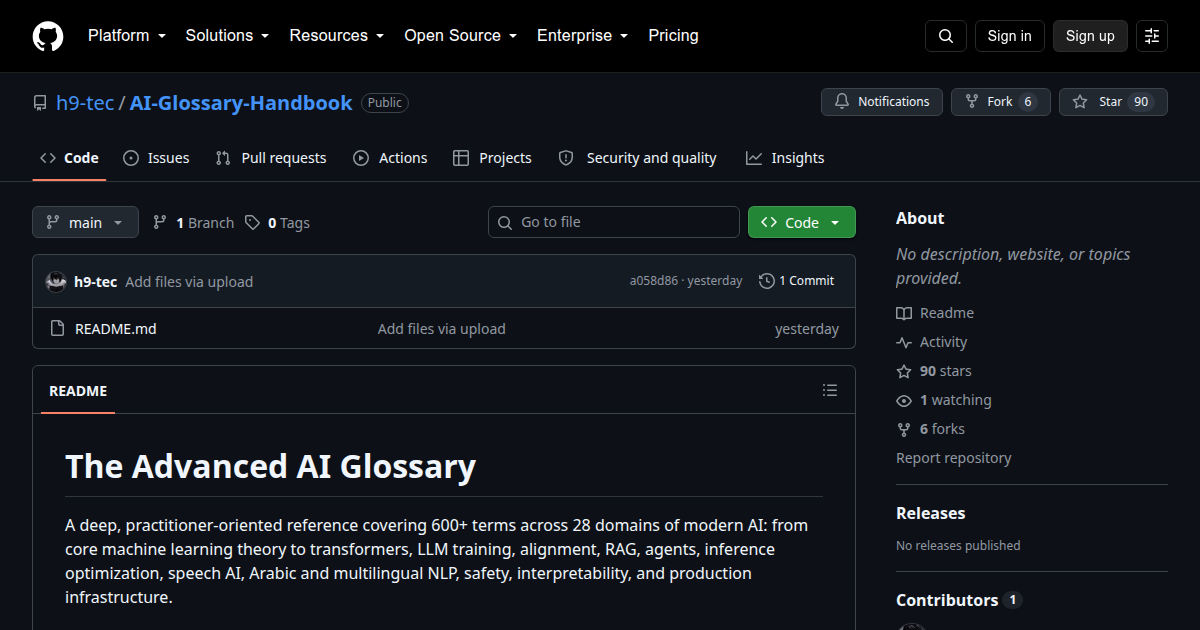
Before publishing, we checked each lesson’s term list against the open AI Glossary Handbook on GitHub, a community reference whose README now describes its terms as MIT licensed, as a sanity check that nothing important was missing.
Where to start: if you are new, lessons 01, 02, and 05 will carry most conversations. Building on an API today, take 05, 07, 08, and 09 in one sitting. Preparing for interviews, 04, 11, and 12 hold the training and evaluation questions that come up. Running models for a team, keep 09 and 16 open in a permanent tab.
Continue learning:
- Start the glossary at lesson 01
- LLM Concepts: A Deep Dive, the long-form companion to lessons 01 and 02
- Browse all AI and ML Concepts content