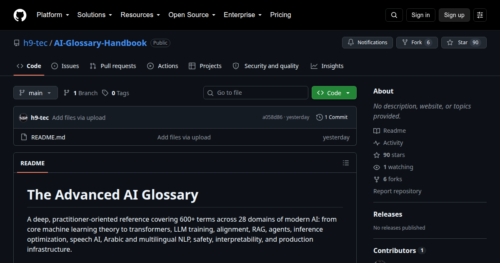
LLM Course by Maxime Labonne is the curriculum most people who actually want to understand large language models end up at, not because it’s the flashiest, but because it’s structured as three real layers (fundamentals, scientist, engineer) with runnable Colab notebooks at every step. 80,000 stars from people who’d rather read code than marketing. View… Continue reading
Posts Tagged → llm
How ChatGPT Works: KV-Cache, GPU Cluster, and the Router
A look at how ChatGPT works. ChatGPT served 100 million weekly active users within two months of launch, the fastest consumer-software adoption in history. The architecture that scaled to that size wasn’t new technology; it was the careful application of patterns every ML inference system has used for years, plus one trick: the per-session KV-cache… Continue reading
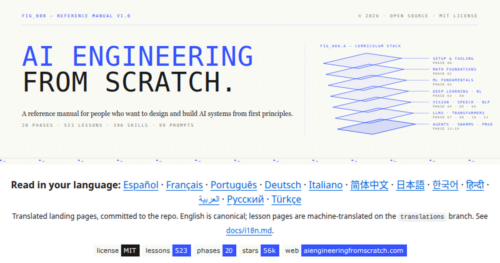
AI Engineering from Scratch: the Free 20-Stage Path
TL;DR 30 sec6 min coredeep dive optional AI Engineering from Scratch is a free MIT-licensed curriculum that walks you from linear algebra to shipped agent systems in 523 lessons across 20 phases, and every lesson leaves you a runnable artifact. 523 lessons, 20 phases, roughly 342 hours of work, in Python, TypeScript, Rust, and Julia…. Continue reading
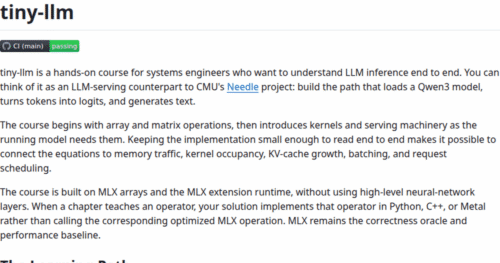
Tiny-LLM: Build a Mini vLLM on Apple Silicon
TL;DR 30 sec7 min coredeep dive optional Tiny-LLM is a hands-on course where you build an LLM serving engine from raw array operations on Apple Silicon: KV cache, continuous batching, and paged attention, ending with a coding agent running on the engine you wrote. Four weeks: Qwen3 from matrix multiplies, a faster single request, a… Continue reading
Zero to SGLang: the Official Inference Course
TL;DR 30 sec7 min coredeep dive optional Zero to SGLang is the official SGLang course, built with the Datawhale community, that takes you from running your first inference server to building a mini SGLang engine and then into the real one’s advanced internals. Part 0 gets a Qwen3-0.6B server running on your GPU in the… Continue reading
LLM Zoomcamp: the Free 10-Week LLM Course
TL;DR 30 sec7 min coredeep dive optional LLM Zoomcamp is DataTalksClub’s free 10-week course on building production-ready LLM applications, running from agentic RAG and vector search through evaluation, monitoring, and a capstone, with no GPU and no ML background required. Seven modules plus a data-ingestion workshop and a capstone, taught through pre-recorded video and graded… Continue reading
Ed Donner’s Free LLM Engineering and Agentic AI Courses
TL;DR 30 sec7 min coredeep dive optional Ed Donner’s two free course repositories cover the applied LLM stack end to end: an 8-week LLM engineering course that starts on your own machine with Ollama, and a 6-week agentic engineering course refreshed in 2026 around the OpenAI Agents SDK, CrewAI, LangGraph, Google ADK, Pydantic AI, and… Continue reading
Mooncake Explained: KV-Cache-Centric LLM Serving
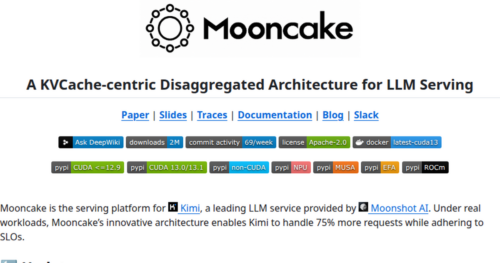
TL;DR 30 sec6 min coredeep dive optional Mooncake is Moonshot AI’s open-source serving architecture that treats the KV cache as the center of the system: prefill and decode run on separate clusters, and a disaggregated cache pool built from spare CPU, DRAM, and SSD moves context at RDMA speed. Best Paper at FAST 2025, and… Continue reading
Train an LLM from Scratch: the Full Tutorial Repo
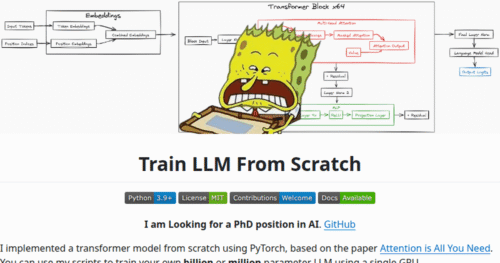
TL;DR 30 sec6 min coredeep dive optional Train an LLM from Scratch is a free MIT repository that walks the entire training pipeline in seven steps, from downloading data and building a transformer piece by piece to aligning the result with DPO and chatting with it, and a free Colab GPU is enough to finish… Continue reading
GPT-6.1 Sol: Developer Guide to Pricing and Benchmarks
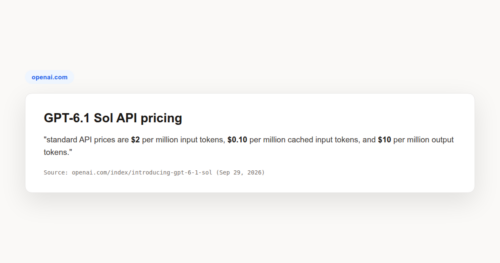
TL;DR 30 sec9 min coredeep dive optional GPT-6.1 Sol is OpenAI’s September 29 upgrade to GPT-6 Sol: near-Astra results for agent coding, desktop automation, and document work while charging a fifth of Astra’s standard rates, served as gpt-6.1-sol in the API with cached input at a dime per million tokens. GPT-6.1 Sol pricing is $2… Continue reading
Machine Learning: The Honest First Lesson
TL;DR 30 sec6 min coredeep dive optional Machine learning lets software work out its own rules from examples instead of following instructions a programmer typed, and every model in the field trains through one repeating cycle of prediction, penalty, and update. Samuel’s checkers program was already learning at IBM in 1949; a paper he published… Continue reading
01 - Introduction to AI & Large Language Models
Large language models have transformed how we interact with technology, enabling machines to understand and generate human-like text with remarkable fluency. These powerful AI systems underpin tools like ChatGPT and are reshaping education, business, and creative work. In this lesson, you will learn what large language models are, how they work, and how to use… Continue reading
The AI Glossary: LLM and Agent Terms, Explained
AI jargon is scattered across papers, release notes, and vendor docs, and each source assumes you already know the other half of the vocabulary. This AI glossary gathers the language of modern LLM work into sixteen short lessons: every term gets a one or two sentence definition, the terms people mix up are paired and… Continue reading
Claude Fable 5.1: What Changes for Developers
Fable 5.1 is Anthropic’s successor to Fable 5, aimed at agents that run for hours: code fixes, research passes, long knowledge work. It shipped on September 1, 2026 with the same $10 and $50 per million token list prices and one big change underneath: cache reads cost $0.25 instead of $1. This guide covers the… Continue reading
AI Glossary 01 - Model Training Terms and Basics
You open any explainer on this site, whether it is LLM Concepts: A Deep Dive or Machine Learning System Design 101, and within two paragraphs the vocabulary starts stacking up: loss, gradient, pretraining, scaling laws. This first glossary lesson pins down those model training terms, one or two plain sentences each, so the rest of… Continue reading
AI Glossary 02 - Neural Architectures and Transformer Terms
Every explainer on this site, starting with LLM Concepts: A Deep Dive, leans on architecture vocabulary: attention, heads, KV cache, mixture of experts. This second glossary lesson collects the transformer terms behind those phrases, the older neural network words they grew out of, and the newer designs competing for the job. Each entry gets a… Continue reading
AI Glossary 03 - Tokenization Terms and Data Context
Usage meters, rate limits, and pricing tables on this site, starting with LLM Concepts: A Deep Dive, all count tokens, never words. This third glossary lesson collects the tokenization terms behind that count: how raw text becomes the units a model consumes, which hidden tokens ride along in every request, and the vocabulary for the… Continue reading
AI Glossary 04 - LLM Training Terms at Scale
When a lab reports a training run that occupied thousands of GPUs for months, a whole vocabulary hides inside that sentence. How ChatGPT Works walks through the infrastructure on this site; this fourth glossary lesson supplies the LLM training terms such writeups assume: the optimizer’s controls, the memory tricks, the ways one model gets sliced… Continue reading
AI Glossary 05 - Prompting Terms and In-Context Learning
The shortest path from a raw model to a useful answer runs through the request you send it, and an entire craft has grown around that seam. This fifth glossary lesson collects the prompting terms: the anatomy of a request, the reasoning patterns that raise answer quality, and the newer vocabulary for managing the whole… Continue reading
AI Glossary 06 - Embedding Terms and Vector Search
Ask a search system for pages about “hiring policy” and it needs some way to match that phrase against documents that never use those words. Embeddings are that bridge, and this sixth glossary lesson collects the embedding terms around them: what the vectors are, how search runs over them, and the reranking vocabulary wrapped around… Continue reading