A look at how Apple AirTags work. Apple AirTags find lost keys across a continent using a mesh of one billion Apple devices, none of which belong to the AirTag’s owner. The architecture is the most elegant crowd-sourced sensing system ever shipped at consumer scale, and the cryptographic trick that makes it privacy-preserving is what convinced users to opt in.
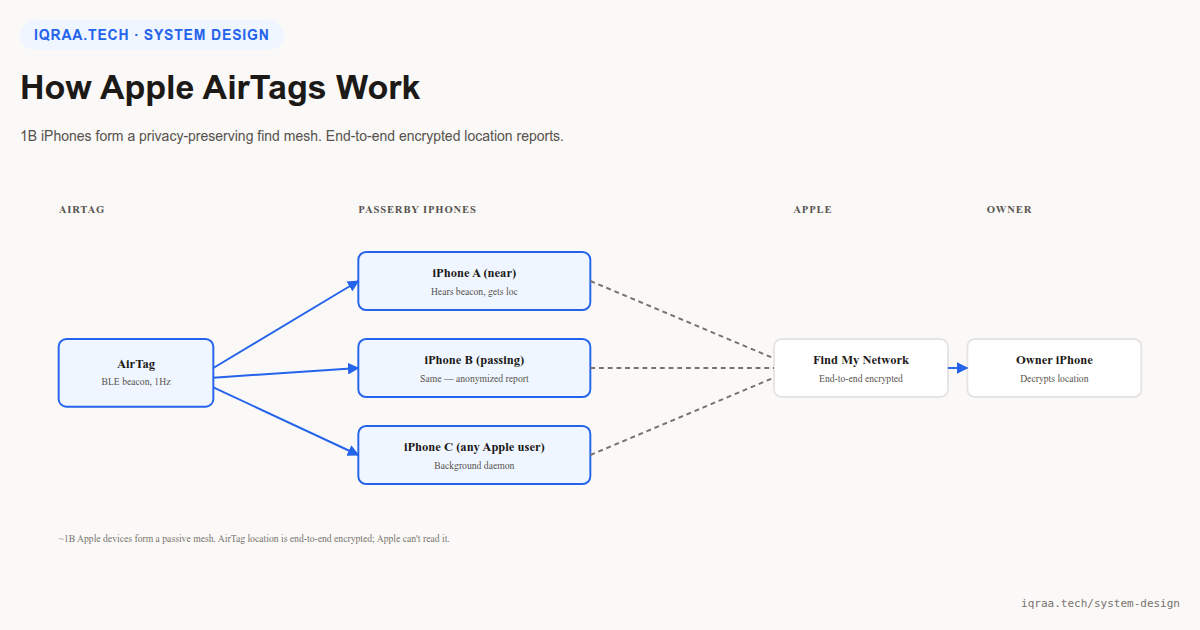
How Apple AirTags Work: The problem at scale
An AirTag is a tiny BLE (Bluetooth Low Energy) beacon. Its radio range is maybe 30 feet. To find one across a city or a continent, you need either a GPS receiver in the tag (battery-killing, expensive) or a global mesh of receivers willing to listen for it. Apple’s solution is the latter: every iPhone running iOS 13+ silently listens for AirTags (and any Find My-enabled device) in the background, anonymously reports their location to Apple, and routes the data back to the owner. The system works because there are roughly a billion active iPhones, and any of them walking past a lost AirTag becomes part of the find network.
The core architecture
The AirTag itself broadcasts a rotating BLE beacon roughly once per second. The beacon identifier rotates on a schedule derived from a cryptographic key the AirTag holds. When a passerby iPhone (any Apple user, anywhere) hears the beacon, the iPhone: (1) computes its own current location using GPS + Wi-Fi triangulation, (2) encrypts that location using the AirTag’s public key, (3) sends the encrypted location report to Apple’s Find My Network servers, with no identifier tying the report to the reporting iPhone. The owner’s iPhone polls the Find My Network, downloads all reports encrypted under their key, decrypts them locally, and shows the most recent location in the Find My app.
The cryptographic trick that makes it private
The non-obvious genius: the location reports are end-to-end encrypted between the AirTag and its owner. Apple holds the encrypted blobs but cannot decrypt them: the keys never leave the owner’s devices. The reporting iPhone doesn’t know whose AirTag it just heard (the beacon identifier rotates), and Apple can’t tie a report to either the reporter or the owner. This is what makes the system acceptable to privacy-conscious users: a billion Apple devices form a global location-finding mesh, and no one (including Apple) can use it to track anyone except their own property.
Public-key cryptography is the entire reason this works at scale. Without the end-to-end encryption, the Find My Network would be a privacy nightmare: Apple would hold a database of every iPhone’s location over time, indexed by every device each one passed. The encryption is the trust layer that makes the data sharing acceptable.
Anti-stalking was bolted on later
The original AirTag design had a flaw: anyone could slip an AirTag into someone’s bag and track them. The cryptographic privacy that protected owners also protected stalkers. Apple’s response (starting in 2022) was a separate anti-tracking system: every iPhone periodically scans for AirTags moving with it that aren’t owned by the user. If an unknown AirTag has been in your presence for an extended period, your iPhone alerts you and helps you locate and disable it. Android got a similar scanner app later. This required a separate protocol on top of the Find My mesh. The original privacy-preserving design didn’t anticipate malicious use by owners.
The one non-obvious insight
The Find My Network is the largest deployed crowd-sourced sensing system in the world, and almost no one who participates in it knows they’re participating. Every iPhone owner is silently contributing their device’s location-sensing capability to find other people’s lost stuff, with their own privacy protected by the same crypto that protects the AirTag owner. This is a model for future infrastructure: opt-in-by-default crowd-sourced services where the cryptographic design ensures no party can exploit the data. The same pattern could apply to traffic reporting, air-quality sensing, disaster response: anywhere a billion passive sensors would be more useful than a million active ones.
Apple AirTags work because a billion iPhones form a privacy-preserving location-finding mesh, with end-to-end encryption ensuring Apple itself can’t read the data. The architecture is the most elegant crowd-sourced sensing system in production, and the crypto is the trust layer that makes it acceptable at scale.
Continue learning: