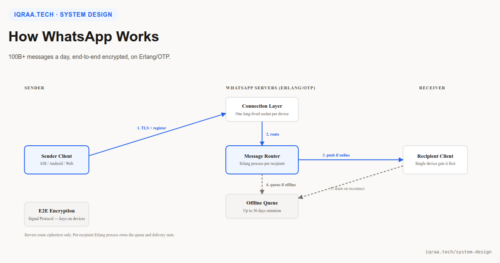
A look at how WhatsApp works. WhatsApp sends roughly 100 billion messages a day for nearly 3 billion users, with end-to-end encryption on by default and a total engineering team that hovered around 50 people during its first billion users. The architecture that pulls this off is one of the cleanest examples of “pick the… Continue reading
Posts Tagged → system-design
How Slack Works: Workspace-Sharded Architecture at Scale
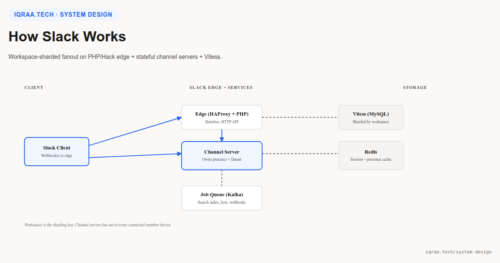
A look at how Slack works. Slack runs tens of millions of concurrent workspaces on a stack that started as a single PHP/Hack service and evolved into one of the cleanest sharded-by-workspace architectures on the internet. The non-obvious bet they made early: treat the workspace as the atomic unit of state. Every connection, every channel,… Continue reading
How YouTube Works: Transcode Once, Serve From Edge
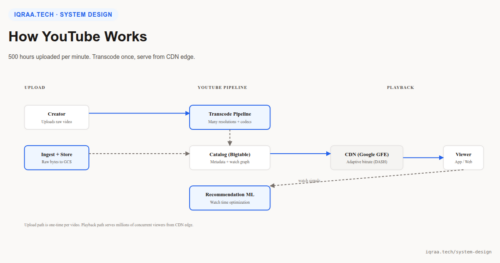
A look at how YouTube works. YouTube streams 500-plus hours of uploaded video every minute, to 2.5 billion monthly viewers, in resolutions from 144p to 8K. The architecture split that makes it possible: a heavy one-time upload pipeline that turns each video into dozens of pre-transcoded variants, and a thin playback path that serves from… Continue reading
How Stripe Works: Idempotent API Over an Append-Only Ledger
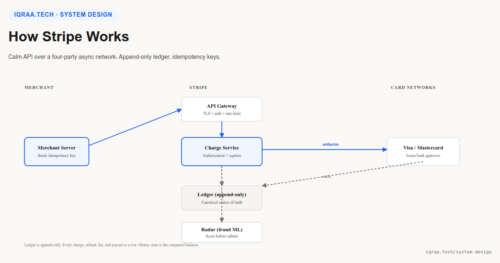
Stripe processes hundreds of billions of dollars in payments per year by being the calmest API in the middle of one of the messiest systems ever built: the four-party card payment network. Understanding how Stripe works is less about moving money and more about keeping a perfectly honest ledger while talking to dozens of slow,… Continue reading
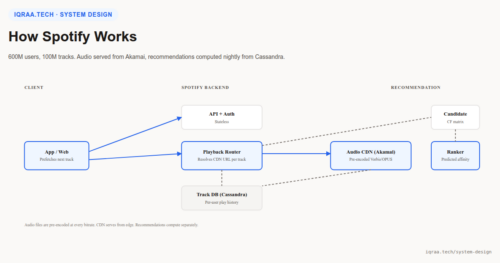
How Spotify Works: Audio CDN Plus Nightly Recommendation
A look at how Spotify works. Spotify streams to roughly 600 million monthly active users across 100 million tracks, and the parts that look hardest (audio delivery at planet scale) are actually the easy part. The hard part, and the architectural bet Spotify made early, is keeping the recommendation surface honest: a per-user play history… Continue reading
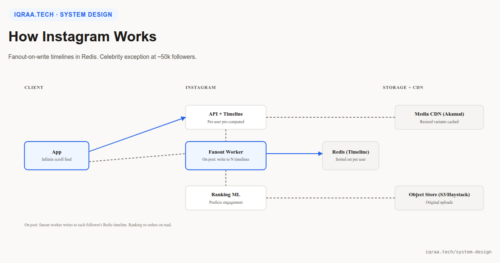
How Instagram Works: Fanout-on-Write With Celebrity Exception
A look at how Instagram works. Instagram serves billions of users a feed that’s the textbook example of the “fanout-on-write” pattern, with a hybrid escape hatch for celebrities. The architecture that’s survived a decade of feature growth is built on one decision: each user gets a pre-materialized timeline in Redis, updated whenever someone they follow… Continue reading
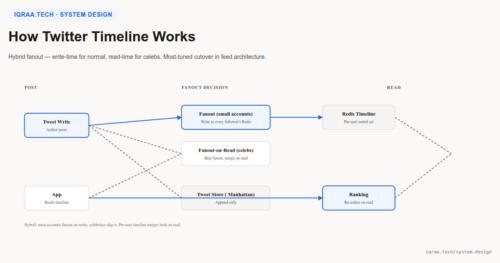
How Twitter Timeline Works: Hybrid Fanout Architecture
A look at how Twitter timeline works. Twitter’s timeline is the architecture every feed product gets compared to, because Twitter’s engineering team published the most honest write-ups of the trade-offs. The headline pattern is hybrid fanout: write-time fanout for normal users, read-time fanout for celebrities, merged on every read. The cutover threshold is the most-tuned… Continue reading
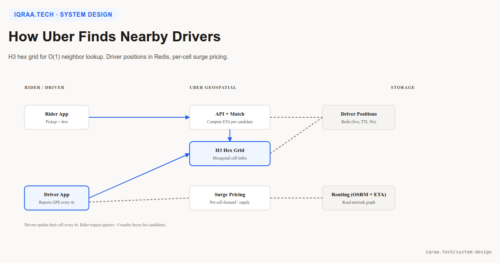
How Uber Finds Nearby Drivers: H3 Hex Grid Architecture
A look at how Uber finds nearby drivers. Uber finding nearby drivers is the textbook real-time geospatial problem: a rider requests a car, and within ~1 second the system has to find the closest available drivers, compute ETA for each, surface them to the rider, and let one accept, across millions of concurrent riders, drivers,… Continue reading
How ChatGPT Works: KV-Cache, GPU Cluster, and the Router
A look at how ChatGPT works. ChatGPT served 100 million weekly active users within two months of launch, the fastest consumer-software adoption in history. The architecture that scaled to that size wasn’t new technology; it was the careful application of patterns every ML inference system has used for years, plus one trick: the per-session KV-cache… Continue reading
How Reddit Works: Python Monolith Plus 90% Varnish Cache
A look at how Reddit works. Reddit is one of the most-visited sites on the internet running on a stack most modern engineers would call heresy: Python monoliths, Postgres, Varnish, and a 90%+ edge-cache hit rate that means most requests never touch an application server at all. The architecture is a love letter to caching… Continue reading
How Airbnb Works: Calendar as a Consistency Boundary
A look at how Airbnb works. Airbnb runs a marketplace of 7 million listings across 220 countries, and the architectural challenge isn’t search or booking. It’s the consistency of the calendar. Two guests trying to book the same listing for overlapping dates must never both succeed. The architecture is built around preventing that race under… Continue reading
How Zoom Works: SFU Beats MCU at Scale
A look at how Zoom works. Zoom handles millions of concurrent video meetings per day with sub-second latency, and the architectural decision that makes it possible is the choice of SFU (Selective Forwarding Unit) over the more familiar MCU or peer-to-peer mesh. That one choice is why Zoom scales to 1,000-person meetings while competitors stall… Continue reading
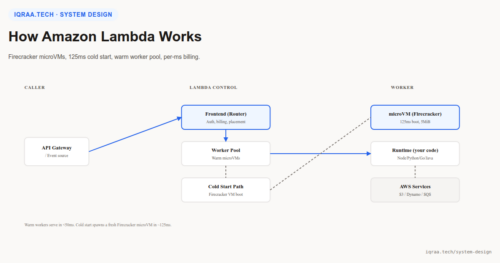
How Amazon Lambda Works: Firecracker MicroVMs at Scale
A look at how Amazon Lambda works. AWS Lambda runs your code on demand without you managing servers, and the architectural feat that makes it economically viable is Firecracker microVMs, a purpose-built VMM that boots a fully-isolated VM in ~125 milliseconds. That single engineering choice is what let AWS offer “pay per 100ms of execution”… Continue reading
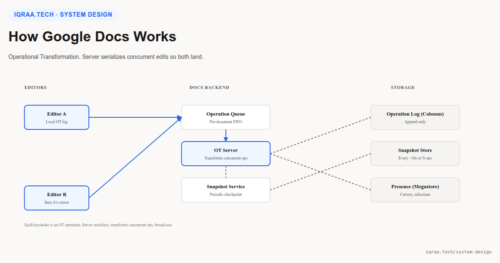
How Google Docs Works: Operational Transformation at Scale
A look at how Google Docs works. Google Docs lets two people edit the same paragraph at the same time without overwriting each other, and the architectural decision that makes that possible is Operational Transformation (OT), a server-side algorithm that takes concurrent edits from multiple users and serializes them into a single consistent document state…. Continue reading
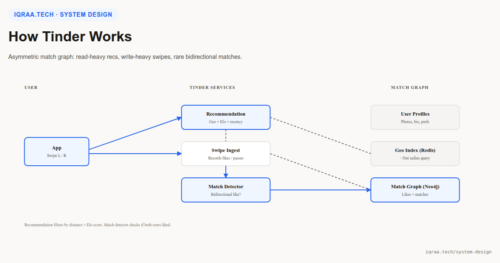
How Tinder Works: Asymmetric Match Graph at Scale
A look at how Tinder works. Tinder does ~1.6 billion swipes per day across 70+ countries, and the architectural problem nobody talks about is the match-graph asymmetry: most right-swipes never produce a match, so the write-heavy path (every swipe is recorded) is decoupled from the read-heavy path (matches are rare bidirectional edges). Tinder’s architecture optimizes… Continue reading
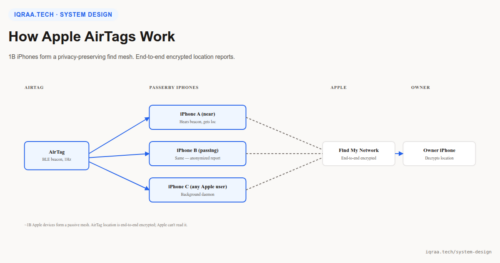
How Apple AirTags Work: Encrypted Crowd-Sourced Finding
A look at how Apple AirTags work. Apple AirTags find lost keys across a continent using a mesh of one billion Apple devices, none of which belong to the AirTag’s owner. The architecture is the most elegant crowd-sourced sensing system ever shipped at consumer scale, and the cryptographic trick that makes it privacy-preserving is what… Continue reading
How Bluesky Works: AT Protocol and Portable Identity
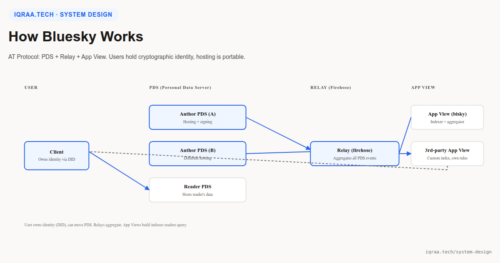
A look at how Bluesky works. Bluesky runs on the AT Protocol, an attempt to do what Twitter never did: separate the social graph from any single company’s hosting. The architecture has three layers (PDS, Relay, App View), and the bet is that users own their identity (via decentralized identifiers) and can move hosting without… Continue reading
How Cloudflare Scaled Postgres: SQL at the Edge
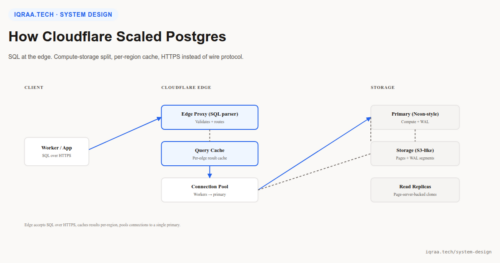
A look at how Cloudflare scaled Postgres. Cloudflare’s serverless Postgres puts a SQL database at the network edge, close to users, queries answered in single-digit milliseconds from anywhere. The architecture borrows from Neon and Turso: separate compute from storage, run compute at the edge, store pages and WAL segments centrally, and use read replicas backed… Continue reading
How Meta Serverless Works: TwSF and Bin ACL at FB Scale
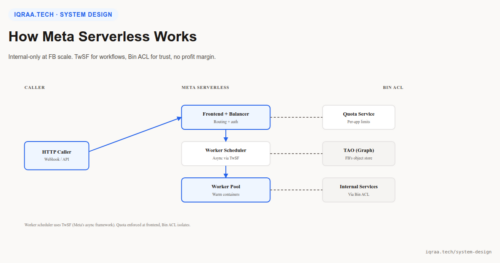
A look at how Meta serverless works. Meta’s serverless platform runs internal webhooks and async jobs for Facebook, Instagram, and WhatsApp at a scale that dwarfs every public serverless offering combined. The architectural choice that makes it work is TwSF (Meta’s internal async workflow framework), purpose-built for the call patterns Lambda was never designed for…. Continue reading