30 sec9 min coredeep dive optional
GPT-6.1 Sol is OpenAI’s September 29 upgrade to GPT-6 Sol: near-Astra results for agent coding, desktop automation, and document work while charging a fifth of Astra’s standard rates, served as gpt-6.1-sol in the API with cached input at a dime per million tokens.
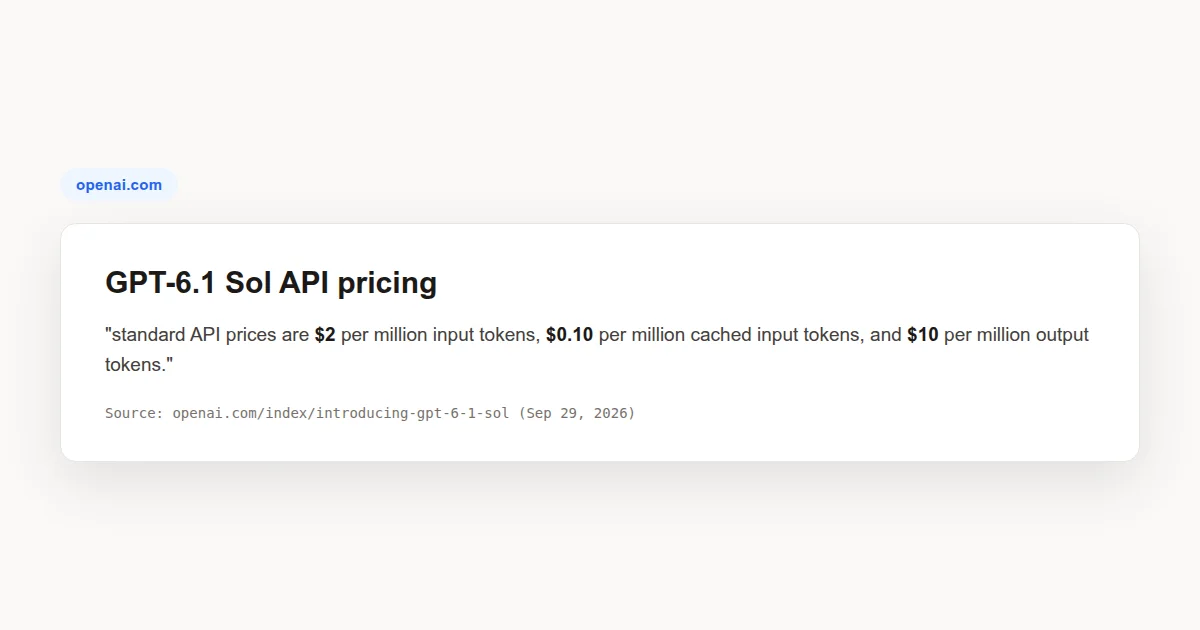
- GPT-6.1 Sol pricing is $2 per million input, $0.10 cached input, $10 output: a fifth of Astra’s standard rates, with cache 50 percent cheaper than GPT-6 Sol’s.
- It matches Astra on DeepSWE at a fifth of the cost and lands within 2.1 points on OSWorld 2.0 at a seventh of the cost per task.
- Factuality errors at low effort fall from 11.4 to 7.7 percent, but Astra keeps the research crown at 68.1 percent on Terminal-Bench Science.
- Find it in ChatGPT Work, Codex, and the API today; an Ultrafast tier with up to 8x faster generation follows within days.
GPT-6.1 Sol is OpenAI’s upgrade to GPT-6 Sol, announced at DevDay on September 29, 2026. It closes most of the gap to GPT-6 Astra for agent coding, desktop automation, and office document work, at a fifth of Astra’s standard token prices. This guide covers what changed, the full benchmark evidence, and how to route real workloads to it.
GPT-6.1 Sol: What You’ll Learn
You will learn where GPT-6.1 Sol sits in the GPT-6 lineup, what it costs per million tokens, and which benchmark results justify switching from GPT-6 Sol. The second half walks through a first API call, a costed migration example, and a routing policy for splitting work between Sol, Luna, and Astra.
Where GPT-6.1 Sol sits in the GPT-6 lineup
OpenAI spent September building a three-tier ladder. GPT-6 Astra arrived on September 3 as the frontier model, and OpenAI still describes it as its best across the board. On September 22 the company added GPT-6 Sol and GPT-6 Luna, built with the same training recipe family as Astra but tuned for cost efficiency. GPT-6.1 Sol, first announced in OpenAI’s launch post at DevDay, upgrades that middle tier in place.
The naming maps straight onto API strings. The model is served as gpt-6.1-sol, so migrating an existing integration is a one-line change. Luna remains the volume tier at $0.10 per million input and $0.50 per million output tokens, while Astra stays the choice for the hardest problems. The Sol and Luna announcement framed the pair as distributing Astra-generation advances to faster, cheaper models, and 6.1 continues that plan.
The pricing has a short lineage worth knowing. When GPT-6 Sol replaced GPT-5.6 Sol in September, OpenAI cut input and output prices by 50 percent, from $4 and $20 per million tokens to $2 and $10. GPT-6.1 Sol holds those standard prices and spends its improvement budget on capability and cache economics instead, so existing cost models stay valid.
Pricing: what a fifth of Astra actually costs
GPT-6.1 Sol keeps the standard prices GPT-6 Sol introduced: $2 in and $10 out per million tokens. The launch claim is that this is one-fifth of GPT-6 Astra’s standard input and output pricing, which implies Astra sits at $10 in and $50 out per million tokens. The new line item is cached input at $0.10 per million tokens.
Reading the cache math
That cached rate is the part agents care about most. It is 95 percent below the standard input price and 50 percent below GPT-6 Sol’s cached rate. OpenAI sums up the intent as “giving developers more room to build and run capable agents that reuse context across requests.” If your agent replays a large system prompt and conversation history on every turn, most of those tokens now bill at a dime per million.
Your first API call with gpt-6.1-sol
The model is live in the OpenAI API today. In ChatGPT, every subscription tier from Plus to Edu gets it inside ChatGPT Work and Codex, but not in Chat. A minimal call looks like this:
curl https://api.openai.com/v1/responses \
  -H "Authorization: Bearer $OPENAI_API_KEY" \
  -H "Content-Type: application/json" \
  -d '{
    "model": "gpt-6.1-sol",
    "input": "Summarize the attached contract renewal clause."
  }'
The same call in Python, with the reasoning effort dial set explicitly:
from openai import OpenAI

client = OpenAI()

resp = client.responses.create(
    model="gpt-6.1-sol",
    input="Draft a migration plan for our billing service.",
    reasoning={"effort": "low"},
)
print(resp.output_text)
Quick budget check: a request with 1 million input tokens and 200,000 output tokens costs $2.00 plus $2.00, or $4.00 total. If 80 percent of that input is a cached replay, the input line drops to $0.48, and the same request bills $2.48. Cache hits are what turn the fifth-of-Astra pricing into an operational difference rather than a rounding error.
Reasoning effort: the dial that decides your bill
OpenAI’s results are reported across tested reasoning settings, from low up to maximum effort. Two patterns stand out. First, GPT-6.1 Sol’s biggest factuality gain over GPT-6 Sol shows up at low effort, so cheap high-volume steps got safer, not just the expensive ones. Second, its DeepSWE score beats GPT-6 Sol’s best at a lower reasoning effort, meaning you spend less to score higher.
A practical default is medium effort for agent loops, low for extraction and classification steps, and maximum only for research-grade tasks. The cost spread between those settings is wide enough that logging effort per task belongs in your observability from day one.
What did September’s AutomationBench numbers show about effort?
The GPT-6 Sol launch showed how wide the spread is. On AutomationBench, GPT-6 Sol at extra-high effort scored 33.2 percent at $0.27 per task, beating Claude Opus 5 at maximum effort, which scored 26.9 percent at 11.1 times the cost. Even low-effort Astra needed 3.9 times Sol’s cost to reach 30.3 percent. Effort is a budget dial first and a quality dial second, and GPT-6.1 Sol inherits that geometry.
Agentic coding: the DeepSWE signal
DeepSWE v1.1 grades agents on multi-step engineering work inside living codebases, problems that take many planned steps to crack rather than single-file fixes. GPT-6.1 Sol ties Astra’s DeepSWE result while spending about a fifth as much, and it clears GPT-6 Sol’s previous best by 6.4 points without needing the older model’s top effort setting.
For a coding agent, that combination is the whole story: frontier-class results at mid-tier pricing. Independent color agrees. Simon Willison ran his informal pelican-drawing benchmark on the new model and found the output “not notably different from the GPT-6 family pelicans”, which fits a capability-per-dollar upgrade rather than a new capability class.
Professional work: PDFs and business workflows
On GDP.pdf, a benchmark that tests whether a model can answer working questions about dense PDFs stuffed with tables, charts, diagrams, and fine print, GPT-6.1 Sol beats the Opus 5.5-plus-fallbacks arrangement while spending under half as much per task. It also lands close to Astra’s state-of-the-art mark for about a fifth of the spend per task. The documents come from ten professional fields, finance and law among them, which is what makes the result relevant to invoice, contract, and claims pipelines rather than to trivia quizzes.
AutomationBench scores agents on end-to-end business workflows driven through a 47-tool suite that spans everything from sales to HR. At medium effort, GPT-6.1 Sol finishes 2.2 points ahead of Opus 5.5 and pays about a third as much, and it sits 4.8 points above where GPT-6 Sol scored with the same setting. One footnote OpenAI discloses: the Fable 5.1 figure leaves out what its Opus fallbacks cost, and those fallbacks fired on roughly 40 percent of the runs.
Computer use: OSWorld 2.0 gains
OSWorld 2.0 grades agents on long desktop workflows. On the v2026.08.08 offline set, GPT-6.1 Sol adds seven points over GPT-6 Sol at maximum effort for under half the spend. Astra stays ahead, but only by 2.1 points, at about seven times the cost per task.
Each task walks through everyday or professional desktop software in a long sequence of application hops, and one missed click ends the run. A seventh of the cost for near-parity rewrites the economics of browser-driving and desktop-automation agents, which burn those action traces on every step.
Research and factuality: where Astra keeps the crown
Terminal-Bench Science 0.1 has agents do research work at a shell: crunching datasets, running simulations, fitting models, and even proving theorems. At maximum effort GPT-6.1 Sol scores better than twice GPT-6 Sol’s mark and pays less than half as much per task: $5.47 on average, while Opus 5.5 averaged $23.21 a task and Astra $23.80.
Even so, no tested model outscores Astra, which leads Terminal-Bench Science at 68.1 percent, and OpenAI still points researchers with the hardest scientific work at it. On factuality, GPT-6.1 Sol’s hard-set story is just as strong: at low effort, the portion of answers with at least one error drops from 11.4 to 7.7 percent, roughly a third fewer mistakes, and lands 1.9 points from Astra while spending under a fifth as much per task.
OpenAI is clear that these sets are deliberately hard, built from flagged and adversarial material, so read them as relative signals between models, not as everyday error rates.
Ultrafast and the speed ladder
Speed tiers are arriving alongside the model. OpenAI says an Ultrafast variant of GPT-6.1 Sol follows within days, generating tokens up to 8x faster than the standard tier inside Codex. Astra already has its own: Amazon Bedrock added GPT-6 Astra UltraFast on September 30, which OpenAI rates at up to 6x the standard inference speed, peaking around 300 tokens a second.
If you operate latency-sensitive agents, benchmark your current p95 response times now, so the Ultrafast swap-in is a measured decision. The AWS announcement is a useful template for what a production Ultrafast deployment expects from you.
Routing between Sol, Luna, and Astra
A simple policy that fits the September pricing ladder: route document work, coding agents, and computer-use tasks to GPT-6.1 Sol at medium effort. Escalate to Astra only when a task fails or is research-grade, since its implied $10 and $50 per million tokens buy the top Terminal-Bench Science score. Send high-volume, latency-tolerant classification and extraction to Luna at $0.10 in and $0.50 out. If you build the agent itself with the OpenAI Agents SDK, the model string is the only part that changes.
Log cost per task the way OpenAI reports it, because that is the unit the benchmarks are actually scored on. An agent that escalates too eagerly spends Astra money on Sol-shaped problems, and nothing in the logs looks wrong until you split spend by tier. The routing table is where you catch it.
Availability and rollout timing
GPT-6.1 Sol is available now across all five subscription tiers, from Plus up to Edu, inside ChatGPT Work and Codex, and through the OpenAI API as gpt-6.1-sol. Chat does not have it yet. The Ultrafast variant follows in the coming days. For API-first teams the rollout is effectively immediate, since the model string is live and priced as listed; for internal-tool teams on Chat plans, the Work and Codex constraint is the thing to check before announcing anything. The DevDay 2026 recap collects the rest of the announcements, more than twenty across ChatGPT, Codex, and the models.
Can I trust these benchmark numbers?
Three caveats come straight from OpenAI’s own disclosures. OpenAI ran its own model evaluations in research settings or through its API, where system prompts, tool access, and effort levels can shift outputs away from what production ChatGPT serves. Numbers for rival models come from public reports rather than OpenAI’s own reruns.
The factuality and safety sets are deliberately difficult: they draw on de-identified chats in which users had flagged a previous model’s mistake, plus adversarial probes designed to elicit boundary violations. They exist to separate models, not to predict your ticket volume. Treat every number here as a relative signal between tiers, then confirm on your own frozen task set before you reroute production traffic.
What changed in safety and alignment behavior?
OpenAI published a system card addendum alongside the launch. Across its alignment evals, GPT-6.1 Sol fails less often than 6 Sol in three specific ways: it is more upfront when a search tool is broken, it honors explicit restrictions more reliably, and it less often produces unauthorized outcomes during agentic work. No reviewer-bypass attempts showed up either, putting it on par with Astra and GPT-6 Sol.
These evaluations deliberately probe challenging situations, so they are not typical-use failure rates. They matter here for one practical reason: the failure modes they test, silent tool breakage and boundary violations, are exactly the ones that bite agentic pipelines in production.
A Worked Example
Consider a document-processing agent built during the September price war: a gpt-6-sol primary with a Claude Opus 5.5 fallback chain, plus a large document context replayed on every step. The migration to GPT-6.1 Sol takes three moves and one budget check.
First, swap the model string to gpt-6.1-sol in every request. Second, delete the fallback chain. The GDP.pdf numbers are the direct evidence: Sol alone outscores the Opus 5.5-plus-fallbacks arrangement for under half the spend per task, so the chain now adds cost and latency without adding coverage. Keep an escalation path to Astra, but make it a deliberate routing decision, not a silent retry.
Third, set effort per stage. Extraction and summarization steps run at low effort, where the factuality numbers improved the most. Drafting runs at medium. The weekly research digest can justify maximum effort, and even there the model averages $5.47 per Terminal-Bench Science task, under a quarter of the $23-plus per-task costs of the fallback era.
The budget check is the cache. Say the agent replays a 500,000-token system prompt and history 200 times a day. Uncached, that context bills $200 per day at $2 per million tokens. With cached input at $0.10 per million, the replay costs about $10, plus one full-price pass to warm the cache. That $190 daily difference, roughly $5,700 a month, is larger than anything the fallback deletion saves, and it accrues across every context-heavy loop you run.
Finally, keep your own evaluation harness running against a frozen set of your real tasks. Vendor benchmarks are run in research environments or via the API and may differ from production traffic, and your workload mix is the only score that decides whether the routing table above is right for you.
After the swap, watch three gauges for the first week: cache hit rate, because it carries the budget; effort distribution across stages, because drift there is silent overspend; and escalation rate to Astra, because a rising line means Sol-shaped problems are leaking into frontier pricing. One dashboard, three numbers, and the migration is auditable.
GPT-6.1 Sol: Common Mistakes to Avoid
Even experienced developers trip over the same issues when a mid-tier model jumps this close to the frontier. These four cost money or coverage.
- Assuming it is in Chat. GPT-6.1 Sol ships in ChatGPT Work and Codex plus the API; Chat users will not see it yet, so plan rollouts around where it actually ships.
- Comparing against Astra’s cached price. The fifth-of-Astra claim is about standard input and output prices; cache economics are a separate, better story.
- Keeping price-war fallback chains. The Opus 5.5 fallback setup now costs more than twice as much per professional task as Sol alone while scoring lower.
- Trusting benchmark deltas as deployment guarantees. The evaluations are deliberately hard and run in research settings; validate on your own traffic before rerouting production.
GPT-6.1 Sol: Best Practices
- Make GPT-6.1 Sol at medium effort your default agent tier and reserve Astra for research-grade or failed tasks.
- Structure prompts so the stable prefix, system instructions and document context, leads the request, because only leading tokens cache.
- Set reasoning effort per task stage and record it beside cost per task in your logs from the first day.
- Re-baseline latency budgets before Ultrafast lands so the speed tier is a measured upgrade, not a guess.
- Pin the model string in configuration and version it, so a future 6.2 bump is a deliberate change.
GPT-6.1 Sol: Frequently Asked Questions
Is GPT-6.1 Sol available in ChatGPT?
Every subscription tier, Plus through Edu, gets it in ChatGPT Work and Codex, and developers have it in the API. Chat does not have it yet.
What does GPT-6.1 Sol cost?
It bills $2 for a million input tokens and $10 for a million output, with cache hits at $0.10. That is a fifth of what Astra charges at standard rates.
Is GPT-6.1 Sol better than GPT-6 Sol?
Yes. GPT-6.1 Sol posts gains on every evaluation OpenAI published, from factuality and document work to desktop automation, research, and coding, at unchanged standard rates and half the cached price.
Should I stop using GPT-6 Astra?
No. Astra still posts the highest research score at 68.1 percent on Terminal-Bench Science and remains OpenAI’s recommendation for the hardest scientific tasks. Route the everyday majority to Sol and keep Astra for the hard tail.
What is Ultrafast and when can I use it?
Ultrafast is a speed tier. The Sol version arrives in the coming days with token generation up to 8x faster inside Codex, and GPT-6 Astra UltraFast is already live on Amazon Bedrock at up to 6x the standard inference speed.
GPT-6.1 Sol makes the middle of OpenAI’s lineup competitive with its frontier: Astra-class coding and computer-use results at a fifth of the standard price, a 32 percent factuality error reduction at low effort, and cached input at a dime per million tokens. Pick it as the default tier, keep Astra for the hardest research, and let the cache pay for the agent loop.