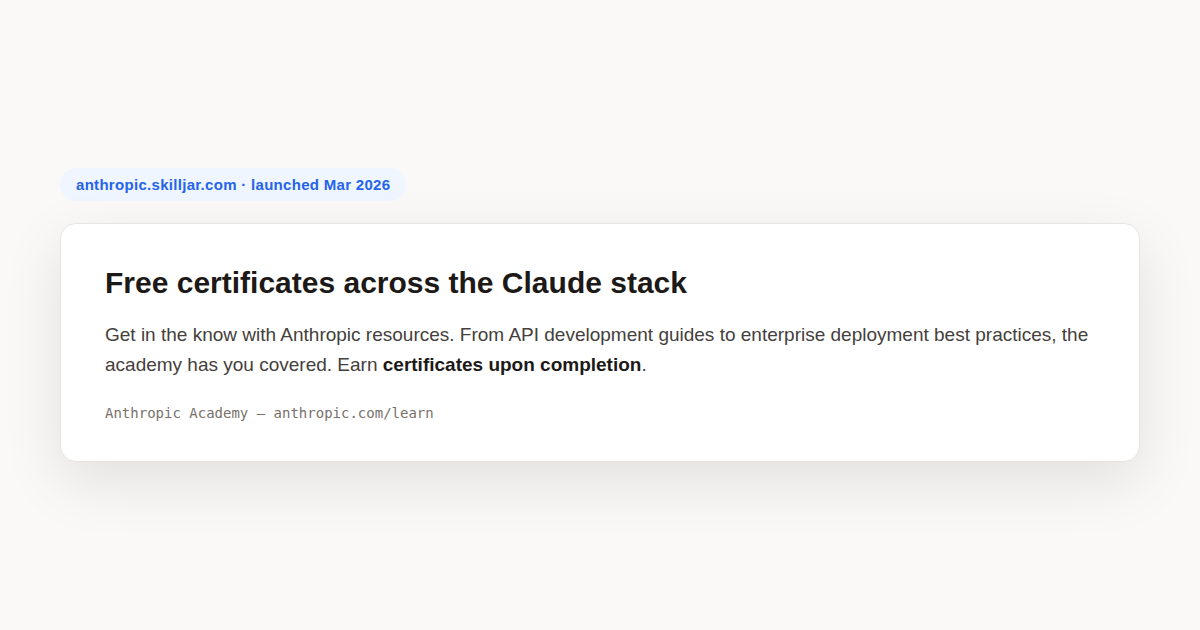
Anthropic Academy is the official learning hub from Anthropic at anthropic.skilljar.com, launched on March 2, 2026 with roughly twenty video courses across four tracks. Every course is free. Every course that has a final assessment issues a Skilljar certificate you can add to LinkedIn. The catalog covers the full Claude stack from non technical AI literacy through advanced MCP servers and cloud deployment on AWS Bedrock and Google Vertex AI.
Anthropic Academy: What You’ll Learn
The Academy is broader than a single course. It is a catalog of roughly twenty courses, organized into four tracks. The Product Training track covers Claude 101, Claude Cowork, and Claude Platform 101 for non technical audiences. The Developer Deep Dives track is where most readers of this site will spend time, covering Claude Code 101, Claude Code in Action, Building with the Claude API, Introduction to MCP, MCP Advanced Topics, Introduction to Agent Skills, and Introduction to Subagents. The AI Fluency track is a four course curriculum co developed with university faculty for non developers. The Enterprise Cloud track covers Claude on Amazon Bedrock and Claude on Google Vertex AI.
This is the fourth post in the Iqraa AI Agents series and the last in the Foundations phase. We assume you have done the Kaggle Gen AI Intensive, the Hugging Face AI Agents Course, and the Microsoft AI Agents course on this site, or you have equivalent background. Anthropic Academy is the vendor specific complement to the three vendor neutral courses you just did.
Anthropic Academy: The Catalog in Detail
The catalog has been growing continuously since launch. As of mid 2026 it has roughly twenty courses plus one learning path. The list below is the live catalog from the Skilljar homepage, grouped by track.
Product Training track. Claude 101 covers Claude for everyday work tasks. Introduction to Claude Cowork covers working alongside Claude on real files. AI Capabilities and Limitations is an intro to how AI works. Claude Platform 101 teaches developers to build on the Claude Developer Platform from the ground up.
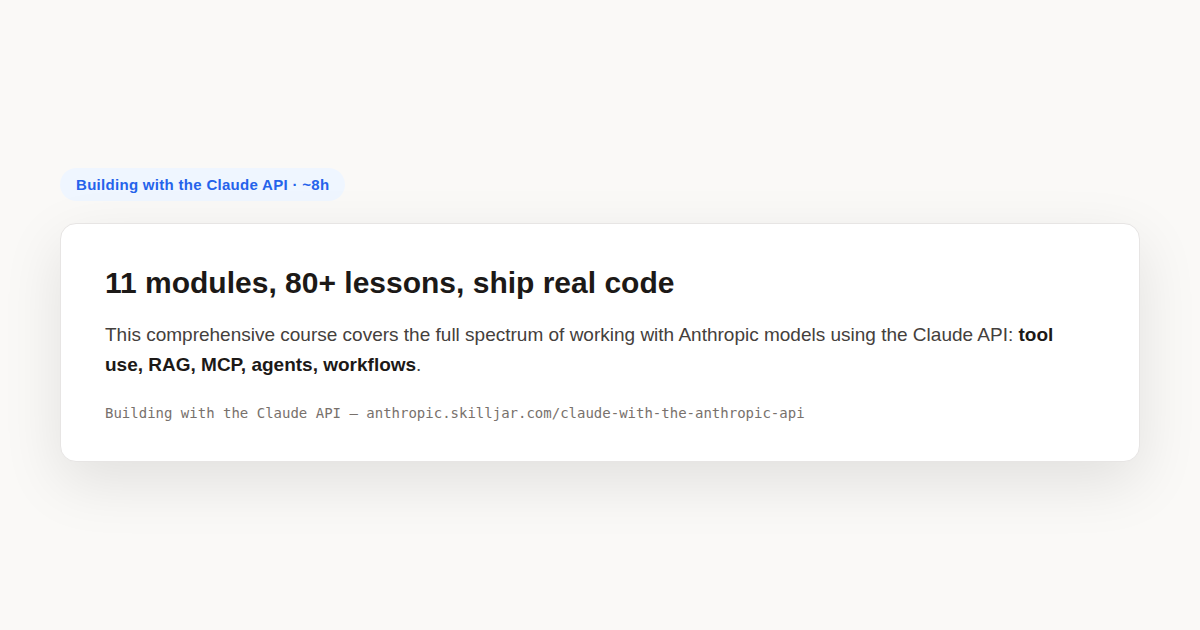
Developer Deep Dives track. This is the track that matters for the AI Agents series on this site. Claude Code 101 teaches installation, the Explore Plan Code Commit workflow, slash commands, CLAUDE.md, subagents, Skills, MCP, and hooks. Claude Code in Action integrates Claude Code into development workflows. Building with the Claude API is the flagship developer course at roughly eight hours and eighty plus lessons, covering prompt evaluation, prompt engineering techniques, tool use, RAG, extended thinking, images, PDFs, citations, prompt caching, code execution, MCP, Claude Code, Computer Use, agents, and workflows. Introduction to MCP and MCP Advanced Topics are dedicated MCP courses. Introduction to Agent Skills covers building Skills in Claude Code. Introduction to Subagents covers using and creating subagents.
AI Fluency track. AI Fluency Framework and Foundations is the flagship non technical course co developed with Prof. Rick Dakan of Ringling College and Prof. Joseph Feller of University College Cork. It teaches Anthropic’s 4D Framework, Delegation, Description, Discernment, Diligence. The track has seven variants for specific audiences including students, educators, nonprofits, small businesses, builders, and pK through 12 educators. Materials are released under Creative Commons.
Enterprise Cloud track. Claude with Amazon Bedrock was originally an AWS internal accreditation that Anthropic published publicly. Claude with Google Cloud Vertex AI is the equivalent for Google Cloud.
The Building with the Claude API Flagship Course
Building with the Claude API is the longest course in the Academy at roughly eight hours and eighty plus lessons across eleven modules. It is the closest equivalent to a full Claude SDK curriculum. The modules in order are Introduction, Accessing the API, Prompt Evaluation, Prompt Engineering Techniques, Tool Use, RAG and Agentic Search, Features of Claude including extended thinking, images, PDFs, citations, prompt caching, and code execution, MCP, Claude Code and Computer Use, Agents and Workflows, and Final Assessment.
By the end of this single course you have built a multi turn chat, a prompt evaluation pipeline with auto grading, a tool use agent with web search and text edit tools, a RAG pipeline with chunking and embeddings and BM25 and multi index retrieval, an MCP server and client in Python, and parallelization chaining and routing agent workflows. That is more shipped code than most agent courses produce across an entire catalog.
The course assumes proficiency in Python and basic JSON. It does not assume any prior Claude or Anthropic SDK experience. If you have done the Hugging Face course on this site, you will find Building with the Claude API a smooth transition from smolagents to the Anthropic SDK.
Prerequisites and What You Need
The Academy has the lightest infrastructure requirements of any course in this series. You need an email address to create a free Skilljar account at anthropic.skilljar.com. No Anthropic account is required to view the video courses or take the assessments.
If you want to follow along with the hands on exercises, you need a Claude API key from the Anthropic Console, which requires an Anthropic account with billing set up. The Building with the Claude API course uses real Claude calls, which means real token costs. Budget a few dollars for the full eight hour course. The Claude Code courses require a Claude Pro or Max subscription or an API key. The MCP courses require Python plus an API key. The cloud courses require an AWS or Google Cloud account.
You do not need any of that to watch the videos and earn the certificate. The hands on layer is optional. The Academy explicitly states in its FAQ that no Anthropic account is required to access the learning content.
The Anthropic Academy Certificate
Every course that has a final assessment issues a Skilljar certificate on completion. The certificate has a unique verification URL and an Add to LinkedIn button. Skilljar is the platform Anthropic chose for the Academy, and the certificate is issued by Skilljar on behalf of Anthropic. It is a vendor certificate, not a university credential, but it is real and verifiable.
Certificates do not expire as of mid 2026. Anthropic has not announced any policy change. The catalog is actively growing with seven to eight new courses added in Q2 2026 alone, so the certificate you earn today continues to be valid as the catalog expands.
Separate from the Academy, Anthropic launched a Claude Certified Architect Foundations credential in March 2026 that is only available via the Claude Partner Network, not via the public Academy. That is a paid partner only exam track. This tutorial covers only the public Academy.
Distinguishing the Academy from Anthropic’s GitHub Courses
This is the most common point of confusion. Anthropic has two separate educational offerings and they are complementary, not duplicative. We cover the other one later in this series as Post 12.
Anthropic Academy at anthropic.skilljar.com is video first. Roughly twenty courses. Skilljar certificates. Broad coverage of the full Claude stack from non technical AI literacy through MCP and cloud deployment. Self paced, no auth required to view, free certificates on completion.
Anthropic Courses on GitHub at github.com/anthropics/courses is code first. Five Jupyter notebook sub courses. No certificates. Narrow coverage focused on the Claude API, prompt engineering, evaluations, and tool use. Clone and run, no signup required, real API spend required.
If you learn better from video, do the Academy. If you learn better from runnable code, do the GitHub repo. If you want both, do the GitHub repo first to get your hands on the SDK, then do the Academy to fill in conceptual gaps.
Run the Claude API Quickstart Locally
The fastest way to get hands on with the Claude SDK before doing the Academy’s flagship course is the official Python quickstart.
pip install anthropic
export ANTHROPIC_API_KEY=sk-...
python -c "from anthropic import Anthropic; print(Anthropic().messages.create(model='claude-3-5-sonnet-20241022', max_tokens=64, messages=[{'role':'user','content':'Hello'}]).content[0].text)"
That is the entire pattern. The Academy’s Building with the Claude API course builds on this foundation with tool use, RAG, MCP, and agent workflows. If the quickstart works, you are ready for the course. If it does not, fix the API key and environment first.
A Worked Example, the MCP Courses in Depth
The Academy has two MCP courses, Introduction to MCP and MCP Advanced Topics. They pair to take you from zero to production MCP server.
Introduction to MCP covers the three core MCP primitives, Tools, Resources, and Prompts. You build a working MCP server in Python exposing all three primitives, and a client that calls it. The course uses the MCP Server Inspector for debugging, which is the official MCP debugging tool that Anthropic maintains. By the end of the intro course you have a working MCP server you can plug into Claude Desktop, Cursor, Cline, or any other MCP aware host.
MCP Advanced Topics covers sampling, log and progress notifications, Roots for file access, JSON message architecture, and the two production transports, Stdio and Streamable HTTP. The course teaches you how to scale an MCP server from a local development tool to a production service. By the end you have a production grade MCP server using switchable transports, file system access via Roots, and sampling for client side LLM work.
The two courses together take roughly four to six hours. They are the cleanest MCP curriculum we have seen, and we have reviewed the Hugging Face MCP course and the Microsoft MCP for Beginners course later in this series. The Anthropic Academy MCP courses are the most pedagogically sound. The Hugging Face course is the most project focused. The Microsoft course is the most multi language. They are complementary.
Anthropic Academy: Common Mistakes to Avoid
The Academy is well built but it invites a few predictable mistakes.
- Treating the certificate as a university credential. The Skilljar certificate is real and verifiable, but it is a vendor credential, not a university credential or an industry certification. Hiring managers will recognize it as Anthropic issued, which carries weight, but it is not the same as an AWS certification or a Coursera Specialization.
- Skipping the AI Fluency course as a developer. The 4D Framework in AI Fluency is useful even for engineers. Delegation, what to delegate to AI. Description, how to describe tasks to AI. Discernment, how to evaluate AI output. Diligence, how to use AI responsibly. Most engineers skip this as non technical and miss the conceptual scaffolding.
- Trying to do all twenty courses in a weekend. The catalog has more content than you can absorb in a weekend. Pick the track that matches your goal. Developers should do Claude Code 101, Building with the Claude API, and the two MCP courses. Non developers should do AI Fluency Framework and Foundations and Claude 101.
- Confusing the Academy with the GitHub courses. They are different offerings. See the dedicated section above.
Anthropic Academy: Best Practices
- Start with Claude 101 even if you are an experienced developer. The first twenty minutes orient you to how Anthropic thinks about Claude, which informs the rest of the catalog.
- Do Building with the Claude API before doing the dedicated MCP courses. The API course has an MCP module that gives you enough context to decide if you want to go deeper.
- Use the Skilljar certificate on LinkedIn. It links back to a verification URL on the Skilljar site, which makes it more credible than a self reported credential.
- Pair the Academy with the Claude Code tutorials on this site for hands on recipes that complement the Academy’s conceptual depth.
- Watch for new courses. Anthropic added seven to eight courses in Q2 2026 alone. The catalog is a moving target and the freshest courses are the most current to the Claude model line.
Anthropic Academy: Frequently Asked Questions
Is Anthropic Academy free?
Yes. Every course is free. Every certificate is free. The Skilljar account is free. The only paid layer is the actual Claude API usage if you follow along with hands on exercises, which is metered by Anthropic, not by the Academy.
Do I need an Anthropic account?
No, you only need a free Skilljar account. The Academy FAQ explicitly states that no Anthropic account is required to access the learning content. You need an Anthropic account only if you want to run the hands on exercises that call the Claude API.
How long does it take to complete the catalog?
The full catalog is roughly forty to sixty hours of video plus assessments plus hands on work. Most learners do not complete the full catalog. They pick the track that matches their goal and complete the three to five courses in that track in roughly fifteen to twenty five hours.
What is the difference between the Academy and the GitHub courses?
The Academy at anthropic.skilljar.com is video first with certificates. The GitHub repo at github.com/anthropics/courses is code first with no certificates. They are complementary. We cover the GitHub repo as Post 12 in this series.
Does the certificate expire?
Not as of mid 2026. Anthropic has not announced any expiry policy. The catalog continues to grow, but existing certificates remain valid.
Can I use the certificate on LinkedIn?
Yes. Every certificate has an Add to LinkedIn button that pre populates the credential with the Skilljar verification URL. It appears under your Licenses and Certifications section.
Anthropic Academy is the official Claude learning path with free certificates. Pair it with the Claude Code tutorials on this site for hands on recipes, and with the Anthropic GitHub courses for code first learning.