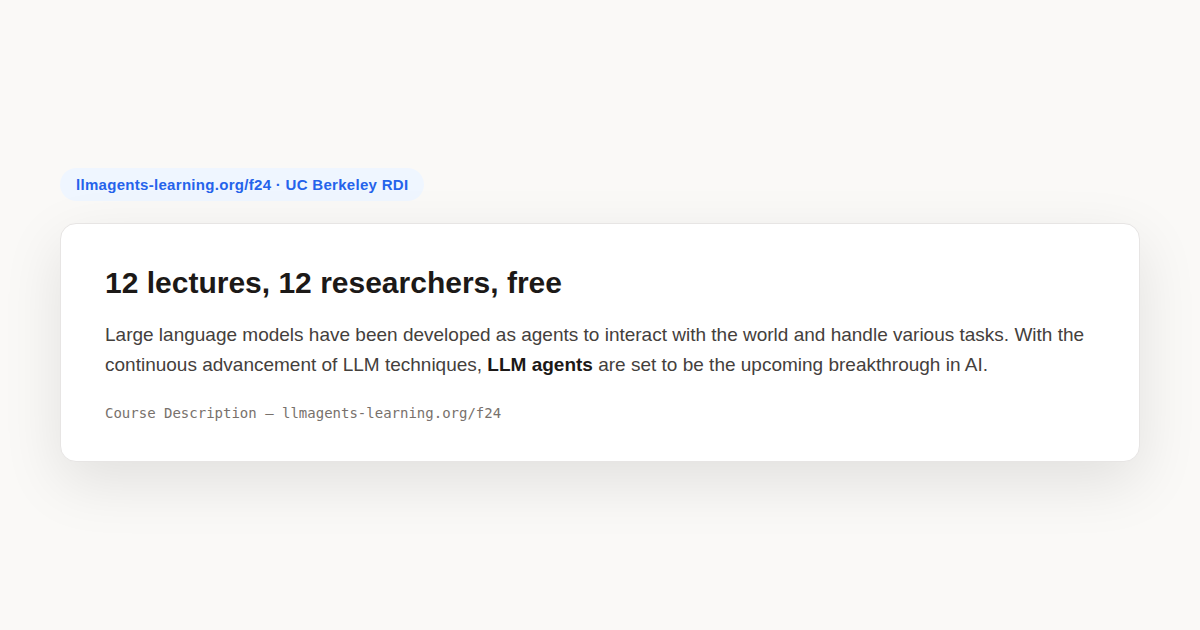
LLM Agents MOOC is the UC Berkeley graduate course taught by Professor Dawn Song and Google DeepMind Research Scientist Xinyun Chen in Fall 2024. Twelve guest lectures from leading researchers including Denny Zhou of Google DeepMind, Shunyu Yao of OpenAI, Jerry Liu of LlamaIndex, Jim Fan of NVIDIA, Percy Liang of Stanford, and Ben Mann of Anthropic. The full syllabus, video lectures, slides, and quizzes are publicly accessible without registration.
LLM Agents MOOC: What You’ll Learn
This is the academic foundations course in the Iqraa AI Agents series. It is broader and more theoretical than the industry courses earlier in the track. Where Hugging Face and Microsoft teach you to ship agents, Berkeley teaches you why agents work, what their known failure modes are, and what the research frontier looks like. Twelve lectures, twelve quizzes, three labs, one optional hackathon. Audit freely. Or earn one of five certificate tiers from Trailblazer to Legendary.
The course assumes Berkeley upper division computer science background. Solid machine learning and deep learning foundations, comfort reading arXiv papers, Python for the labs. If you do not have that background, do the Kaggle Gen AI Intensive and the Hugging Face course on this site first.
LLM Agents MOOC: The Twelve Lecture Syllabus
Verbatim from the official syllabus at llmagents-learning.org/f24.
- September 9, LLM Reasoning. Denny Zhou, Google DeepMind. Chain of thought reasoning without prompting, why LLMs cannot self correct reasoning yet, premise order in reasoning.
- September 16, LLM agents brief history and overview. Shunyu Yao, OpenAI. WebShop and ReAct papers, the foundational work on agents that reason and act.
- September 23, Agentic AI Frameworks and AutoGen. Chi Wang, AutoGen AI. Plus Jerry Liu, LlamaIndex, on building a multimodal knowledge assistant.
- September 30, Enterprise trends and key components. Burak Gokturk, Google. Grounding capabilities on Vertex AI, needle in a haystack retrieval.
- October 7, Compound AI Systems and DSPy. Omar Khattab, Databricks. Optimizing instructions and demonstrations for multi stage language model programs.
- October 14, Agents for Software Development. Graham Neubig, Carnegie Mellon. SWE agent, OpenHands, agent computer interfaces for software engineering.
- October 21, AI Agents for Enterprise Workflows. Nicolas Chapados, ServiceNow. WorkArena, TapeAgents, knowledge work tasks.
- October 28, Unified Neural and Symbolic Decision Making. Yuandong Tian, Meta AI FAIR. Beyond A* search with transformers, Dualformer.
- November 4, Project GR00T Generalist Robotics. Jim Fan, NVIDIA. Voyager, Eureka, DrEureka, sim to real transfer.
- November 18, Open Source and Science in the Era of Foundation Models. Percy Liang, Stanford. Cybench, evaluating cybersecurity capabilities.
- November 25, Measuring Agent Capabilities and Anthropic RSP. Ben Mann, Anthropic. Responsible Scaling Policy, computer use models.
- December 2, Building Safe and Trustworthy AI Agents. Dawn Song, UC Berkeley. Trustworthiness, evidence based AI policy.
The Five Certificate Tiers
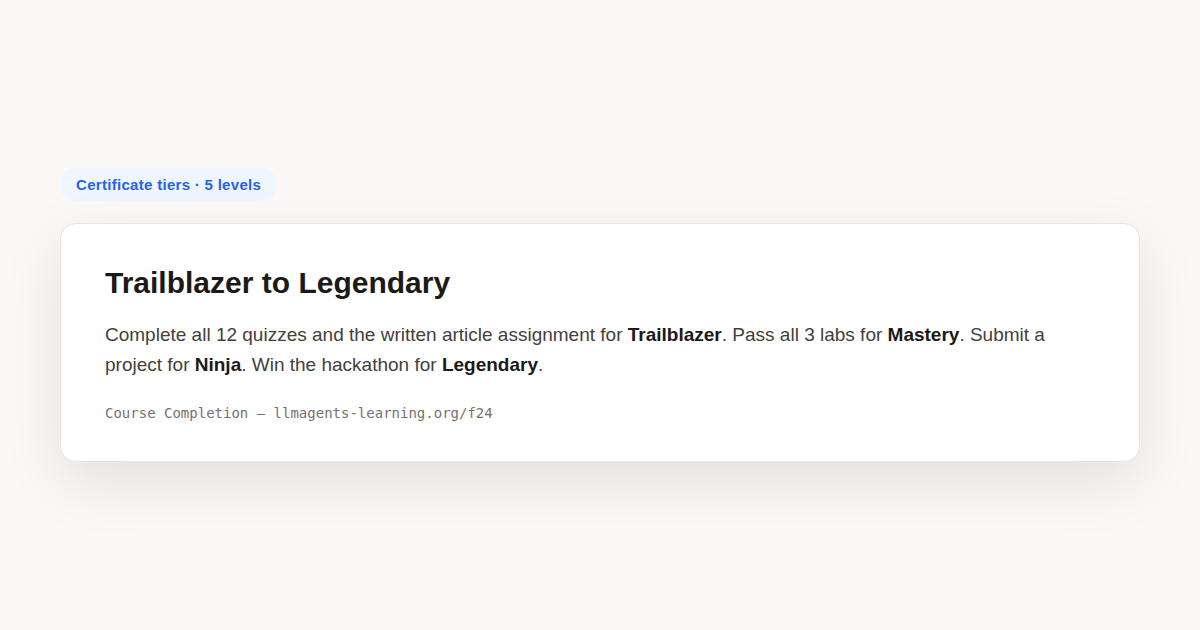
Berkeley offers five certificate tiers, each requiring more work than the previous.
Trailblazer. Complete all twelve quizzes and the written article assignment.
Mastery. Trailblazer requirements plus all three lab assignments.
Ninja. Mastery requirements plus a submitted project to the LLM Agents Hackathon.
Legendary. Ninja requirements plus prize winner or finalist at the hackathon.
Honorary. Awarded to the most helpful students in the Discord, with Ninja or Mastery coursework.
As of mid 2026 the course is archived but certificates are still issued on request via the Discord. The Fall 2024 cohort certificates have all been released. The Spring 2025 sequel, which we cover as Post 08 on this site, has its own equivalent tier structure.
Prerequisites and What You Need
This is a graduate level Berkeley computer science course. The course does not teach Python or basic machine learning. It assumes both.
You need to be comfortable reading research papers. Each lecture has two to four supplementary readings from arXiv. The course does not require you to read them all but you will get more out of the lectures if you do.
You need a Python environment for the labs. The three labs are hands on agent building assignments using the frameworks from lecture. You need an LLM API key for the labs. Berkeley does not provide one. Budget a small amount of API spend.
You do not need a Berkeley account, an enrollment, or any registration. All lectures are on YouTube. All slides are on the Berkeley RDI website. All quizzes are Google Forms. The only registration is for the certificate declaration form, which is optional.
Why Academic Foundations Matter for Practitioners
If you are an engineer who has shipped agents, the question is whether you need the academic background. The answer is yes, for two reasons.
First, the field is moving fast and the vocabulary is unstable. When a paper says reflection or planning or tool use, the meaning depends on which research tradition the authors are coming from. Berkeley’s lectures are the canonical reference for what each term means in the literature. Knowing the canonical meaning saves you from confusing yourself and your team.
Second, the failure modes of agents are not arbitrary. They follow patterns the research community has documented. Hallucination in tool calls. Compounding errors in multi step reasoning. brittleness in prompt variations. Knowing the patterns lets you debug faster. You can read a new agent failure and immediately say this is the same pattern as the SWE-agent paper documented.
The twelve lectures together give you the vocabulary, the patterns, and the research landmarks. That pays off across every other course in this series.
How This Course Fits in the Series
The natural sequence on this site is Kaggle Gen AI Intensive for broad literacy, Hugging Face AI Agents Course for hands on agent engineering, Microsoft AI Agents for production depth, Anthropic Academy for Claude specific certification, and then this Berkeley course for academic foundations. The order is not strict. If you are an engineer who learns by doing, do Berkeley after you have shipped an agent. If you are a researcher who learns by reading, do Berkeley first.
Watch Lecture 1 Free
The fastest way to see what the course is like is to watch Lecture 1 on YouTube. Denny Zhou from Google DeepMind on LLM reasoning. The lecture is roughly two hours, the slides are downloadable, and the supplementary readings are linked from the syllabus page.
open "https://llmagents-learning.org/f24"
# Click Lecture 1 livestream link, or search YouTube for "Denny Zhou LLM Reasoning Berkeley"
If after Lecture 1 you want more, do the rest in order. If Lecture 1 feels too theoretical, skip ahead to a more applied lecture like Graham Neubig on agents for software development or Jim Fan on robotics.
A Worked Example, the SWE Agent Lecture in Depth
Lecture 6 by Graham Neubig of Carnegie Mellon is the lecture most cited by engineers who have done this course. Neubig’s research focuses on agents for software engineering, and the lecture covers two of his major projects, SWE-agent and OpenHands.
SWE-agent is an agent computer interface designed for software engineering. The key insight is that the agent’s interface to the computer matters as much as the agent’s reasoning. Most agent interfaces are designed for chat, which is the wrong interface for software engineering. SWE-agent’s interface is designed for code editing, file navigation, and test execution, which makes the agent dramatically more effective on real software bugs.
OpenHands is the open source platform Neubug’s group maintains for AI software developers as generalist agents. It is the successor to SWE-agent with a broader scope. The lecture covers the architecture, the evaluation harness, and the benchmark results on SWE-bench, the standard benchmark for software engineering agents.
What you should take from this lecture is the agent computer interface pattern. The interface between the agent and its environment is a design decision, not a fixed constraint. Most production agent failures are interface failures, not reasoning failures. The agent does the right thing but cannot communicate it through the interface. Designing the interface deliberately is the highest leverage engineering choice in agent systems.
LLM Agents MOOC: Common Mistakes to Avoid
The course is well regarded but it invites predictable mistakes.
- Treating it as a video only course. The lectures are dense and reference papers throughout. If you skip the readings you will miss half the content.
- Skipping the labs. The Mastery tier certificate requires the labs. Without the labs you stop at Trailblazer, which is the reading comprehension tier.
- Trying to do all twelve lectures in a weekend. Each lecture is roughly two hours of video plus two to four hours of reading. A realistic pace is one lecture per week.
- Confusing this course with the Spring 2025 sequel. The Spring 2025 course at
llmagents-learning.org/sp25is the advanced sequel, focused on formal math and reasoning. We cover it as Post 08 on this site. They are sister courses with different focus.
LLM Agents MOOC: Best Practices
- Do one lecture per week with the assigned readings. The pace matches the original cohort.
- Join the LLM Agents Discord even if you are doing the archived version. The community is active and answers questions.
- Pair the course with the earlier courses in this series for hands on practice. Berkeley is theory heavy, the others are practice heavy.
- Submit a project to the next hackathon if you want the Ninja or Legendary tier. The hackathon runs alongside each cohort.
- Read at least the abstract and introduction of every cited paper. The full read is optional, the abstract is not.
LLM Agents MOOC: Frequently Asked Questions
Is the LLM Agents MOOC still free?
Yes. All lectures, slides, quizzes, and lab instructions are publicly accessible without registration. The course is archived but the materials remain available.
Do I need a Berkeley account?
No. The course is open. You need a Google account for the quizzes since they are Google Forms. You need an LLM API key for the labs. You do not need any Berkeley credential.
Does the course still issue certificates?
Yes on request. The Fall 2024 cohort certificates have all been issued. New completers can request a certificate via the LLM Agents Discord. The five tier structure remains in effect.
How is this different from the Spring 2025 Berkeley course?
The Fall 2024 course, this one, is the broad survey. The Spring 2025 course at llmagents-learning.org/sp25 is the advanced sequel focused on reasoning, formal math, and verifiable code generation. We cover Spring 2025 as Post 08 in this series.
How long does the course take?
Twelve lectures at two hours each plus readings and quizzes is roughly forty to sixty hours of focused work. The three labs add another twenty to thirty hours if you do them. The hackathon is open ended.
What background do I need?
Berkeley upper division computer science level. Solid ML and DL foundations, Python fluency, comfort with arXiv papers. If you do not have this background, do the earlier courses on this site first.
LLM Agents MOOC from UC Berkeley is the academic foundations course. Pair it with the earlier industry courses on this site for hands on practice and with the Spring 2025 sequel for advanced depth.