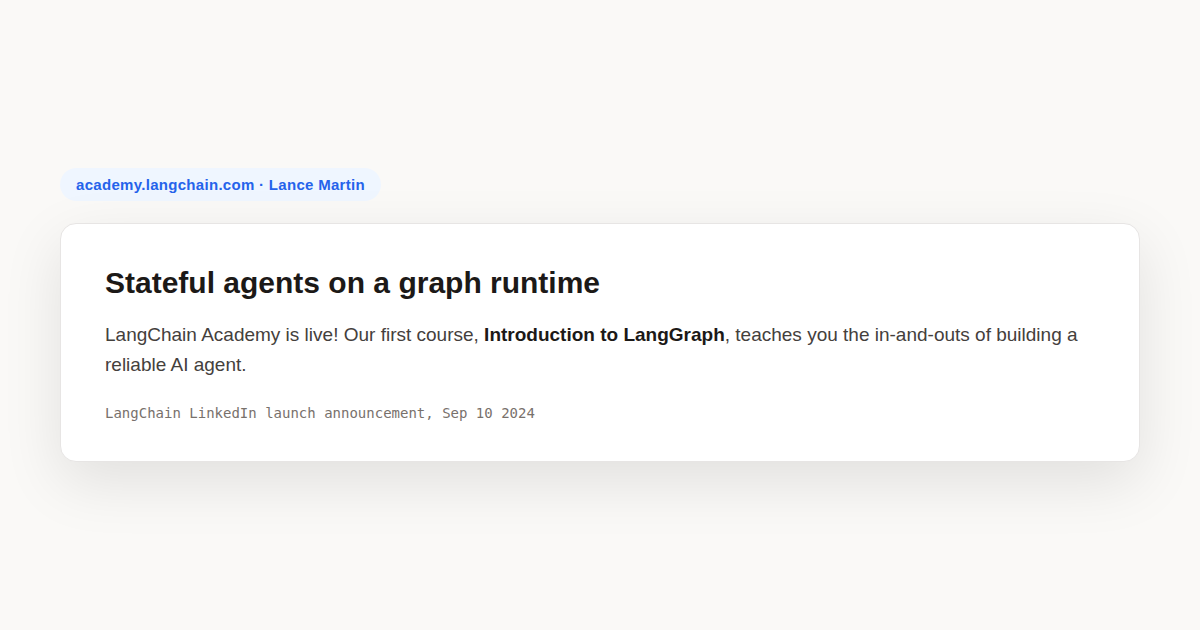
LangGraph is the LangChain Academy’s foundation course on the LangGraph framework, taught by LangChain engineer Lance Martin. Seven modules covering simple graphs through state and memory, human in the loop, subgraphs, parallelization, long term memory, and deployment. Free, self paced, ~6 to 8 hours of video plus hands on Jupyter notebooks. The course launched September 10, 2024 and tracks LangGraph v1.x as of mid 2026.
LangGraph: What You’ll Learn
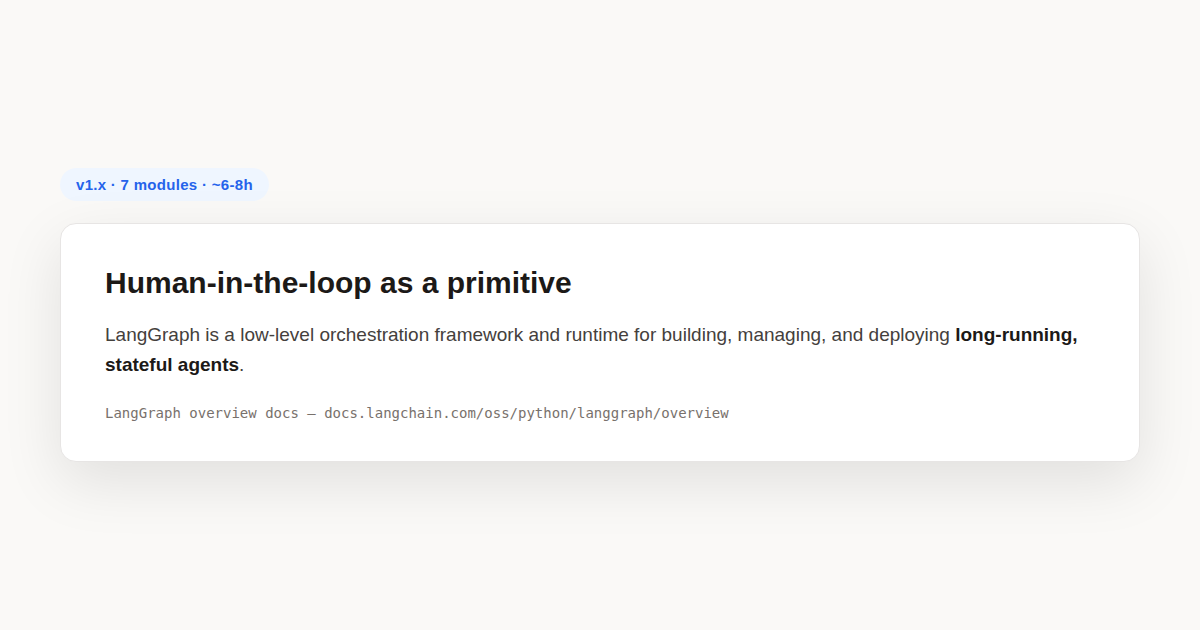
This is the framework specific course in the Iqraa AI Agents series. Where Andrew Ng’s course on this site teaches framework free design patterns, this course teaches the production framework those patterns are most often implemented in. LangGraph is a low level orchestration framework and runtime for building, managing, and deploying long running stateful agents. The framework is now at v1.x after reaching 1.0 in 2025.
The capstone artifact is a research assistant built in Module 4 with subgraphs, parallelization, and map reduce, deployed in Module 6 via LangGraph Platform. By the end you have a deployed agent you can call from any application.
LangGraph: The Seven Modules
Verbatim module structure from the course landing page and the GitHub repo at langchain-ai/langchain-academy.
- Module 0, Setup. Environment, API keys, LangGraph Studio install.
- Module 1, Introduction. Simple graph, chain, router, agent, agent memory, deployment.
- Module 2, State and Memory. State schema, state reducers, multiple schemas, trim and filter messages, chatbot external memory, chatbot summarization.
- Module 3, UX and Human in the Loop. Streaming, breakpoints, editing state and human feedback, dynamic breakpoints, time travel.
- Module 4, Building Your Assistant. Subgraphs, parallelization, map reduce, research assistant.
- Module 5, Long Term Memory. Memory store, memory agent, memory schema profile, memory schema collection.
- Module 6, Deployment. Creating, connecting, assistant, double texting, deployment.
Prerequisites and What You Need
Python 3.11, 3.12, or 3.13. Basic Python fluency and Jupyter familiarity. An OpenAI API key for GPT 4o via langchain-openai. A LangSmith API key for tracing. A Tavily API key for the Module 4 web search lessons. No formal LangChain or LCEL prerequisite stated.
The course is Python only. A separate LangChain Academy course, Quickstart LangGraph Essentials TypeScript, covers the JS/TS equivalent in condensed form. If you are a TypeScript developer, do that course instead.
External API costs for the full course are roughly five to twenty dollars in OpenAI spend. Tavily has a generous free tier. LangSmith has a free developer tier.
The Capstone Research Assistant
Module 4 ships a research assistant in module-4/research-assistant.ipynb. The assistant produces customizable knowledge outputs like reports, wikis, or summaries using web search and document tools. It is built on LangGraph features for parallelization and human review. By Module 6 the assistant is deployed via LangGraph Platform or Studio with a long running endpoint.
This is the same pattern the Hugging Face course on this site teaches with smolagents in Unit 3. The difference is the framework. LangGraph gives you explicit graph definitions for state transitions. smolagents gives you a code execution loop. Both work. The choice is whether you want graph correctness or code flexibility.
Run Module 1 Locally
git clone https://github.com/langchain-ai/langchain-academy.git
cd langchain-academy
pip install -r requirements.txt
export OPENAI_API_KEY=sk-...
jupyter notebook module-1/introduction.ipynb
The notebooks are pinned to langchain-core >= 1.2.28 and the framework line is v1.x. The course repo received documentation link updates in October 2025 and the security patches in April 2026. As of mid 2026 the repo is actively maintained.
A Worked Example, Module 3 Human in the Loop
Module 3 is where LangGraph differentiates from other frameworks. Human in the loop is not an afterthought in LangGraph, it is a core primitive. The framework supports breakpoints at any node, dynamic breakpoints based on state, time travel back to previous states, and direct state editing during a pause.
The pattern matters for production. Most real agents need human approval before irreversible actions like sending email, charging a card, or modifying a database. LangGraph lets you add an approval gate as a single line in the graph definition. The agent runs to the gate, pauses, surfaces the proposed action to a human approver, and either continues or rolls back based on the response.
The same pattern in smolagents requires custom code. In LangGraph it is a flag. This is the framework’s core value proposition.
LangGraph: Common Mistakes to Avoid
- Trusting the videos for current API syntax. The videos launched in September 2024 against LangGraph 0.2. The framework is now at v1.x. The notebooks are updated, the videos are not. Use the notebooks as truth.
- Skipping Module 3 human in the loop. Module 3 is the framework’s signature feature. Skipping it means you miss why LangGraph exists.
- Using the course as a LangChain course. It is not. LangChain and LangGraph are related but separate frameworks. If you need LangChain LCEL, that is a different course.
- Not pinning the requirements.txt versions. LangGraph evolves fast. Use the repo’s pinned versions, not the latest PyPI release, while taking the course.
LangGraph: Best Practices
- Do the modules in order. Module 4 subgraphs assume Module 2 state. Module 6 deployment assumes Module 4.
- Use LangSmith tracing from the start. The course includes it in the setup. It is the only way to debug complex graph executions.
- Pair with the Hugging Face course on this site for the same use case in smolagents and LlamaIndex.
- Read the LangGraph overview docs at
docs.langchain.com/oss/python/langgraph/overviewfor the conceptual framing the course assumes. - Deploy the Module 4 capstone to LangGraph Platform even if you do not need it in production. The deployment workflow is part of the learning.
LangGraph: Frequently Asked Questions
Is the LangChain Academy LangGraph course free?
Yes. Self paced, no cost, no certificate. The notebooks are public on GitHub.
Does the course issue a certificate?
No. LangChain Academy does not issue certificates. The portfolio piece is the deployed Module 4 research assistant.
What version of LangGraph does the course target?
The 1.x line. The course launched in September 2024 against LangGraph 0.2 but the notebooks were updated in 2025 and 2026 to track 1.x. As of mid 2026 the framework is at 1.2.9.
Do I need to know LangChain first?
No. The course is LangGraph specific. LangChain LCEL is not required. Some familiarity with LLM concepts and Python fluency is enough.
How long does the course take?
Six to eight hours of video plus hands on notebook work. Total roughly fifteen to twenty five hours depending on pace.
Is there a TypeScript version?
Yes. Quickstart LangGraph Essentials TypeScript is a separate, condensed course on LangChain Academy.
LangGraph is the framework specific deep dive. Pair it with Andrew Ng’s design pattern course for theory and the Hugging Face course for framework comparison.