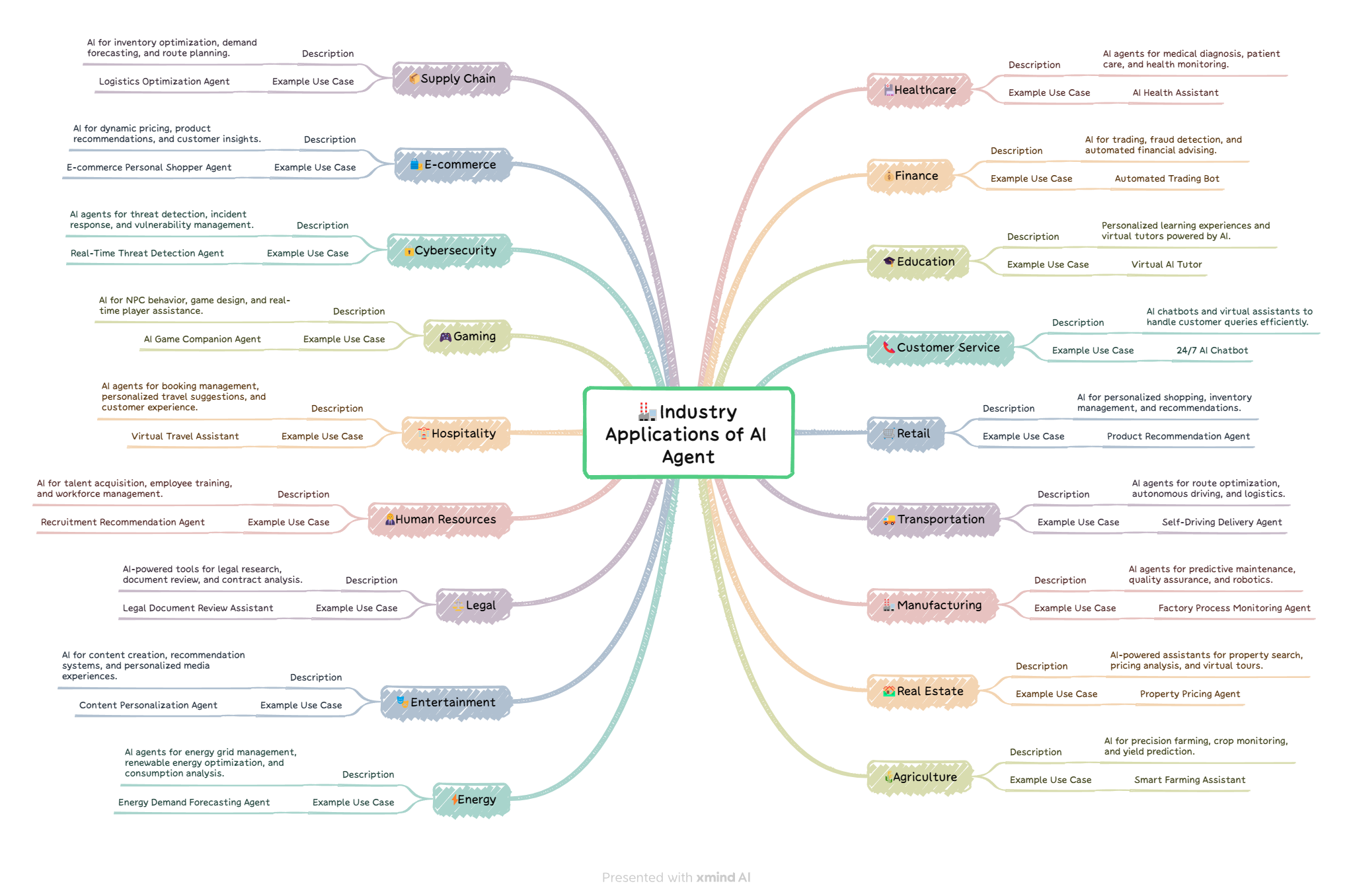
500+ AI Agent Projects does what the title promises: it catalogs 500+ agent projects, sorted by both framework (LangGraph, CrewAI, AutoGen, Agno, LlamaIndex) and by industry (Healthcare, Finance, Education, Retail, Cybersecurity, and on). The value isn’t the count, it’s the organization: when you have an idea for an agent, this is the repo where you can scan the existing landscape in five minutes instead of guessing.
View 500+ AI Agent Projects on GitHub
- 34,609 stars
- 6,160 forks
- Python
- MIT License
AI Agent Projects: Cross-referenced two ways: framework and industry
Most agent directories are flat link dumps. This one cross-references every entry along two axes: which framework it’s built in (LangGraph, CrewAI, AutoGen, Agno, LlamaIndex) and which industry it serves (healthcare, finance, education, retail, cybersecurity, transportation). So if you’re a fintech engineer considering CrewAI, you can filter to “finance + CrewAI” and see what other people have actually shipped in that intersection.
Each entry has a short description and a link to the source repo. Some are starter demos, some are production-adjacent. The curation matters more than the count: 500 is a marketing number, but the 30-50 projects per category that are actually maintained are what you’ll use.
The framework comparison table is the killer feature
Buried in the README is a framework comparison table that’s worth the star on its own. Five frameworks rated on complexity, multi-agent support, streaming, local-LLM compatibility, with a “best for” column that names a concrete use case. LangGraph for stateful RAG pipelines, CrewAI for role-based teams, AutoGen for code generation, Agno for lightweight single agents, LlamaIndex for enterprise document Q&A.
There’s a quick-decision guide right below it: “Just starting out → Agno or CrewAI. Need stateful graphs + RAG → LangGraph.” That beats reading five separate framework docs to make the same call.
Agents you can actually run in 5 minutes
The agents/ subfolder is the working-code layer. Every agent there is self-contained: its own requirements.txt, its own .env.example, its own entry point. No monorepo setup, no shared dependencies to untangle. Clone, install, set your API key, run.
The web-research-agent at agents/01-web-research-agent is the canonical first-run example. It’s a single Python file that does something useful (web research, summarized) without requiring you to learn a framework’s mental model first.
They’re also genuinely good copy-paste starting points for your own agents. Rename, swap the prompt, replace the tool. You’ve got a working draft of your own agent in an afternoon, not a week.
What it doesn’t try to be
It’s a catalog, not a tutorial. The README links out to a separate crewai_mcp_course/ for structured learning, but the core repo assumes you can read Python and already know roughly what an agent framework does. If you’re starting from zero, pair it with AI Agents for Beginners for the conceptual layer.
Quality also varies across 500+ entries. That’s the nature of a catalog this size. Some linked projects are mature; others are weekend experiments. Treat the stars on each linked repo as your filter.
Get started
Pick an agent and run it directly:
git clone https://github.com/ashishpatel26/500-AI-Agents-Projects.git
cd 500-AI-Agents-Projects/agents/01-web-research-agent
pip install -r requirements.txt
cp .env.example .env
python agent.py
Then browse the framework comparison table to decide which framework you actually want to invest in.
500+ AI Agent Projects is the index the rest of the ecosystem needed. Bookmark it for the framework comparison alone. The rest of the catalog is a bonus you’ll reach for whenever a new agent idea lands.