Awesome AI Agents by the E2B team is the closest thing the agent ecosystem has to a phone book: an actively maintained, two-column list of every meaningful AI assistant and agent project, split into open-source and closed-source, with a corresponding visual “landscape” map. If you need to know what’s out there, this is where you look first.
View Awesome AI Agents on GitHub
- 28,806 stars
- 3,167 forks
- List (Markdown)
- No license declared
Awesome AI Agents: Two columns: open source vs closed source
Most “awesome” lists conflate free and paid. This one is explicit: every entry lives under either “open source projects” or “closed-source projects and companies”, and the README draws the line clearly. That matters when you’re trying to figure out whether you can fork and adapt something or whether you’ll have to budget for a SaaS subscription.
Each entry has a category (general purpose, multi-agent, build-your-own, etc.), a short description, and the relevant links (GitHub, docs, Discord). It’s enough metadata to triage without leaving the page.
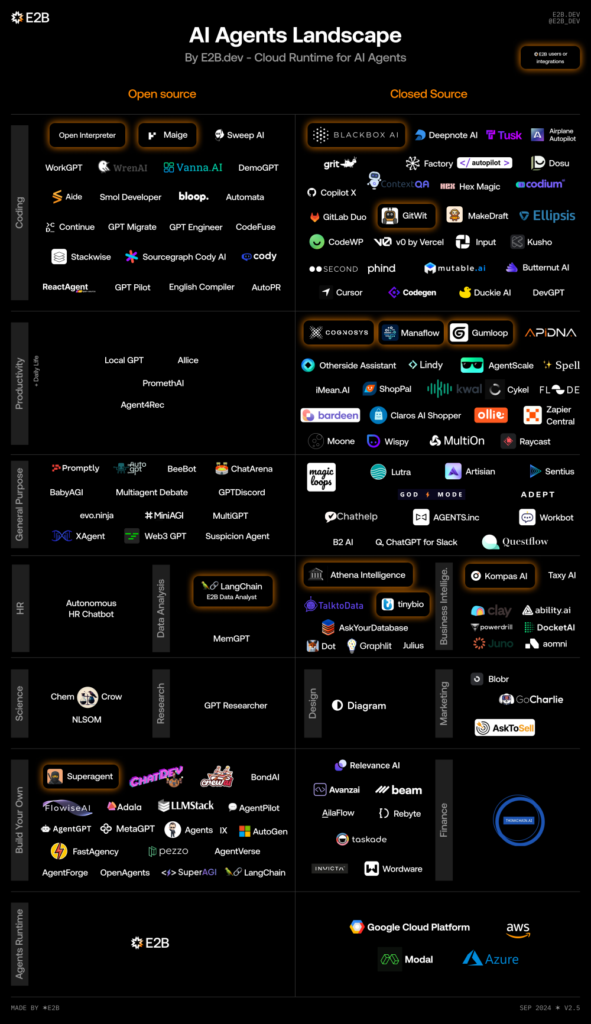
The landscape image is the killer feature
The hero of the README is the assets/landscape-latest.png image, a visual map of the entire AI agent ecosystem, organized by category. It’s the fastest way to wrap your head around who the players are. The companion web UI at e2b.dev/ai-agents renders the same data as a filterable, searchable interface, generally the better surface for actual exploration; the GitHub repo is the source of truth and the canonical star-able artifact.
When a new agent launches, this is usually the first list it gets added to. Following the repo’s commits is a low-effort way to track what’s new.
Maintained by E2B, with a transparent angle
The list is curated by the team behind E2B, a code-interpreter SDK for AI apps. They’re upfront about this: the README links to their product, the Discord is theirs, the landscape chart carries their branding. That’s not a hidden bias, it’s a stated one, and it’s a reasonable trade for a well-maintained free resource.
If your project is open-source or genuinely novel, submissions via pull request or their Google Form get reviewed. The maintainers are picky: they note in the README source that several projects are queued as “TBD” pending verification of whether they qualify as actual agents.
What’s not here
The list deliberately excludes agent-adjacent infrastructure: SDKs, frameworks, evaluation tools. Those live in the sister repo awesome-sdks-for-ai-agents. So if you’re shopping for LangGraph vs CrewAI vs smolagents, you’re in the wrong place: start at 500+ AI Agent Projects for framework comparisons.
It’s also, by the maintainers’ own admission, not comprehensive. The agent space moves faster than any list can track. Use it as a starting point, not an exhaustive reference.
How to actually use it
The right workflow is: spot-check the landscape chart once a quarter to recalibrate what categories even exist, then use the web UI’s filter when you have a concrete need (“I want an open-source customer-support agent”). The README’s flat alphabetical list is a last resort: fine if you know a project’s name, painful if you don’t.
Use it
Bookmark the README, but explore via the web UI for actual research:
open https://e2b.dev/ai-agentsStar the GitHub repo so new entries show up in your feed. That’s the lowest-effort way to stay current with what’s shipping in the agent world.
Awesome AI Agents is the index every agent builder checks at least once a month. Star it for the landscape chart alone, then graduate to the web UI when you actually need to filter and compare.