GenAI Agents by Nir Diamant is one of the most prolific agent tutorials repositories on GitHub: 53+ Jupyter notebooks covering everything from a basic conversational bot to multi-agent systems with complex memory. New tutorials land every few weeks. If you learn by opening a notebook and running it cell by cell, this is your kind of resource.
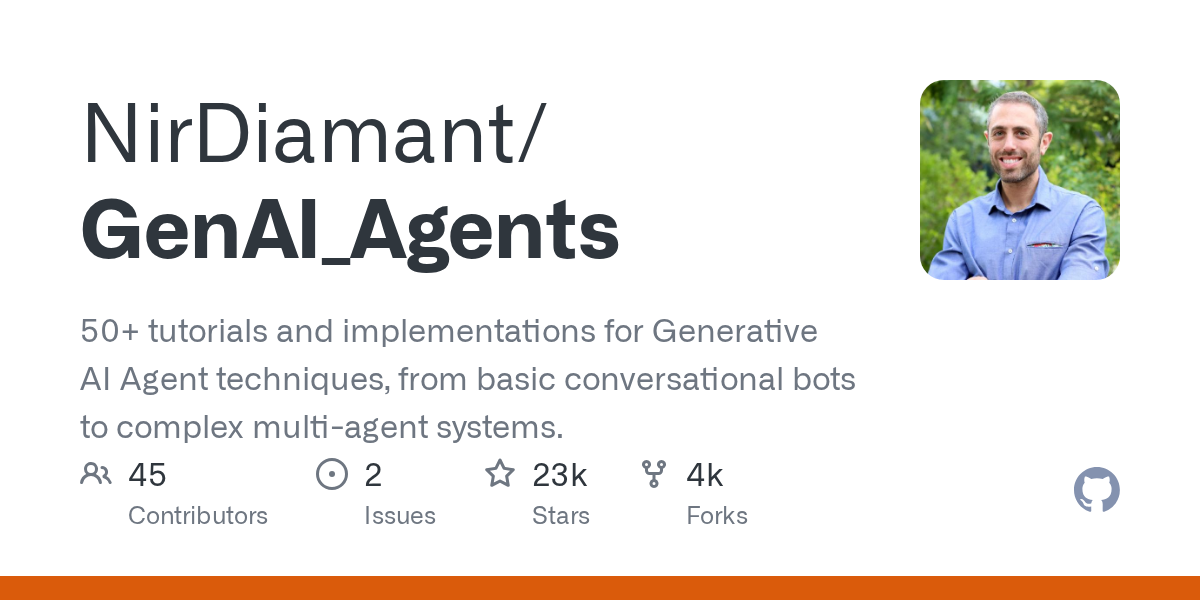
- 23,250 stars
- 3,916 forks
- Jupyter Notebook
- No license declared
53 notebooks and counting
The repository’s defining feature is its tutorial cadence. Nir publishes a new agent tutorial every few weeks: recent additions include a Document Intake Agent, an HR AI Assistant, an Art Tourguide built on LightRAG, a Contextual Quoting System, and an ML/DS Assistant. Each one is a single Jupyter notebook in all_agents_tutorials/ that you can open in Colab and run end-to-end.
The arc runs from a basic single-agent conversational bot through reflection, planning, tool use, multi-agent orchestration, RAG-augmented agents, and into specialist domains (customer support, fraud detection, research). You can pick any notebook in isolation. Each one explains its own prerequisites.
Part of a four-repo ecosystem
This isn’t a standalone repo. Nir maintains a quartet that covers the full agent-building surface: GenAI Agents (this one: architecture and patterns), RAG Techniques (40+ retrieval notebooks), Prompt Engineering Techniques, and Agent Memory Techniques (30 notebooks on vector stores, graphs, Mem0, Zep). Together they’re a self-contained curriculum for the techniques layer of agent engineering.
And there’s a production-focused sibling, Agents Towards Production, which picks up where this one leaves off: deployment, observability, the parts you need once your agent actually has users.
Backed by a serious content operation
The repo is the free layer of a larger DiamantAI content ecosystem. There’s a newsletter (50,000+ subscribers) that publishes related deep-dives, a paid course called “Prompt to Production” (17 modules, each pairing a video lecture with a hands-on lab), and an active Discord and Reddit community at r/EducationalAI.
This matters because it means the tutorials stay current. A solo maintainer’s repo goes stale when life gets busy; a content creator whose business depends on it keeps shipping. The cadence of new notebooks is the proof.
What you’ll actually do with it
The intended workflow is notebook-driven. Pick a technique you don’t know, open the matching notebook in Colab, run every cell, then modify one piece (the system prompt, the tool list, the LLM provider) and watch what changes. That modification step is the actual learning; reading the notebook without running it is just skimming.
For a beginner, start with the introduction agent and the reflection pattern. For an intermediate, jump straight to the multi-agent orchestration or the RAG-augmented agent that matches your use case.
One honest note: the notebooks are demonstrations of techniques, not production code. Error handling is light, secrets management is assumed (you’ll need your own API keys via Colab’s secret store), and the patterns sometimes favor readability over robustness. That’s the right trade for teaching material, but it means you’ll need to harden anything you actually ship. Pair this repo with the production-focused sibling for the gap.
Get started
Clone or just open in Colab:
git clone https://github.com/NirDiamant/GenAI_Agents.git
cd GenAI_Agents/all_agents_tutorials
jupyter notebook
Or hit “Open in Colab” on any notebook in the README. The cloud runtime means no local setup.
GenAI Agents earns its stars by being the most prolific source of runnable agent tutorials on GitHub. If you learn by doing rather than reading, this is the repo to subscribe to. Nir’s cadence will keep your skills current.