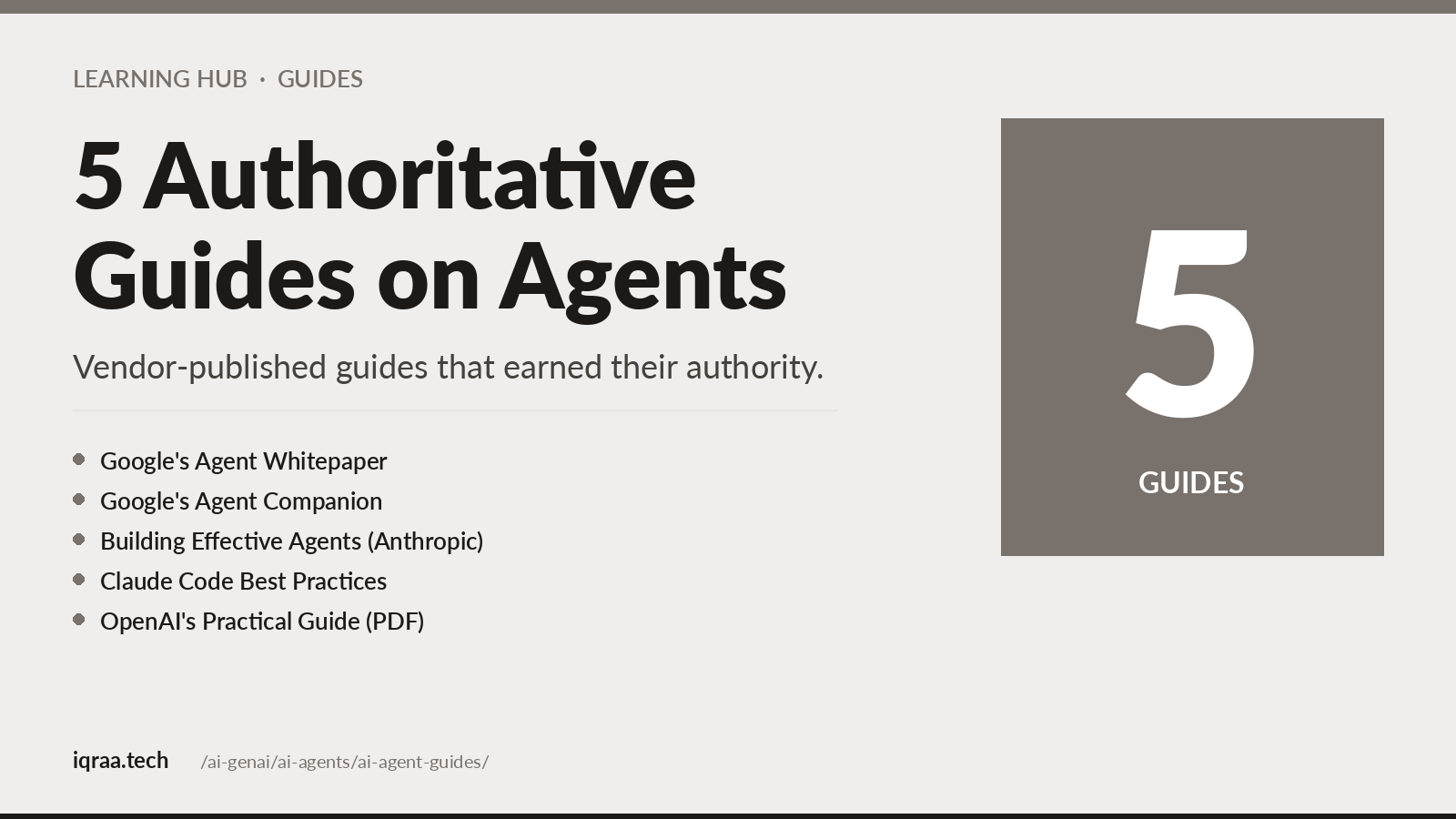
Five authoritative guides on AI agents, published by Google, Anthropic, and OpenAI, and chosen because they earned their authority rather than claimed it. Each one is a primary-source document the rest of the agent literature references. Together they’re the engineering layer underneath everything you’ll find in the Repos and Courses roundups.
Why these five guides on AI agents
Most “introduction to AI agents” content on the web is a paraphrase of one of these documents. The paraphrases are usually worse, slower to read, less precise, and one step removed from the source. This roundup sends you to the sources themselves.
The five guides split into three buckets: Google’s pair of whitepapers (academic-flavored, structured), Anthropic’s pair of essays (engineering-flavored, opinionated), and OpenAI’s single PDF (a practical project-building guide). All five are free.
1. Google: Agents Whitepaper
The foundational Google whitepaper that defines what an agent is in their vocabulary (reasoning, tools, orchestration) and walks through the components in detail. Hosted on Kaggle, free with a Kaggle account.
If you’ve ever wanted a vendor-published reference that takes the vocabulary seriously instead of using “agent” loosely, this is it. The companion whitepaper (next entry) builds on this one; read them in order.
Why it matters: the canonical Google statement of what an agent is. Cited across the industry as the reference definition.
↔ Read Google’s Agents Whitepaper on Kaggle
2. Google: Agent Companion Whitepaper
The follow-up to Google’s first whitepaper goes deeper into agent-to-tool interfaces, multi-agent patterns, and production considerations. Same Kaggle home, same vocabulary, more depth.
Read the first whitepaper before this one; the companion assumes the foundation. Together they’re the most complete free agent-engineering reference from a major vendor.
Why it matters: the production-and-patterns companion to the foundational whitepaper. Where the first one defines terms, this one names the tradeoffs.
↔ Read Google’s Agent Companion Whitepaper on Kaggle
3. Anthropic: Building Effective Agents
Anthropic’s widely-cited essay that introduced the agent design taxonomy most of the industry now uses: workflows (deterministic pipelines with LLM steps) versus agents (LLM-directed loops), and when to pick each. Short, opinionated, and unusually clear.
If you read one document on this list, read this one. It’s the source of “start simple, add complexity only when it pays for itself”, a line that’s been quoted a thousand times because it’s correct.
Why it matters: the agent design taxonomy that quietly became the industry default.
↔ Read Building Effective Agents on anthropic.com
4. Anthropic: Claude Code Best Practices
The engineering playbook for building with Claude Code specifically: agentic coding patterns, context management, tool orchestration, evals. Different from Anthropic’s general agent essay; this one is about shipping software with an agentic coding tool.
If you’re building or adopting Claude Code into your workflow, this is the operating manual. The patterns are portable beyond Claude Code, most of them apply to Cursor, Cline, Aider, and similar agentic coding tools too.
Why it matters: the closest thing to a vendor-published engineering manual for agentic coding workflows.
↔ Read Claude Code Best Practices on anthropic.com
5. OpenAI: A Practical Guide to Building Agents (PDF)
OpenAI’s project-oriented PDF guide: pick a use case, design the agent, choose tools, write the eval set, deploy. The format is closer to a workbook than an essay: concrete examples, sample prompts, decision trees. Free PDF hosted on cdn.openai.com.
Useful as a complement to the Anthropic essay: where Anthropic gives you the design taxonomy, OpenAI gives you the project workflow. Read Anthropic first; OpenAI second.
Why it matters: the practical project-side companion to Anthropic’s design-side essay.
↔ Download OpenAI’s Practical Guide to Building Agents (PDF)
How to use these guides
Read Anthropic’s “Building Effective Agents” first. It’s the shortest, the most cited, and the foundation for everything else. Then OpenAI’s PDF for the project-side workflow. Then the two Google whitepapers, in order, for the deepest vendor reference. Anthropic’s Claude Code guide is a specialty topic, read it when you’re actively shipping with Claude Code.
Each link opens in a new tab. None are paywalled; none require an account except Google’s Kaggle-hosted whitepapers, which require a free Kaggle login. Pair these guides with the Papers roundup for the underlying research and the Courses roundup for structured-graded versions of the same material.
Five guides, three vendors. Google’s whitepapers for the vocabulary, Anthropic’s essays for the design taxonomy, OpenAI’s PDF for the project workflow: the primary-source layer underneath the rest of the agent literature.