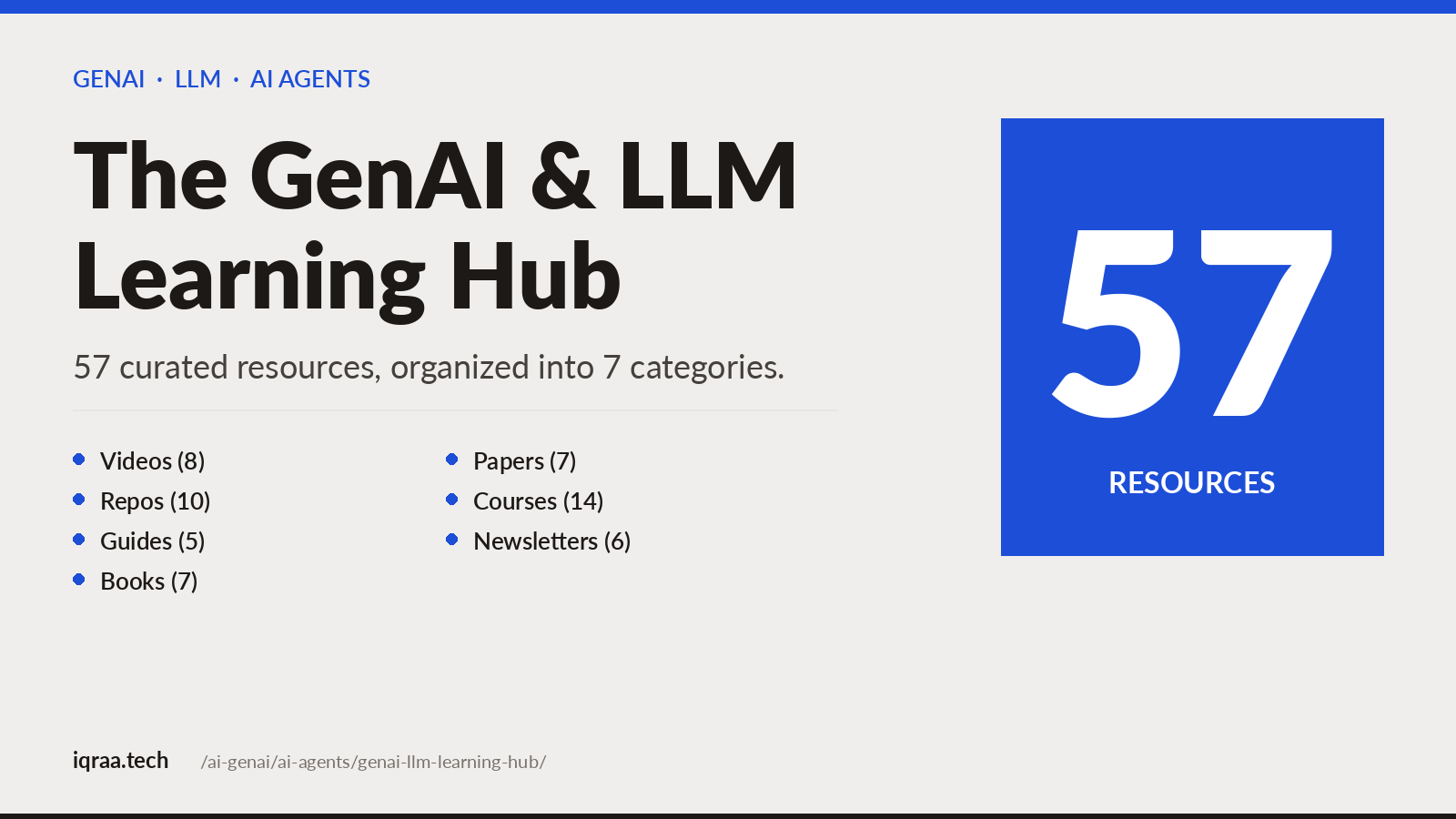
Welcome to the LLM Learning Hub on iqraa.tech, the curated learning hub for Generative AI, Large Language Models, and AI agents: 57 resources organized into seven categories, each hand-picked and reviewed. It exists because the “where do I start?” question has too many answers on social media and too few that hold up after a month. Every outbound link below goes to the canonical source (arXiv, GitHub, the official course page, O’Reilly). The reviews are ours.
Who this LLM Learning Hub is for
Engineers and builders who want a working understanding of LLMs and agents, not a survey course, not a hype feed. If you’ve ever started three tutorials at once and finished none, this hub is for you. If you’ve ever wished someone would tell you which ten papers actually matter instead of listing fifty, this hub is for you. The curation is opinionated by design: each category is pruned to the smallest honest set, and each entry inside it gets a two-sentence review that says what it is and what it isn’t.
If you’re an absolute beginner, start with the videos roundup, specifically the LLM Introduction talk and the Stanford Agentic AI overview. If you’re shipping into production, go straight to the courses and the repos. If you’re designing systems, the books and the papers are your layer.
How the LLM Learning Hub is organized
Seven categories. Each one is a single roundup post with original reviews and direct outbound links (target=_blank, rel=noopener, no redirects, no affiliate tags, no paywalled mirrors). The category pages on the source sites, like GitHub topic pages, O’Reilly learning paths, arXiv listings, are useful for browsing but bad for prioritization. That’s the gap this hub closes.
Each roundup is sized to a weekend’s reading. None of them attempt to be exhaustive; they attempt to be the shortest list you can finish. When a resource already has a dedicated Creator Picks spotlight on this site, the roundup links to it instead of duplicating the analysis.
The seven categories
1. Videos, 8 talks to learn LLMs
YouTube talks and lecture playlists covering LLM fundamentals, agentic AI overviews, and hands-on agent building. From a high-level Stanford overview to a multi-hour “LLMs from Scratch” deep-dive. Use this category to build the mental model before you touch code.
2. Repos, 10 GitHub repos worth your stars
The runnable side of the curriculum. Includes Nir Diamant’s GenAI Agents (23.4k★), Microsoft’s AI Agents for Beginners (70.3k★), the Prompt Engineering Guide (76.9k★), mlabonne’s LLM Course (81.2k★), and Microsoft’s ML for Beginners (88.5k★), with live star counts, fork counts, and honest scope notes for each.
3. Guides, 5 authoritative agent guides
Vendor-published guides that earned their authority: Google’s Agents and Agent Companion whitepapers, Anthropic’s “Building Effective Agents” essay and Claude Code best practices, and OpenAI’s practical PDF on agent construction. These are the documents the rest of the agent literature references.
4. Books, 7 books for the LLM bookshelf
One free foundational text (Understanding Deep Learning by Simon J.D. Prince) plus six career-level references from Manning and O’Reilly, including Chip Huyen’s AI Engineering and the LLM Engineer’s Handbook. Books are marked free versus paid; O’Reilly entries are gated but kept as outbound links.
5. Papers, 7 foundational LLM & agent papers
The reading list that actually matters: ReAct, Generative Agents, Toolformer, Chain-of-Thought, Tree of Thoughts, Reflexion, and the RAG Survey. Each with a two-paragraph honest summary and an explicit “why it matters” line. If you only read one roundup on this hub, read this one.
6. Courses, 14 free courses on LLMs & agents
The HuggingFace Agents Course plus thirteen DeepLearning.AI short courses covering MCP, vector databases, advanced RAG, multi-agent systems (CrewAI and AutoGen), LLMOps, evaluating AI agents, and computer use with Anthropic. All free; most finishable in a weekend.
7. Newsletters, 6 worth your inbox
Practitioner-led newsletters with no hype layer: Gradient Ascent, DecodingML (Paul Iusztin), Deep (Learning) Focus (Cameron Wolfe), NeoSage (Shivani), Jam with AI (Shirin & Shantanu), and Data Hustle (Sai). Author and rough cadence noted for each.
How to use this LLM Learning Hub
The LLM Learning Hub works best when you pick one category that matches your current gap. Open the roundup, read the blurbs, pick one resource inside it, and commit to finishing it before moving on. The hub will still be here when you come back. The biggest mistake with curated lists is treating them as a checklist. They’re a menu, not a queue.
Each roundup in the LLM Learning Hub links out to the canonical source and cross-links to the other six roundups, so you can move between categories without losing your place. The internal-link structure is bidirectional: every post in the hub links back to this index and to its sibling roundups. If you want applied deep-dives on individual repos, the Creator Picks archive is the layer underneath this hub. Five of the repos in the Repos roundup already have full spotlights there.
The GenAI & LLM Learning Hub collects 57 curated resources across seven categories, each with an honest review and a direct outbound link. Bookmark this page; it’s the index for the rest.