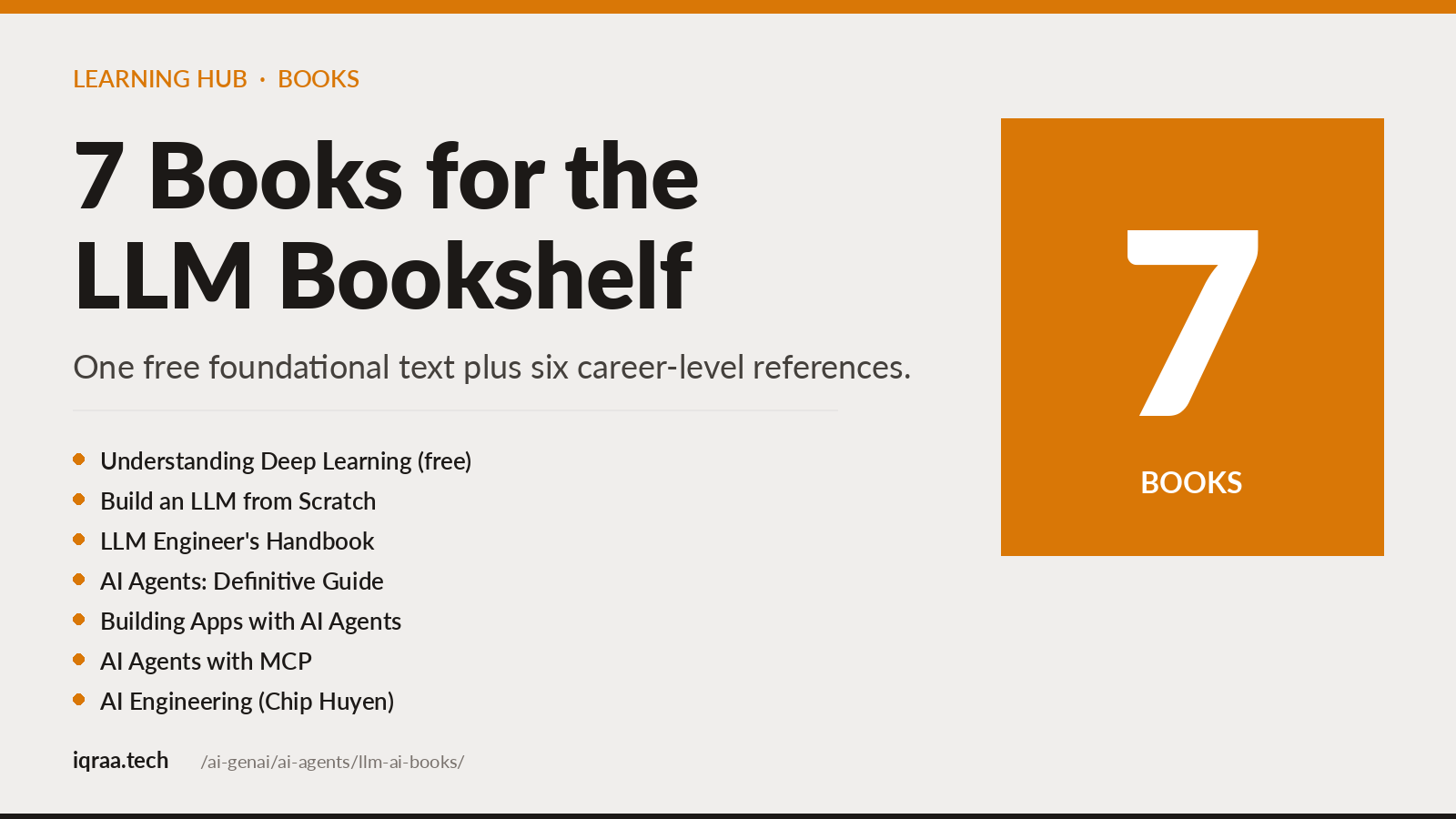
Seven books for the LLM engineer’s bookshelf: one free foundational text and six career-level references from Manning and O’Reilly. The list spans pure deep learning, building LLMs from scratch, agent engineering, and AI systems engineering. Books are marked free versus paid where it matters; the O’Reilly entries are gated but kept as outbound links so you have the canonical ISBN-permalink rather than a mirror.
Why these seven for the LLM engineer
The filter was simple: each book on this list is the one a working LLM engineer would either read cover-to-cover or keep on the desk as a reference. Textbooks that exist only to be assigned in courses were excluded; blog-content stuffed into a book were excluded. One entry is free; six are paid.
Paid book entries below include the publisher (Manning or O’Reilly), the author where it matters, and a direct link to the publisher’s canonical page. O’Reilly entries are gated behind their subscription; Manning’s “Build an LLM from Scratch” is available for direct purchase. None of the outbound links here are affiliate-tagged.
1. Understanding Deep Learning by Simon J.D. Prince (FREE)
The full deep-learning textbook by Simon J.D. Prince, published by MIT Press but available free online. Covers the foundations: probability, supervised learning, neural networks, convolutional and transformer architectures, generative models, and the math underneath all of it. Rigorous, but written to be readable.
If you started in LLMs without ever taking a deep-learning course, this is the book to fill the gap. The free online edition is the same content as the print edition; the print version exists for people who prefer paper.
Why it matters: the most rigorous free DL textbook online. The reference the rest of the field secretly uses.
↔ Read Understanding Deep Learning free online · Free · Author: Simon J.D. Prince
2. Build a Large Language Model (from Scratch) by Sebastian Raschka
Sebastian Raschka’s Manning book on building an LLM from the ground up: tokenization, embedding, attention, training loop, and fine-tuning. The same author also published a long-form video version (entry #2 in our Videos roundup); the book is the deeper, structured version.
If you learn better from books than videos, this is the one to get. The code is clean and runnable; the chapters build on each other cleanly. Published by Manning, available for direct purchase.
Why it matters: the cleanest book-length treatment of “how do I actually build an LLM”, by an author with a track record of explaining this well.
↔ View Build a Large Language Model (from Scratch) on Manning · Paid · Author: Sebastian Raschka
3. The LLM Engineer’s Handbook by Paul Iusztin & team
An O’Reilly-published engineering handbook for shipping LLM systems: architecture, data pipelines, training, fine-tuning, evaluation, deployment, monitoring. Strong on the engineering that turns models into products.
One of the authors (Paul Iusztin) also writes the DecodingML newsletter, which is in our Newsletters roundup. Pair the book with the newsletter for ongoing engineering practice.
Why it matters: the most complete LLM engineering reference published by a major house.
↔ View The LLM Engineer’s Handbook on O’Reilly · Paid (subscription)
4. AI Agents: The Definitive Guide by Nicole Koenigstein
An O’Reilly book that walks through the AI agent landscape, what an agent is, the major frameworks, the design patterns, and how to pick between them for a given use case. Useful as a structured overview when you don’t yet have a framework preference.
Read this one before picking a framework; the book will save you from committing to LangGraph or CrewAI for the wrong reasons. The O’Reilly catalog page is linked below.
Why it matters: the framework-selection reference. Saves you from a costly re-platforming decision six months in.
↔ View AI Agents: The Definitive Guide on O’Reilly · Paid (subscription)
5. Building Applications with AI Agents by Michael Albada
O’Reilly book focused on the application layer of AI agents, taking an agent from a working demo to a real application with users, observability, and reliability. Picks up where most agent tutorials end.
If “the demo works but production breaks” describes your current agent project, this is the right book. Strong on evals, observability, and the operational side of agent engineering.
Why it matters: the production-layer reference for agent applications. Where demo-agent ends and prod-agent begins.
↔ View Building Applications with AI Agents on O’Reilly · Paid (subscription)
6. AI Agents with MCP by Kyle Stratis
An O’Reilly book on building agents against the Model Context Protocol, the open spec for standard agent-tool interfaces. The first book-length treatment of MCP that we’ve seen from a major publisher.
MCP is becoming the standard agent-tool interface; if you’re building agents that consume tools (which is most agents), this is the reference for doing it cleanly. Pair with Anthropic’s Claude Code Best Practices guide (in our Guides roundup) for the engineering view.
Why it matters: the first major-published MCP reference. The book for the standard agent-tool interface.
↔ View AI Agents with MCP on O’Reilly · Paid (subscription)
7. AI Engineering by Chip Huyen
Chip Huyen’s latest O’Reilly book, the LLM-era successor to her “Designing Machine Learning Systems” (entry #8 in our Repos roundup via the dmls-book repo). Covers the engineering of AI applications: query understanding, retrieval, model selection, evals, deployment, and the systems view.
If you read one book on this list, read this one. Chip’s writing is unusually clear and her engineering taste is reliable. Pair the book with the dmls-book repo (the code companion to her earlier book) for the foundational ML systems layer.
Why it matters: the LLM-era engineering canon. The book the rest of the field is currently reading.
↔ View AI Engineering by Chip Huyen on O’Reilly · Paid (subscription)
How to read them
If you have time for one book, read Understanding Deep Learning (free) if you lack the foundations, or AI Engineering by Chip Huyen if you already have the foundations and need the LLM-era layer. If you’re shipping an agent application specifically, the Albada book is the production-side guide. If you’re building an LLM, Raschka’s book is the canonical step-by-step.
The two Manning / O’Reilly catalogs each have a free trial that lets you read these books without paying full price. The Kaggle / arXiv / GitHub alternatives in our Repos and Papers roundups cover the same surface for free if you prefer to read code and papers over books.
Seven books, one free. One free deep-learning textbook, two Manning / O’Reilly classics on building LLMs, three O’Reilly references on agents and applications, and Chip Huyen’s AI Engineering: the bookshelf the rest of the hub points at.