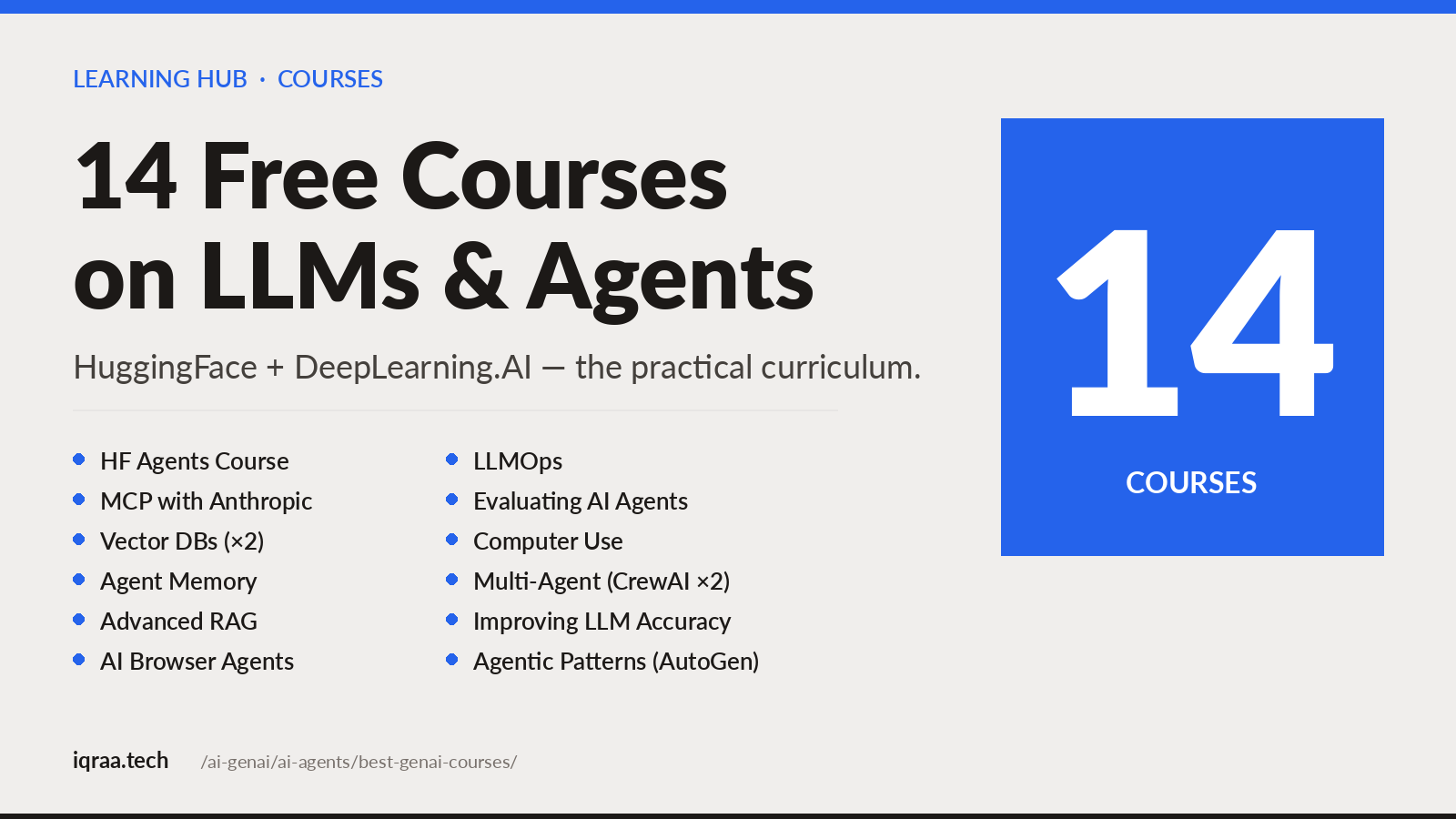
Fourteen free courses on Large Language Models and AI agents: the HuggingFace Agents Course plus thirteen DeepLearning.AI short courses covering MCP, vector databases, advanced RAG, multi-agent systems, LLMOps, evaluation, and computer use. All free; most finishable in a weekend; none requiring anything more than an email signup. This is the structured-graded layer of the Learning Hub. Pair it with the Repos roundup for the runnable side.
Why these fourteen courses on LLMs
The filter was strict: free, on-demand, taught by a recognized instructor or vendor, and finishable in under a week of evenings. Paid courses were excluded; university MOOCs with fixed schedules were excluded; “introduction to prompt engineering” content was excluded unless it had unusual depth.
One course, the HuggingFace Agents Course, already has a dedicated Creator Picks spotlight on this site. The roundup links to it instead of duplicating the analysis. Two of the DeepLearning.AI courses (MCP with Anthropic, Computer Use with Anthropic) overlap thematically with our existing MCP Course spotlight and Anthropic Academy spotlight; both are worth reading alongside the courses below.
1. HuggingFace Agents Course
HuggingFace’s free, certified, benchmarked course on building agents with their smolagents library. Covers the agent loop, tool use, retrieval, multi-agent orchestration, and a final graded project with a certificate.
Already covered in depth in our Hugging Face Agents Course spotlight. The short version: the only free agent course that gives you a graded certificate, and the content holds up.
Why it matters: the canonical free, certified agent course. Platform: HuggingFace. Level: intermediate. Length: ~10 hours.
↔ Start the HuggingFace Agents Course · Read our spotlight →
2. MCP: Build Rich-Context AI Apps with Anthropic
DeepLearning.AI short course taught jointly with Anthropic, on building applications against the Model Context Protocol. The course walks through MCP servers, clients, and the standard agent-tool interface that MCP defines.
Pair this with our existing MCP Course spotlight for the HuggingFace-flavored version. Both are free; both cover MCP well; pick by preferred platform.
Why it matters: the standard MCP orientation, taught by the vendor that drove the spec. Platform: DeepLearning.AI. Level: intermediate. Length: ~1 hour.
↔ Start MCP with Anthropic on DeepLearning.AI
3. Building Applications with Vector Databases (Pinecone)
Pinecone-taught DeepLearning.AI course on building production applications on vector databases, ingest, index, query, and the engineering around each. Strong on the database side; less focused on the LLM side.
If “what even is a vector database” is your current question, this course answers it. Pair with the Embeddings-to-Apps course below for the full stack.
Why it matters: the canonical vendor-taught vector DB course. Platform: DeepLearning.AI. Level: beginner-to-intermediate. Length: ~2 hours.
↔ Start Vector DBs with Pinecone on DeepLearning.AI
4. Vector Databases: Embeddings to Applications
The companion to the Pinecone course above, covers the full stack from embeddings through application-level retrieval. Deeper on the embedding side; complements the Pinecone course instead of duplicating it.
Take both if you’re going to be doing serious retrieval work. The two courses together cover what most production RAG systems actually do under the hood.
Why it matters: the embedding-to-application bridge. Platform: DeepLearning.AI. Level: intermediate. Length: ~2 hours.
↔ Start Embeddings to Applications on DeepLearning.AI
5. LLMs as Operating Systems: Agent Memory
DeepLearning.AI course treating LLMs as the operating-system kernel of an agent, with memory management as the core abstraction. This is the course version of the “Generative Agents” paper (entry #2 in our Papers roundup).
If “agent memory” was a fuzzy concept for you, this course makes it concrete. The framework is portable across agent libraries; you don’t need to commit to a specific one to take the course.
Why it matters: the cleanest applied treatment of agent memory. Platform: DeepLearning.AI. Level: intermediate. Length: ~1.5 hours.
↔ Start Agent Memory on DeepLearning.AI
6. Building and Evaluating Advanced RAG
DeepLearning.AI course on advanced RAG patterns beyond naive retrieval: query rewriting, multi-hop, hybrid search, evaluation. Useful if you’ve already shipped a naive RAG system and run into its ceiling.
Pair with the RAG Survey paper (entry #7 in our Papers roundup) for the conceptual layer. The course is applied; the paper is the taxonomy.
Why it matters: the course that moves you past naive RAG. Platform: DeepLearning.AI. Level: intermediate-to-advanced. Length: ~2 hours.
↔ Start Advanced RAG on DeepLearning.AI
7. Building AI Browser Agents
DeepLearning.AI course on agents that drive a browser: DOM-aware agents, page interaction, and automation. Browser agents are a distinct archetype from tool-calling agents; this course covers the specific patterns they need.
If you’re building an agent that needs to interact with web pages, this is the orientation. The patterns transfer to most browser-agent frameworks.
Why it matters: the only major free course on browser agents specifically. Platform: DeepLearning.AI. Level: intermediate. Length: ~1.5 hours.
↔ Start AI Browser Agents on DeepLearning.AI
8. LLMOps
DeepLearning.AI short course on LLM operations, the production-engineering layer: deployment, monitoring, versioning, the parts that turn a model into a service.
If you’ve ever shipped a model and watched it drift in production, this is the course. Pairs well with the Made with ML repo (entry #5 in our Repos roundup) for the broader ML engineering foundations.
Why it matters: the production-operations bridge for LLM systems. Platform: DeepLearning.AI. Level: intermediate. Length: ~1 hour.
↔ Start LLMOps on DeepLearning.AI
9. Evaluating AI Agents
DeepLearning.AI short course on agent evaluation specifically: trace eval, tool-call eval, end-to-end eval. Different from model evaluation; agents have a longer evaluation surface that includes their tool calls.
Pair with the Building and Evaluating Agents video (entry #4 in our Videos roundup). The video is the conceptual framing; this course is the applied workflow.
Why it matters: the canonical free agent-eval course. Platform: DeepLearning.AI. Level: intermediate. Length: ~1 hour.
↔ Start Evaluating AI Agents on DeepLearning.AI
10. Building Towards Computer Use with Anthropic
DeepLearning.AI course on agents that use a computer, the next step beyond browser agents. Taught with Anthropic, focused on Claude’s computer-use capabilities. The frontier of what’s currently shippable in agentic systems.
Pair with our Anthropic Academy spotlight for related Anthropic-taught content. Read Anthropic’s Building Effective Agents guide first (entry #3 in our Guides roundup) for the design taxonomy.
Why it matters: the frontier-agent course. Platform: DeepLearning.AI. Level: advanced. Length: ~1.5 hours.
↔ Start Computer Use with Anthropic on DeepLearning.AI
11. Practical Multi AI Agents and Advanced Use Cases with CrewAI
DeepLearning.AI course on building production multi-agent systems with CrewAI: role design, task orchestration, advanced patterns. CrewAI is one of the two dominant multi-agent frameworks; this is the vendor-co-taught course.
If you’ve picked CrewAI as your framework, take this course before you start building. Pair with the AutoGen course below (entry #13) to understand the framework-choice tradeoff.
Why it matters: the canonical CrewAI advanced course. Platform: DeepLearning.AI. Level: intermediate-to-advanced. Length: ~2 hours.
↔ Start Practical Multi-AI Agents (CrewAI) on DeepLearning.AI
12. Improving Accuracy of LLM Applications
DeepLearning.AI course on the engineering patterns that lift LLM accuracy: structured outputs, retry logic, fine-tuning decision points, evals. Less flashy than agent courses; more useful in production.
Most LLM applications fail not because the model is bad but because the surrounding engineering is sloppy. This is the course that tightens the engineering.
Why it matters: the engineering-accuracy course that production teams need. Platform: DeepLearning.AI. Level: intermediate. Length: ~1 hour.
↔ Start Improving Accuracy on DeepLearning.AI
13. AI Agentic Design Patterns with AutoGen
DeepLearning.AI course on multi-agent patterns with Microsoft’s AutoGen framework, the other major multi-agent option alongside CrewAI. Covers the same surface as the CrewAI course with a different framework philosophy.
Take this course and the CrewAI course (entry #11) back-to-back before committing to either framework. The frameworks are similar in scope but different in design; understanding both helps you choose.
Why it matters: the canonical AutoGen course and the natural comparison point for CrewAI. Platform: DeepLearning.AI. Level: intermediate. Length: ~2 hours.
↔ Start Agentic Design Patterns (AutoGen) on DeepLearning.AI
14. Multi AI Agent Systems with CrewAI
DeepLearning.AI’s foundational CrewAI course, different from the advanced course (entry #11). This one is the introduction; the other is the follow-up. If you’re new to CrewAI, start here; if you’ve shipped with CrewAI already, skip to the advanced course.
The two CrewAI courses together form a coherent track; take them in order if you’re committing to the framework.
Why it matters: the foundational CrewAI course. Platform: DeepLearning.AI. Level: beginner-to-intermediate. Length: ~1.5 hours.
↔ Start Multi AI Agent Systems (CrewAI) on DeepLearning.AI
How to use this list
Fourteen courses is a lot. Don’t take them all. Pick by your gap. If you’re new to agents, start with the HuggingFace Agents Course (entry #1). If you’re shipping, take LLMOps (entry #8), Improving Accuracy (entry #12), and whichever framework course matches your stack (entries #11/#13/#14 for multi-agent). If you’re going deep on retrieval, the two Vector DB courses (entries #3/#4) plus Advanced RAG (entry #6). If you’re going deep on MCP, entry #2 plus the MCP Course spotlight.
All fourteen courses are free. None require anything more than an email signup. Most can be finished in a weekend; the longest (HuggingFace Agents Course) takes a week of evenings. Pair with the Papers roundup for the conceptual layer and the Repos roundup for the runnable-code layer.
Fourteen free courses, one weekend each. The HuggingFace Agents Course plus thirteen DeepLearning.AI short courses: the structured, graded layer of the GenAI & LLM Learning Hub. Bookmark this page; the courses will outlive most individual tutorials.