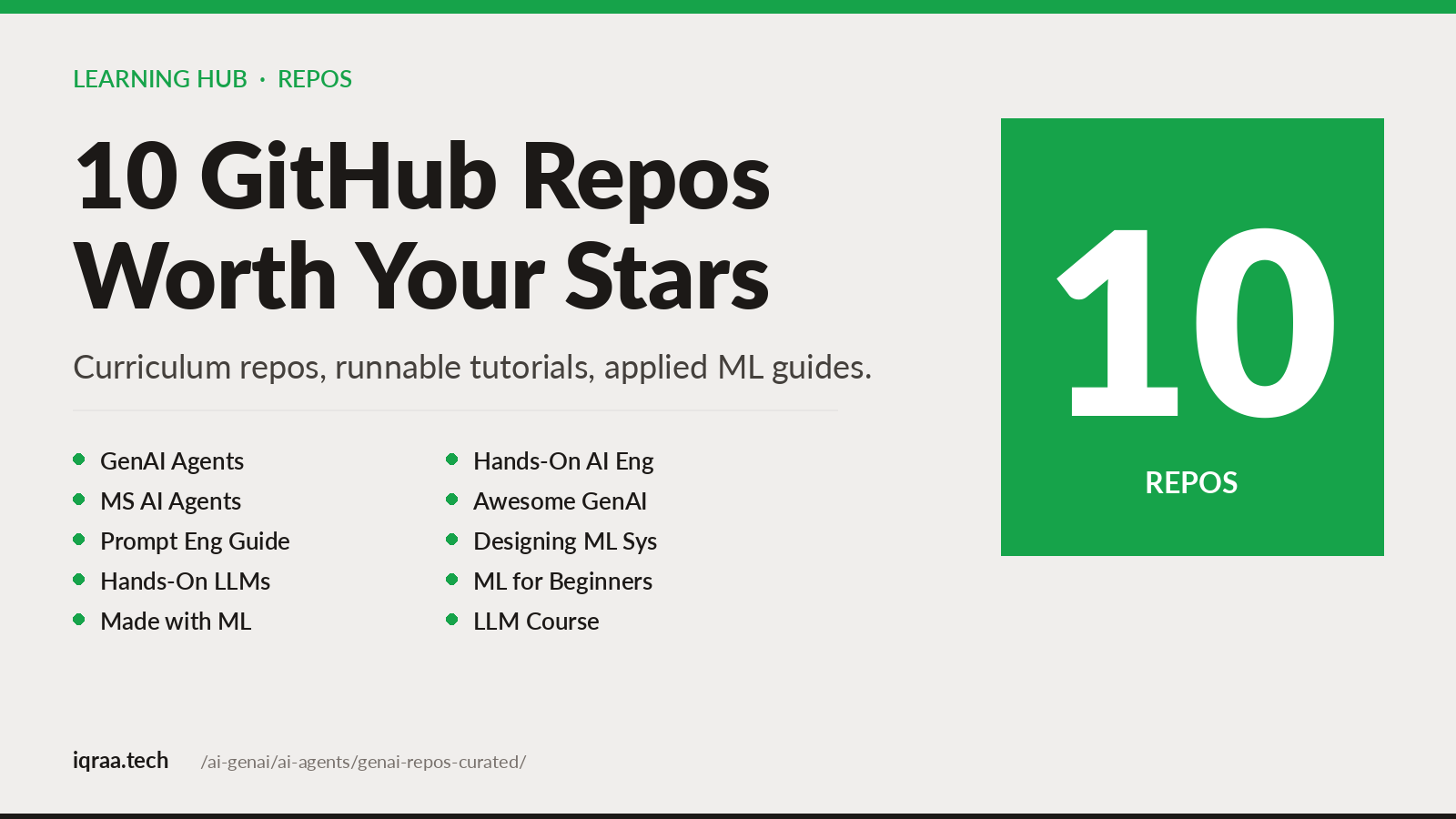
Ten GitHub repositories that earn a star: the runnable side of the GenAI, LLM, and AI-agent curriculum. Every entry below has live star and fork counts (fetched on publish day), an honest scope note, and a direct link to the repo. Four already have dedicated Creator Picks spotlights on this site; the roundup links to those instead of duplicating the analysis, and flags three more that are spotlight-worthy in their own right.
Why these ten GitHub repos
This list mixes three archetypes: tutorial repositories you clone and run cell-by-cell, curriculum repositories structured as multi-week courses, and reference repositories that catalog the rest of the ecosystem. Every entry has cleared a maintenance bar (recent commits, real issues, real stars), and the star count is included so you can sort by traction, not by my opinion.
Two important notes: First, the list does not include Nir Diamant’s RAG_Techniques, Prompt_Engineering, or Agent_Memory_Techniques sibling repos. They’re worth your time but GenAI Agents (below) is the umbrella entry point. Second, Microsoft’s ML for Beginners (entry 9) and Microsoft’s Generative AI for Beginners are different courses. The latter is already covered in our Generative AI for Beginners spotlight; the former is the broader classical-ML curriculum and is the one in this list.
1. GenAI Agents by NirDiamant
- 23,476 stars
- 3,947 forks
- Jupyter Notebook
- No license declared
The most prolific source of runnable agent tutorials on GitHub. Fifty-three-plus Jupyter notebooks covering everything from a basic conversational bot through reflection, planning, tool use, multi-agent orchestration, and specialist domains. Nir ships a new tutorial every few weeks.
Already covered in depth in our GenAI Agents spotlight, read that for the full breakdown. The short version: if you learn by opening a notebook in Colab and running it cell-by-cell, this is the repo to subscribe to.
Why it matters: the closest thing the agent ecosystem has to a canonical runnable tutorial library, with shipping cadence to match.
↔ View GenAI Agents on GitHub · Read our spotlight →
2. Microsoft AI Agents for Beginners
- 70,335 stars
- 23,296 forks
- Jupyter Notebook (Python)
- MIT License
Microsoft’s official 18-lesson agent curriculum, covering everything from “what is an agent” through multi-agent orchestration, MCP, and deployment patterns. The lessons are coherently sequenced, this isn’t a topic dump, it’s a course.
Already covered in depth in our AI Agents for Beginners spotlight. The short version: the right starting point if you want a structured, vendor-backed curriculum rather than a notebook dump.
Why it matters: the most-starred dedicated agent curriculum on GitHub, and it’s maintained by the Azure AI team.
↔ View AI Agents for Beginners on GitHub · Read our spotlight →
3. Prompt Engineering Guide by dair-ai
- 76,951 stars
- 8,456 forks
- MDX
- MIT License
The technique-by-technique reference for prompt engineering, zero-shot, few-shot, chain-of-thought, ReAct, self-consistency, directional stimuli, and everything in between. Each technique gets a one-page explainer with the original paper link.
Already covered in depth in our Prompt Engineering Guide spotlight. The short version: this is the page you’ll keep open in a tab while you build prompts.
Why it matters: the single most cited prompt-engineering reference on the open web.
↔ View Prompt Engineering Guide on GitHub · Read our spotlight →
4. Hands-On Large Language Models by HandsOnLLM
- 27,786 stars
- 6,459 forks
- Jupyter Notebook
- Apache 2.0
The code companion to the O’Reilly book of the same name (listed in our Books roundup). Notebooks cover understanding LLMs, retrieval-augmented generation, agents, fine-tuning, and the engineering around shipping them. The book is paid; the repo is free.
Even without the book, the notebooks stand alone as one of the cleaner applied LLM curricula on GitHub. If you liked Microsoft AI Agents for Beginners and want a deeper model-level dive next, this is the natural follow-up.
Why it matters: the closest equivalent to a university lab manual for working LLM engineers.
↔ View Hands-On Large Language Models on GitHub · Read our spotlight →
5. Made with ML by GokuMohandas
- 48,883 stars
- 7,690 forks
- Jupyter Notebook
- Other
An applied ML engineering curriculum, not strictly LLMs, but the engineering foundations (data pipelines, model training, evaluation, monitoring, deployment) that make LLM applications actually work in production. Strong on MLOps, which most LLM tutorials skip.
If you’ve ever shipped a notebook to production and watched it break, this repo is the cure. The lessons are organized around real engineering decisions, not academic taxonomies.
Why it matters: the engineering layer that turns LLM demos into LLM products, bridging ML and software engineering.
↔ View Made with ML on GitHub · Read our spotlight →
6. Hands-On AI Engineering by Sumanth077
- 2,800 stars
- 745 forks
- Python
- MIT License
A smaller-star but well-organized end-to-end AI engineering roadmap, covering everything from Python fundamentals through ML, deep learning, MLOps, and AI agents. Lower star count than the entries above but the structure is one of the cleanest roadmaps available.
Useful as a checklist for skills you may have skipped, the “I know transformers but never learned proper data engineering” cohort will find gaps filled here.
Why it matters: the curriculum to audit when you suspect your AI engineering foundation has gaps you can’t name.
↔ View Hands-On AI Engineering on GitHub
7. Awesome Generative AI Guide by aishwaryanr
- 28,444 stars
- 5,835 forks
- HTML
- View license
A curated index across the entire generative AI surface, text, code, image, audio, video. Each section is a hand-picked list of tools, papers, and tutorials. The breadth here is the point; this is the catalog you reach for when you need to know what exists.
Pair this with the Awesome AI Agents spotlight on this site for the agent-specific subset.
Why it matters: the broadest curated GenAI index on GitHub, the map of the territory.
↔ View Awesome Generative AI Guide on GitHub
8. Designing Machine Learning Systems by chiphuyen
- 5,126 stars
- 1,028 forks
- Code samples
- View license
The code samples and case studies repository for Chip Huyen’s “Designing Machine Learning Systems” book (O’Reilly). Not an LLM repo strictly, but the canonical ML systems engineering reference, and the foundation underneath every production LLM stack.
Chip’s newer “AI Engineering” book (also in our Books roundup) is the LLM-era successor; this one is the classical-ML foundation. Read together they cover the full surface of shipping ML in production.
Why it matters: the systems engineering canon, the book the rest of the field references.
↔ View Designing ML Systems on GitHub · Read our spotlight →
9. ML for Beginners by Microsoft
- 88,579 stars
- 21,637 forks
- Jupyter Notebook
- MIT License
A 12-week, 26-lesson Microsoft curriculum on classical machine learning, regression, classification, clustering, neural networks, reinforcement learning. Not the same course as Microsoft’s Generative AI for Beginners; that one is about GenAI specifically, this one is the broader ML foundation.
If your AI knowledge is LLM-shaped but you skipped the underlying ML, this is the canonical free course. The lesson quality is consistent across all 26 lessons, which is rare for a free curriculum.
Why it matters: the most complete free classical-ML curriculum on GitHub, from a vendor that maintains it.
↔ View ML for Beginners on GitHub
10. LLM Course by mlabonne
- 81,220 stars
- 9,472 forks
- Python + Notebook
- Apache 2.0
The single most-starred dedicated LLM course repository on GitHub. Three modules: fundamentals, scientist (training / fine-tuning), and engineer (production / serving). Each module is a curated path through external resources, papers, and notebooks; the value is the curation and the structure.
Already covered in depth in our LLM Course spotlight. The short version: this is the page you send someone who asks “how do I actually learn LLMs end-to-end?”
Why it matters: the canonical LLM learning path. Eighty-thousand stars is the ecosystem voting.
↔ View LLM Course on GitHub · Read our spotlight →
How to use this list
Don’t clone all ten. Pick by your gap. If you’re new, start with Microsoft AI Agents for Beginners or LLM Course. If you want depth on a single agent, run a notebook from GenAI Agents. If you want engineering foundations, work through Made with ML or Designing ML Systems. The starred lists above reflect community traction, not your personal priority. Use them as a tiebreaker, not a decision.
Star counts were fetched live from the GitHub API on 2026-07-26. They will be slightly higher when you read this. The forks-to-stars ratio is a useful quality signal: forks suggest people are actually building with the repo, not just bookmarking it.
Ten repos, three archetypes. Tutorial libraries, structured curricula, and curated indexes: the runnable side of the GenAI learning hub. Bookmark this list; it’s the index of what to clone, when, and why.