30 sec7 min coredeep dive optional
Ed Donner’s two free course repositories cover the applied LLM stack end to end: an 8-week LLM engineering course that starts on your own machine with Ollama, and a 6-week agentic engineering course refreshed in 2026 around the OpenAI Agents SDK, CrewAI, LangGraph, Google ADK, Pydantic AI, and MCP.
- LLM Engineering (7,478 stars) builds from a Day 1 local model to an autonomous agentic solution in week 8.
- Agentic Engineering (6,246 stars) was fully refreshed in Summer 2026 with current frameworks and MCP.
- Both keep costs near zero: local models and free tiers are first-class, with frontier APIs optional at cents scale.
- The repos are complete companions to video courses and work standalone, with per-OS setup guides.
Most course repositories are skeletons: slides, a few notebooks, a hope. Ed Donner’s two repos are the opposite, full working curricula where every week ships runnable code, and the teaching philosophy, learn by doing with your own hands on every cell, shows in how they are built. Together they cover applied LLM engineering from first API call to deployed agents, and both were updated within the last week.
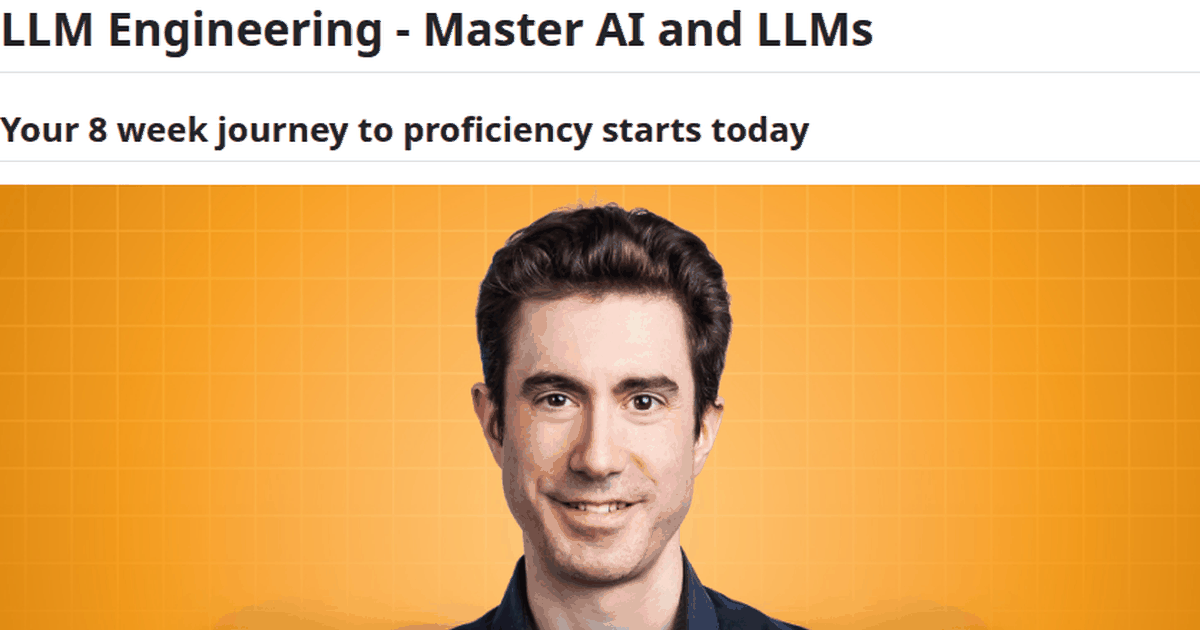
The first repository, llm_engineering, is the foundation course; the second, agents, is the follow-on for agentic work. Both stand alone, the pairing is deliberate, and this guide covers what each contains, which to take first, and where they fit against the other free courses we have reviewed.
Course one: LLM Engineering, eight weeks from Ollama to autonomy
The foundation course makes its most important decision in the first hour. Day 1 has you running a local model through Ollama, llama3.2 specifically, so the first result on screen costs nothing and works offline, with a cloud notebook as fallback for machines that struggle. That local-first opening is not a gimmick; it sets the course’s whole economic posture, where frontier APIs are offered as optional upgrades measured in cents rather than as the price of admission.
The weekly structure builds deliberately: early weeks cover the mechanics of prompting, structured outputs, and working with the APIs, with Google Colab entering from week 3 for GPU work, and the projects compound toward the week 8 payoff, an autonomous agentic AI solution that draws on everything before it. The repository is organized as week folders plus a guides directory, and the guides include complete recipes for free alternatives, Ollama, Gemini free tiers, and OpenRouter, so the paid-API path is genuinely optional.
Course two: Agentic Engineering, six frameworks and MCP
The follow-on course was fully refreshed in Summer 2026, a detail worth dwelling on because agentic frameworks churn faster than any other layer of the stack. The syllabus now runs through the OpenAI Agents SDK, CrewAI, LangGraph, Google ADK, and Pydantic AI, with MCP as the connective standard, which is close to the full landscape a working agent engineer meets in job postings and production systems.
Six weeks is the right unit for this material. Each framework gets its moment, the patterns that transfer across all of them, orchestration, tool use, memory, handoffs, get repeated from different angles until the framework stops being the interesting part, which is the correct pedagogical endpoint: frameworks are vehicles, and the course teaches driving rather than any single car, a distinction that matters more every season as the leaderboard reshuffles and the patterns persist. Setup guides are split per operating system, and the cost posture matches course one, with DeepSeek and local models as the cheap paths.
What the foundation course actually feels like week to week
Reading the week folders in order gives the shape better than any syllabus prose. The opening weeks are deliberately confidence-building: prompts that work, structured outputs, first tool calls, each with visible results the same day. The middle weeks bring the machinery that separates applications from demos, vector search and retrieval, embeddings, and the Colab-backed stretch into heavier models where a GPU earns its keep. The final stretch assembles the pieces, and week 8 lands the autonomous solution the whole course has been quietly building toward, an agent that plans, uses tools, and completes a real task using every layer from the preceding weeks.
Two production decisions shape the experience throughout. The Cursor-first environment keeps the loop between reading code and running it tight, with a pointed aside that Claude Code gets a demo as an example of agentic AI even though the course teaches in Cursor. And the guide notebooks, including the dedicated API-alternatives guide, mean that when a week assumes a frontier model, the local or free route through the same exercise is one document away rather than a research project.
The teaching method: run it, then make it yours
Both courses run on the same contract, stated plainly in the README: code is executed, not just typed, and you are expected to run each cell, inspect the objects, then tweak the code until it is yours. Challenges punctuate the weeks, and the repository invites pull requests for your solutions, with community contributions recognized in the repo itself. That last detail is quietly unusual: a course repo structured to accept student work turns learners into contributors and keeps the material battle-tested across environments.
The surrounding support is also part of the design: per-platform setup guides written with unusual care, an FAQ system, and a resources page with slides and supplemental videos. The author, a former tech founder whose second act is teaching this material, maintains the repos actively, which the update history reflects.
Costs, honestly accounted
The cost accounting deserves its own section because it is handled better than nearly every peer course. The foundation course’s total expected spend is a couple of dollars, with an optional ten dollar splurge in week 7 for a satisfying fine-tuning result, and explicit instructions for spending nothing at all. The agentic course names its API cost up front and documents the cheap and free alternatives in a dedicated guide.
For learners in contexts where API billing is awkward, no credit card, restrictive employers, specific countries, this is the difference between a usable course and a bookmarked one. The local-model path through Ollama is complete rather than hand-waved, which the Day 1 design makes credible.
Where they fit against the other free courses
Against our previous coverage: Microsoft’s Generative AI for Beginners is the concepts-first entry, Donner’s foundation course is the hands-on middle, and the AI Agents for Beginners series plus this agents course cover the agentic layer, with Donner’s going deeper on framework breadth and MCP. Engineers who want project-first practice can pair either course with the runnable projects hub, and readers of Nir Diamant’s notebook tutorials will find Donner’s courses the structured spine those notebooks hang from.
The honest ordering advice: take the foundation course first unless you already ship LLM applications, because the agentic course assumes its vocabulary the way a second semester assumes the first, and skipping the foundation turns framework comparisons into buzzword tourism. A week of overlap is normal and productive, and both repos tolerate being consumed out of order better than most courses, at the cost of some week-to-week references landing early. Against paid alternatives, the honest comparison is also worth stating: the free repos cover the same technical ground as many paid courses, and what payment buys elsewhere is structure, feedback, and credential, three things a disciplined self-learner can substitute with a calendar, a study partner, and a public project log.
Are the repos usable without buying the video courses?
Yes, with a clear boundary. The repositories contain the full code curriculum, setup guides, challenges, and the resources page, which is everything a self-directed learner needs to work through the material. The videos add the narration, the demonstrations of intent behind design decisions, and the pacing of a taught course, and the author’s framing makes clear the repos and videos are companions with the repos as the artifact. Learners who work well from code plus guides will lose little. Learners who need a voice explaining why the next cell matters will feel the gap in weeks where the concepts stack quickly, particularly the transition into agentic orchestration. A workable hybrid: run the repos free, and if a specific week stalls, that is the week to buy or watch selectively.
Why does an 8 week course start with a local model?
Because the first hour decides whether a learner continues, and a billing setup flow kills momentum faster than any conceptual difficulty. The Ollama-first opening guarantees a working result before any account creation, payment method, or API key exists, which removes the three most common Day 1 abandonment points at once. It also plants a mental model that pays off later: models are software you can run, not services you must rent, and the course returns to that framing whenever costs come up. The technical caveat the README flags carefully is model size, steering learners to llama3.2 rather than the much larger llama3.3, because a mismatched local model turns the instant-gratification play into a downloading-failure horror story, and the course catches that before the learner meets it. That level of operational care in a README is a reliable signal for how the rest of the course is maintained.
What changed in the Summer 2026 refresh of the agents course?
The refresh rebuilt the content around the current framework landscape rather than patching it, and the upgrade documentation addresses the three questions returning students actually have: what changed, why it needed changing, and how to migrate code from the middle of the old version. In a field where courses routinely break silently on library updates, publishing an explicit migration path is a maintenance standard worth recognizing. The substance of the refresh tracks the ecosystem’s consolidation: the OpenAI Agents SDK as a serious production path, MCP as the standard connective layer, and Google ADK joining the established CrewAI and LangGraph. New learners should simply start on the refreshed version; mid-course learners should read the migration notes before updating, since framework rewrites mid-project are exactly when half-migrated states bite.
Which framework should you focus on within the agents course?
The course’s breadth is a map, not a mandate, and depth in one framework beats surface contact with six. The choosing logic: if your employer or target employers standardize on one, that one, obviously. Otherwise, the OpenAI Agents SDK is the safe production default with first-party momentum, LangGraph rewards teams building stateful multi-step workflows and wanting explicit control over the graph, CrewAI remains the fastest path to multi-agent team metaphors, Pydantic AI suits Python shops that live on type safety, and Google ADK is the pick inside the Google ecosystem. MCP is not optional regardless of framework, since it is becoming how tools connect across all of them. A reasonable plan: work every week, but build your course project in the framework closest to your next twelve months, and treat the others as reading comprehension.
How do the challenges and pull-request culture work in practice?
The challenges are woven into the weeks as stretch exercises after the taught material, sized for an evening rather than a weekend, and the invitation to submit solutions as pull requests is genuine: community contributions land in a dedicated folder with recognition. For learners, this is a low-stakes first open-source contribution, which many engineers otherwise postpone for years, and reviewing classmates’ alternative solutions to the same challenge is where much of the real learning hides, since the differences between correct implementations are exactly the design decisions that matter. For the course, the culture keeps the code honest across platforms, because a solution that only works on one operating system gets caught by the next learner on another. If you take one habit from the repos, take this one: finish a challenge, open the PR, and read two classmates’ solutions before merging your mental model shut, because the differences are the lesson.
How do the two courses split for a team versus a solo learner?
A team should treat the split as a curriculum boundary. The foundation course is the onboarding artifact: uniform vocabulary, uniform tooling, and a cost profile that means a whole team can take it without an expense conversation, with the week 8 autonomous project doubling as an internal demo of what the team can now build. The agents course is the specialization artifact, and teams should not send everyone through all six frameworks. Pick the framework the team actually uses, have everyone do that week plus the MCP material deeply, and treat the remaining weeks as optional literacy, one person per framework who can advise when a use case suggests a different tool. Solo learners have the simpler problem: take both in order, but allow yourself to stop the agents course after your chosen framework plus MCP, because depth in one framework plus protocol fluency is the marketable combination, and the remaining weeks keep well as reference when a future role or project calls for them.
What do the guides directory and resources page actually add?
The guides are the part of the repos that first-time visitors under-read. Beyond the setup documents, the guides directory carries standalone notebooks on the recurring side-topics a course cannot interrupt itself for: working with the APIs, the free-alternative routes, version-control workflow for submitting solutions, and the introductory material that sets conventions. They are written to be usable without the course, which makes them a free reference library even for people who never start week 1. The resources page complements them with slides and supplemental videos, and the FAQ system answers the questions that actually recur, including the pragmatic ones, can this be taken without a programming background, what jobs it maps to, whether Gemini or free models substitute for OpenAI, with straight answers rather than marketing deflections. Together they form the maintenance layer of the course, the part that quietly decides whether a free curriculum still works in six months, and both are visibly tended, which is the strongest predictor that the courses will still be current when you finish them That maintenance signal also de-risks the sunk-cost worry with free courses generally: an actively tended repository rewards the effort you invest in learning its structure, because the structure is still there, still correct, when you return in six months for a refresher..
What does the author’s teaching background add up to?
Ed Donner’s path into this material shapes how it reads. He built and sold tech companies before turning to AI education, and the courses carry that operator’s instinct: exercises end in artifacts, costs are stated before they surprise, and the syllabus optimizes for what a working engineer can absorb around a job rather than for academic completeness. The voice is direct and unusually present, with support channels answered personally, which readers of the repositories notice quickly. The combination lands as courses that respect both your time and your intelligence, a rarer pairing in free education than it should be.
Take LLM Engineering first, run every cell, and pay nothing while you learn; move to the refreshed agents course when you want the framework landscape mapped properly. Between the two, Ed Donner has assembled the most complete free, hands-on path through applied LLM engineering we have reviewed, and the active maintenance means it tracks a field that refuses to hold still.